The Ring recast

Gotterdammerung new3

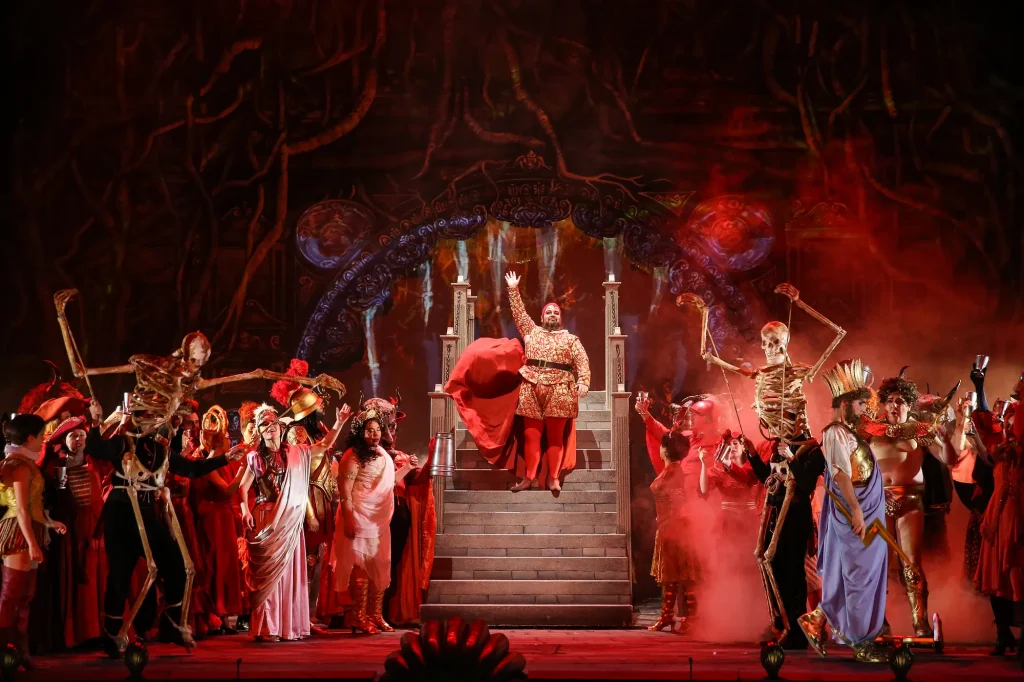
Gil Kane’s and Roy Thomas’s graphic novel Richard Wagner’s “The ring of the Nibelung”  (New York: DC Comics, 1997) transforms Wagner’s dramma in musica into dramma in pittura.

Kane’s artwork visually follows Wagner’s musical fabric while retaining the means of expression characteristic of the comic-book format. His images do not autonomously narrate the tale; rather, they double the musical narrative form established by Wagner.

For example, the drama of Die Walküre begins not with the curtain opening on the first scene, but with its instrumental Vorspeil, which depicts the storm through which Siegmund is running. In his graphic version of the opera, Kane begins with four pages of pictures without text, depicting visually the action painted by Wagner’s orchestral score.

This according to “Od glazbene do slikovne drame: Roy Thomasov i Gil Kaneov strip Wagnerova Prstena Nibelunga by Zdravko Blažeković (Hrvatsko slovo: Tjednik za kulturu I/18 [25 August 1995] pp. 22–23).

Today is Wagner’s 200th birthday! Above, the immolation scene and finale from Götterdämmerung (click to enlarge); below, Anne Evans’s legendary performance  at Bayreuth in 1992.

Related article: Operas as graphic novels

Leave a Comment

Filed under Opera, Visual art

Loïe Fuller’s serpentine success

loie fuller

Skirt dancing, involving the dancer’s graceful manipulation of a full skirt, was a widely popular genre in the U.S. when Loïe Fuller premiered her Serpentine dance in 1892.

Fuller’s costume for this dance involved so much fabric that—combined with atmospheric lighting—it almost completely obscured her human form. By shifting the focus from the dancer to the costume, she added a new level of abstraction to the skirt dance genre, prefiguring many of the innovations of modern dance.

The dance was a huge success and was much imitated, prompting Fuller to sue for copyright infringement; but the judge ruled against her, stating that a dance depicting no story, character, or emotion could not be considered a “dramatic composition” protected by the copyright act.

This according to “Loïe Fuller’s Serpentine dance: A discussion of its origins in skirt dancing and creative reconstruction” by Jody Sperling (Proceedings of the Society for Dance History Scholars XXII [1999] pp. 53–56). Below, a hand-colored 1895 film of an unnamed dancer by the Lumière brothers suggests what Fuller’s performance was like.

Related article: Tórtola Valencia and Otherness

1 Comment

Filed under Dance

Greek and Roman musical studies

greek & roman musical studies

In early 2013 Brill launched Greek and Roman musical studies, the first specialist periodical in the fields of ancient Greek and Roman music.

The journal will publish papers offering cultural, historical, theoretical, archaeological, iconographical, and other perspectives on music in Classical antiquity, and on its reception in later times (especially the Middle Ages and the Renaissance, but also more recent periods).

The Editorial Board will also consider contributions on music elsewhere in the Mediterranean region, including Egypt, Syria, Palestine, and Mesopotamia. Cross-disciplinary approaches are particularly appreciated.

Related articles:

Leave a Comment

Filed under Antiquity, New periodicals

Early lip-synching

Woody_Herman (1)

Sometime in October 1939 Woody Herman and his band traveled to the Vitaphone Studio in Brooklyn to begin work on a ten-minute film short.

Probably within a week or two they returned with their instruments, but not to play them—this time they were there to mime playing as the recordings from their first session were played back! The film was issued with a phonograph record to be played during projection, creating an early example of what is now called lip-synching.

The producers also added some stock clips of an audience whose formal dress and staid demeanor indicate that they were a world away from any jazz performance.

This according to “Celluloid improvisations: Woody Herman and his orchestra” by Mark Cantor (The IAJRC journal XL/1 [February 2007] pp. 22–30).

Today is Herman’s 100th birthday! Above, a still from the second session; below, Herman leads the band in the finale of the Vitaphone film, King Oliver’s Doctor Jazz.

Leave a Comment

Filed under Curiosities, Jazz and blues

Historic Balinese gamelans

Gamelan Gong Gde Denpasar

In August 1928 representatives from the German record companies Odeon and Beka were sent to Bali; their efforts resulted in 98 recordings on 78 rpm discs of a wide variety of examples of Balinese music.

As it happened, at that time Bali was undergoing an artistic revolution. A new style known as kebyar was rapidly gaining popularity, and older ceremonial styles were literally disappearing, as their bronze instruments were melted down and reforged to accommodate the new style’s requirements; the Odeon/Beka recordings preserve several musical traditions that were later lost.

These were the recordings that inspired the young Canadian composer Colin McPhee, who first heard them in 1929. McPhee went to Bali in 1931 and remained there for nearly a decade; his activities included making painstaking transcriptions of Balinese pieces.

This according to the commentary by Edward Herbst that accompanies the CD The roots of gamelan: The first recordings—Bali, 1928; New York, 1941 (World Arbiter, 1999).

Above, a Gamelan gong gede group in Denpasar around the time the recordings were made; this tradition dates from the 15th century. Gong gede survives today, as the video below attests.

Related article: Debussy and gamelan

1 Comment

Filed under Asia, Curiosities, Instruments

Canary pedagogy

serinette

The serinette (after the French serin, canary) is a very small barrel organ that was used to teach repertoire to pet songbirds in the 18th century. These instruments were made in England, France, and Germany.

In 2007 an independent organ and barrel organ builder affiliated with the mechanical instruments center of Waldkirch in Baden-Württemberg embarked upon a series of modern reconstructions of the serinette. His main sources were the description of the serinette found in Dom Bédos de Celles’s L’art du facteur d’orgues (Paris, 1778) and two instruments from Mirecourt.

This according to “Serinetten französischer Bauart aus Waldkirch” by Achim Schneider (Das mechanische Musikinstrument: Journal der Gesellschaft für selbstspielende Musikinstrumente XXXVI/107 [April 2010] pp. 6–9; the author is the organ builder in question.

Above, La serinette by Jean-Baptiste-Siméon Chardin; below, occasionally vertiginous views of a working serinette.

2 Comments

Filed under Animals, Curiosities, Instruments

Ice dance defined

ice dance

The term ice dance was coined for attempts to perform ballroom dances on the ice, and to create ballroom-style dances that could be performed on skates.

The genre was added to the figure skating World Championships in the early 1950s, and it became an Olympic sport in 1976. Ice dancers began to incorporate more and more elements of ballet and theatrical training into their performances, and by the mid-1980s leading dance teams were steadily moving ice dance away from its social-dance origins toward the domain of art dance.

While athleticism remained at the forefront, the lines between sport and art were starting to blur, and in 1992 the International Olympic Committee tightened the rules to steer ice dancing back toward ballroom dancing. It remains to be seen whether ice dancing will continue to be defined narrowly, or whether all forms of expressive skating to music will eventually be considered dance.

This according to What is the “dance” in ice dance? by Ellyn Kestnbaum (Proceedings of the Society for Dance History Scholars 22 [1999] pp. 243–248). Below, the Gold Medalists at the 2012 Olympics.

1 Comment

Filed under Dance, Sports and games

Brahms was Chilean

436px-Johannes_Brahms_1853

To honor Brahms’s 180th birthday, let’s recall the article about his birthplace that ignited a musicological firestorm!

In “Brahms era chileno” (Pauta: Cuadernos de teoría y crítica musical, no. 63 [July-Sept 1997] pp. 39–44), the Argentine composer Juan María Solare states that Johann Jakob Brahms (1806–72), accompanied by his wife, Johanna Henrika Christiane Nissen (1789–1865), took part in a tour of South America as a performer in the orchestra of the Alsterpavillon in Hamburg, and that Johanna gave birth to Johannes Brahms in the village of Copiapó, northern Chile, on 6 February 1833.

He further states that the birth is documented in a letter that Johanna wrote to her sister in Hamburg, but which was lost and eventually ended up in the archive of an obscure village in Patagonia, where it can still be seen; the birth was concealed from German society, and Brahms was baptized under a false place and date of birth upon his parents’ return to Germany.

Later, in an interview, Solare clarified his intention: He wrote the article as a piece of speculative fiction, a type of writing that Pauta sometimes publishes; but since the journal also presents peer-reviewed research, the piece was mistaken for authentic musicology, generating widespread controversy among Brahms scholars.

BONUS: Brahms was from New Orleans:

Related articles:

3 Comments

Filed under Curiosities, Humor, Romantic era

Werner Schroeter and Kulturscheisse

der-bomberpilot

Schroeter’s films abound with the artifice, staginess, recontextualizations, and quotations typical of both camp and kitsch.

His achievement in Der Bomberpilot (1970) involves overturning mainstream interpretations of kitsch as a rejected externality by bringing what he called Kulturscheisse into productive play with contemporary German identities and their efforts to engage with alterity and the past. The film’s score is a grab bag that includes selections from Verdi, Sibelius, Wagner, Strauss, and Elvis, along with U.S. show tunes and German pop songs.

This according to “Embracing kitsch: Werner Schroeter, music and The bomber pilot” by Caryl Flinn, an essay included in Film music: Critical approaches (New York: Continuum, 2001, pp. 129–151).

Above, a still from Der Bomberpilot ; below, the beginning of Mondo Lux: Die Bilderwelten des Werner Schroeter, a documentary finished shortly after Schroeter’s death in 2010.

Leave a Comment

Filed under Film music, Humor

James Brown’s Deleuzian idiocy

JB2

James Brown’s public acclaim as a musical visionary was often counterpointed by the private disdain of many of the trained musicians in his bands, who scorned his musical illiteracy.

An unorthodox valorization of Brown’s approach to composition is suggested by Deleuze’s account, in Différence et répétition, of the idiot as the pedant’s polar opposite. As a musical idiot, Brown’s naive immunity to conceptual rules or institutionally dominant forms of thinking—his capacity, in other words, for thought without presupposition—enabled modes of conceptual originality that evaded the musically trained.

This according to “James Brown: The illogic of innovation” by John Scannell (New formations: A journal of culture/theory/politics 66 [spring 2009] pp. 118–133). Today would have been Brown’s 80th birthday! Below, the Godfather of Soul defies logic in his heyday.

Leave a Comment

Filed under Curiosities, Popular music