In an effort to provide more complete and nuanced bibliographic resources to researchers, RILM is inviting authors to review their publications in the database, create new records, and revise existing records. Through this link, and following the link for “submissions by individuals,” authors can interact directly with the database. An author search lists all entries by the searched author in reverse chronological order, providing a synoptic view of publication history. By opening each record, authors can view the contents and add or revise as they see fit. It is also possible to attach new reviews to records, and to add second abstracts in other languages. Authors can also create new records, and they are especially encouraged to do so. Questions can be directed to questions@rilm.org.
RILM is inviting author abstracts
Comments Off on RILM is inviting author abstracts
Filed under RILM
Music of the spheres
A black hole situated in the center of a galaxy amid a group of thousands of galaxies collectively called the Perseus Cluster (shown above) emits waves in a frequency equivalent to a B♭ 57 octaves below middle C, or one million, billion times lower than the lowest sound audible to the human ear. The Perseus black hole’s sound waves have a frequency of 10 million years.
This information, from an article published online by NASA, resonates with the philosophical concept often associated with Pythagoras and Johannes Kepler of Musica universalis or music of the spheres.
Filed under Curiosities, Science
Musipedia
Inspired by (but not affiliated with) Wikipedia, Musipedia is a searchable, editable, and expandable online collection of melodies. Entries can contain notation, a MIDI file, information about the work and the composer, and the Parsons Code for Melodic Contours. The database can be searched by tapping rhythmic information or by entering melodic information on a virtual keyboard, through a microphone, or using the Parsons Code.
Above, a screen capture shows that the first phrase of The star spangled banner has been entered. A search yielded that song (with notation and a midi file), along with melodies by Beethoven, Chopin, and Šostakovič, and several traditional songs and dance tunes.
Related Articles
- 4 Ways To Find Out The Name Of That Elusive Song (makeuseof.com)
Libretto illustrations
Illustrated libretti for eighteenth-century opera performances comprise a specific and unusual type of visual art. Since these engravings were made before the performances, they cannot be interpreted as objective documentation—indeed, clear evidence points to discrepancies between these representations and what the audiences actually saw. Rather, they must be seen as conveying the intention of these occasions, in surprisingly subtle ways.
Christine Fischer demonstrates this way of reading libretto illustrations in “Engravings of opera stage settings as festival books: Thoughts on a new perspective of well-known sources” (Music in art XXXIV/1–2 [2009], pp. 73–88). In the above engraving by Johann Benjamin Müller of the final scene in Maria Antonia Walpurgis’s Talestri, regina delle amazzoni (1760), Fischer notes that the wide gap between the female Amazons and the male Scythians—their leaders both with drawn swords—demonstrates their opposition, but the bridge in the background indicates their impending reconciliation. The message below the surface involves reassurance that the composer’s ongoing consolidation of her political power in Dresden will be beneficial to all, and that her rule will be based on a deep knowledge of state affairs and peaceful collaboration with powerful men.
Comments Off on Libretto illustrations
Filed under Classic era, Dramatic arts, Literature, Opera, Politics, Reception, Visual art
Rāgs and recipes
In “Why Hindustani musicians are good cooks: Analogies between music and food in North India” (Asian music XXV/1–2 (1993–94), pp. 69–80), Adrian McNeil notes that culinary topics are frequent—sometimes even favorite—subjects of conversation among Hindustani musicians, and that a notable number of top Indian musicians are also expert cooks. He attributes this phenomenon to the similarities between the cognitive and sensory aspects of the two activities, and proposes a “culinary perspective” on rāg.
Offering a basic “culinary recipe” alongside a basic “melodic recipe”, McNeil similarly juxtaposes, in a two-page spread, a photographic “depiction of potato with ginger and puris” with a rāgamālā “depiction of rāg sārant”. Further positing a “melodic conception of food”, he recounts examples of Indian musicians using culinary analogies to illustrate musical matters, and cites a use of the phrase biryāni chicken khā (eat chicken biryāni) to convey a rhythmic pattern to a hungry mrdangam player.
Comments Off on Rāgs and recipes
Filed under Asia, Curiosities, Ethnomusicology, Food, Theory, World music
Der travestirte Hamlet
Der travestirte Hamlet: Eine Burleske in deutschen Knittelversen mit Arien und Chören (1794) was one of several parodies that capitalized on the Hamlet fever that swept the German-speaking lands in the late eighteenth and early nineteenth centuries.
Karl Ludwig Giesecke wrote the play; the composer was not indicated, but there are grounds for believing that it was Vincenc Tuček (1773–1821).
The numbers include a song in which Polonius coaches Ophelia on how to seduce Hamlet, a song in which Hamlet insists that he is not afraid of ghosts, and a duet for Hamlet and Ophelia at the end of the “get thee to a nunnery” scene. No one is killed in the play: Polonius avoids Hamlet’s rapier, Ophelia recovers her sanity, the poisoning is averted, and ultimately everyone goes out to drink wine together. The show ends with a choral finale and a contradance.
This according to “Some Viennese Hamlet parodies and a hitherto unknown musical score for one of them” by Peter Branscombe in Festschrift Otto Erich Deutsch zum 80. Geburtstag (Kassel : Bärenreiter, 1963), which is covered in RILM’s Liber Amicorum: Festschriften for music scholars and nonmusicians, 1840–1966.
Above, Edwin Booth as the Melancholy Dane, ca. 1870.
Related article: Comedy versus opera
Comments Off on Der travestirte Hamlet
Filed under Classic era, Curiosities, Dramatic arts, Humor, Literature
Musical marksmanship
“Playing the piano with a rifle” in The Strand magazine 28 (December 1904, pp. 580–8) describes a performance by Colonel Gaston Bordeverry, who learned the intermezzo from Mascagni’s Cavalleria rusticana by ear and, having devised a system of bull’s-eyes to indicate the correct notes on a specially-built piano, performed the tune by firing 66 shots at the instrument with a rifle. The specially-made bullets were powderless and noiseless when they struck, which they did with enough force to pierce through a one–inch-thick plank.
Colonel Bordeverry and his daughter were variety show performers in the early twentieth century; his performance of the intermezzo was one of their most successful numbers. The article was reprinted as “Not the usual performance practice” in the American Musical Instrument Society newsletter 32/1 (Spring 2003, pp. 12–13, 16).
Comments Off on Musical marksmanship
Filed under Curiosities, Dramatic arts, Performance practice
English dance & song
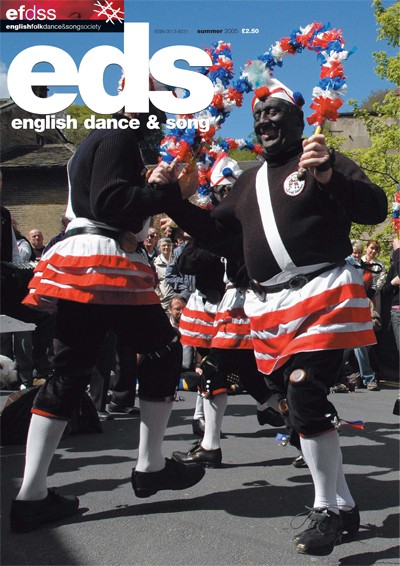
Published by the English Folk Dance and Song Society, English dance & song has appeared at least four times a year since it was launched in 1936. The magazine presents festival listings and other news, interviews with current English traditional and neotraditional performers, and reviews of current publications, as well as brief research-based articles that explore historical documents and current practices.
The Society, which was formed in 1932 by the merger of the Folk-Song Society (founded in 1898) and the English Folk Dance Society (founded in 1911), also publishes a scholarly periodical, Folk music journal.
Related articles:
Comments Off on English dance & song
Filed under Dance, Europe, Music magazines, World music
Association for Cultural Equity
Founded by Alan Lomax in 1983, The Association for Cultural Equity‘s mission—“to facilitate cultural equity, the right of every culture to express and develop its distinctive heritage”—is realized through several projects that use and expand upon Lomax’s research, including the digitization and dissemination of his field collections.
As a part of this service, ACE supports a free online research center that includes an archive of Lomax’s collections; the sound recordings are indexed by place in ACE’s Lomax Geo-Archive, which provides excerpts from the recordings along with the full details of each recording session. Through cooperation with ACE, the American Folklife Center houses Lomax’s physical collection.
Comments Off on Association for Cultural Equity
Filed under Ethnomusicology, Resources, World music