Founded in 2007 by a consortium of French and international institutions and ensembles, Musique contemporaine/Contemporary music is a bilingual search engine for contemporary art music resources held at French institutions. Users can listen to excerpts of unpublished sound archives of conferences and concerts and read the program notes for these events. A glossary (in French) defines the main concepts involved in contemporary music, and an interactive structural map provides links to glossary entries, composers’ biographies, work excerpts, and so on. Also included are an interactive tag cloud of the composers who are most referenced, a composers’ timeline, and an interactive map showing the main French contemporary music organizations and providing their addresses. Simple and advanced searching tools are available.
Musique contemporaine / Contemporary music
Comments Off on Musique contemporaine / Contemporary music
Filed under 20th- and 21st-century music, Resources
Mangled Mozart

Mozart’s Entführung aus dem Serail was first performed in London at The Royal Opera House, Covent Garden on 24 November 1827. Stephanie’s libretto was translated into English and quite freely adapted, and one C. Kramer made numerous and inexplicable changes to the score, editing Mozart’s music, substituting his own numbers for some of the original ones, and adding entirely new numbers. None the wiser, audiences and critics received the mangled work with great enthusiasm.
This according to “The first performance of Mozart’s Entführung in London” by Alfred Einstein (1880–1952) in Essays on music (New York: W.W. Norton, 1956), a collection of his writings issued as a memorial volume; the book is covered in our recently published Liber Amicorum: Festschriften for music scholars and nonmusicians, 1840–1966.
Above, a nineteenth-century engraving depicting a production of the opera in London—perhaps the one that Einstein described. Below, Twyla Tharp and Milos Forman imagine the opera’s premiere in Amadeus.
Comments Off on Mangled Mozart
Filed under Classic era, Curiosities, Dramatic arts, Opera, Performance practice, Reception, Source studies
Petrucci Music Library

Founded in 2006, the International Music Score Library Project (IMSLP) hosts the Petrucci Music Library, a free wiki-based source for public-domain scores.
 The library, which is named for the innovative music printer Ottaviano Petrucci (1466–1539), mainly comprises scans of music editions whose copyright has expired; it also welcomes scores by contemporary composers who are willing to license their works without charge.
Comments Off on Petrucci Music Library
Filed under Resources
Omaha Indian music

Part of the online American memory series sponsored by the Library of Congress, Omaha Indian music presents traditional Omaha music recorded in Nebraska in the 1890s and 1980s. This multiformat ethnographic field collection comprises 44 wax cylinder recordings collected between 1895 and 1897 by Francis La Flesche and Alice Cunningham Fletcher, 323 songs and speeches from the 1983 Omaha powwow (above), and 25 songs and speeches from a 1985 concert at the Library of Congress; contextual information is provided by photographs, field notes, and interviews with Omaha tribe members.
Comments Off on Omaha Indian music
Filed under Ethnomusicology, North America, Resources
Follow the drinking gourd

In 2008 the technology and publishing executive Joel Bresler created the multimedia website Follow the drinking gourd to share his research into the origins and history of the U.S. song, which was popularized by The Weavers and has been recorded some 200 times and reprinted in over 75 songbooks.
While providing ample documentation of the song’s reception history, this unusual resource probes persistent questions regarding the song’s provenance—not least, whether there is any basis for the idea that it was sung by African Americans during the Underground Railroad era. The site presents discussions by authoritative folklorists exploring such questions, and concludes with an invitation to collaborate by supplying further documentation.
Above, the first known publication of the song (Austin: Texas Folklore Society, 1928).
Comments Off on Follow the drinking gourd
Filed under Ethnomusicology, North America, Reception, Resources, Source studies
Nonsense neumes

Built at the behest of Richard Beauchamp, 13th Earl of Warwick (1382–1439), the Beauchamp Chapel at the Collegiate Church of St Mary, Warwick, is a remarkable survival of fifteenth-century architecture, sculpture, and—above all—stained glass. These windows are well known to organologists for their depictions of instruments and performance practice; they also provide useful information about chant and polyphony in fifteenth-century England by preserving fragments of neumatic notation.
Over the centuries craftspeople have restored damaged windows, and, lacking the requisite musical training, they often left replacement staves blank; but in two cases nonsense neumes were devised, supplying consistent-looking décor that most observers would never suspect was counterfeit.
This according to Alexandra Buckle’s “Fit for a king: Music and iconography in Richard Beauchamp’s chantry chapel” (Early music XXXVIII/1 (2010), pp. 3–20).
Comments Off on Nonsense neumes
Filed under Architecture, Curiosities, Middle Ages, Notation, Visual art
Concertina library
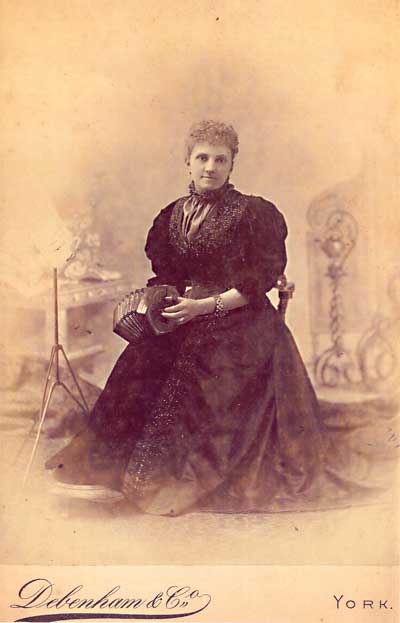
Concertina library: Digital reference collection for concertinas is an online collection of English, Anglo, and duet concertina resources, with entries ranging from research-based articles to instruction manuals, sheet music, and organological studies. Created by the computer scientist and concertina player Robert Gaskins, the library aims to compile and index all of the writings by leading authors on concertina matters, making them available to the public for free.
Above: Marie Lachenal with her concertina, ca. 1885.
Comments Off on Concertina library
Filed under Instruments, Resources
Music theory from Boethius to Zarlino

The winner of the Music Library Association’s 2009 Vincent H. Duckles Award, Music theory from Boethius to Zarlino: A bibliography and guide by David Russell Williams and C. Matthew Balensuela (Hillsdale: Pendragon Press, 2007) is a companion volume to Pendragon’s Music theory from Zarlino to Schenker: A bibliography and guide by Williams and David Damschroder (1990). Like the earlier volume, the book aims to create a logically organized introduction to major Medieval and Renaissance theorists and a thorough review of scholarly work on them.
Comments Off on Music theory from Boethius to Zarlino
Filed under Antiquity, Middle Ages, Renaissance, Resources, Theory
Comedy versus opera

Music was commonly introduced into French plays at least by the time of Molière, but after Louis XIV gave Lully a monopoly on opera in 1673 this practice was drastically circumscribed. Actors protested politely at first, but Louis did not take the hint, so dramatists began to turn to their sharpest weapon: satire.
Operagoers were depicted as ridiculous losers, and operas as overblown and barbaric. Opera houses were portrayed as venues for illicit flirtation, and opera singers as people with questionable morals. Operas were said to bay at the moon, to have no new airs, and to employ monkeys instead of poets and musicians. While this derision had no apparent effect on the opera world, it gave French comedy a rich new subject.
This according to “Comedy versus opera in France, 1673–1700” by Henry Carrington Lancaster, an essay included in Essays and studies in honor of Carleton Brown (New York : New York University Press, 1940), which is covered in RILM’s recently-issued Liber Amicorum: Festschriften for music scholars and nonmusicians, 1840–1966.
Above, Gabriel Jacques de Saint-Aubin’s depiction of Lully’s Armide as performed at the Palais-Royal in 1761.
Related articles:
Filed under Baroque era, Curiosities, Dramatic arts, Humor, Literature, Opera, Reception
Seebüller Hefte
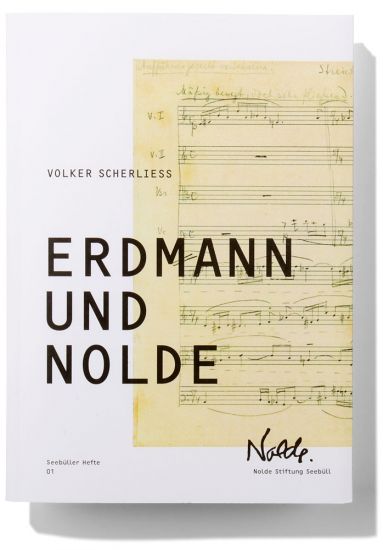
In 2009 the Nolde Stiftung Seebüll in Neukirchen, Germany, inaugurated the series Seebüller Hefte with Volker Scherliess’s Erdmann und Nolde, which documents the friendship between the artist Emil Nolde and the pianist Eduard Erdmann (1896–1958). The foundation’s museum occupies the house that Nolde designed for himself in 1927; it is now devoted to exhibitions of his works.
Comments Off on Seebüller Hefte
Filed under New series, Visual art