Much vocal music has been transcribed for tuba, but little is available for advanced-level players. Coloratura opera arias offer material that would be challenging for more experienced tubists, and these types of arias are much less text-dependent than other kinds of vocal music.
This according to Guidelines for transcribing coloratura opera arias for tuba, with transcriptions of three arias by Vivaldi, Gluck, and Delibes by Robert Lynn, a 2005 dissertation for Ball State University.
Above, a performance by TubaDiva (Jennifer Paradis-Hagar); below, Alessandro Fossi performs Musetta’s aria “Quando me’n vo” from Puccini’s La Bohème.
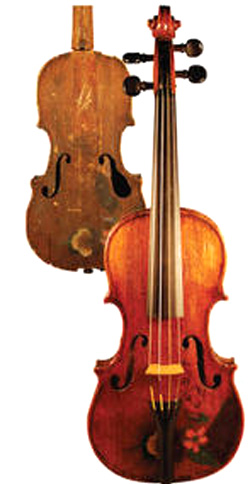
In 1892 Alfred Hill, of the London violin-making firm W.E. Hill & Sons, got into an argument about Irish Home Rule with one of his employees. The argument escalated until the employee became enraged and walked out.
This confrontation had considerable consequences; the employee was the firm’s only bow maker.
At a loss, Hill took two men from the case-making department and told them to start making bows. Neither William Napier nor William Retford (inset) had any experience as bow makers—but they went on to revolutionize the art of bow making, developing the fine and reliably consistent product that the violin world now knows as the Hill bow.
This according to “Industry meets art: The history of the iconic Hill bow” by Philip J. Kass (Strings XXV/4:187 [November 2010] pp. 61–64).
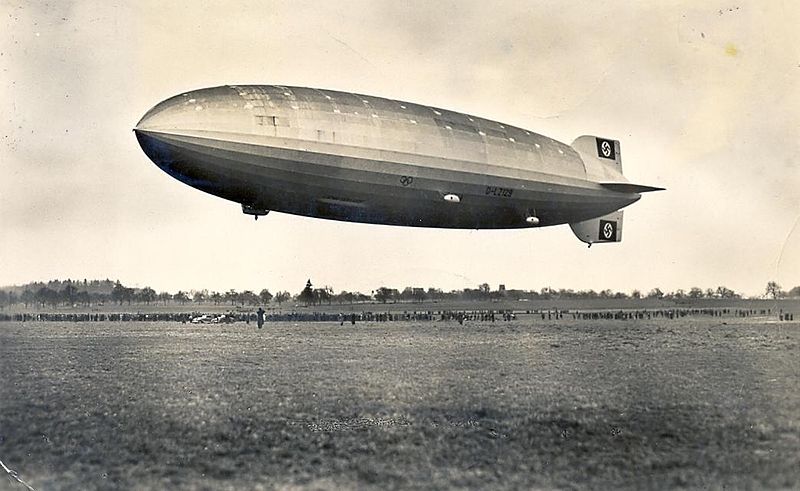
The lightweight aluminum alloy grand piano weighed only 162 kg (356 lbs). The frame, rim, fallboard, and top lid were made of duralumin, and the legs, back bracing, and lyre were made of hollow duralumin tubing.
The piano was a prominent feature of the Hindenburg’s first flight to America in 1936, during which the pianist Franz Wagner gave several concerts for the passengers, playing works by Chopin, Liszt, Beethoven, and Brahms as well as popular music.
The instrument was not on board for the Hindenburg’s fatal flight in 1937; it was removed before the beginning of that season and put on display at the Blüthner factory, which was destroyed during an air raid in 1943.
Today is the 75th anniversary of the Hindenburg disaster! Above, the piano in the lounge on board the Hindenberg; below, a tour of the Hindenburg’s “A” deck, with a few glimpses of the instrument.
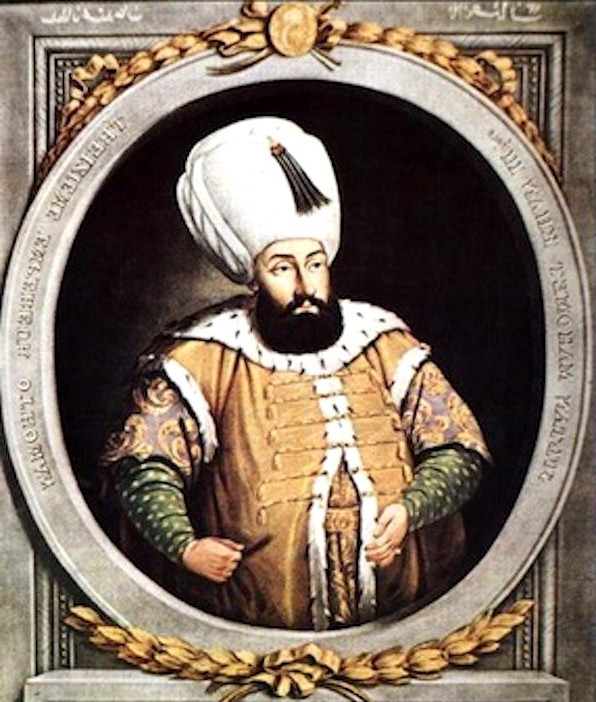
In 1599 the English organ builder Thomas Dallam personally accompanied to Istanbul an instrument he had built for the Ottoman Sultan Mehmed III at the behest of Queen Elizabeth. The gift was intended to smooth relations in the hope of gaining access to Ottoman caravan routes.
The instrument, which could sound a fanfare, chime the hours, and play several pieces by itself due to controlled wind release, delighted the Sultan, who declared a festive occasion with amnesty for over 300 prisoners.
Dallam himself made a highly favorable impression, and was offered many luxuries in exchange for staying in Istanbul. He respectfully declined, however, citing his responsibilities toward his family. Dallam’s success assured his prosperity back home, and soon the trade routes to India were opened to the British.
Until now, the assumed hurdles of electronic design have kept laypersons at bay. Circuit bending—the chance-directed rewiring of preexisting electronic devices—transforms the circuit into a friendly and immediate canvas, like that of a painter: Just walk up and paint.
Indeed, the modern-day painter’s canvas is more immediate than ever, since there is no longer a need to study the science of pigment making. Similarly, circuit bending’s chance approach—an act of clear illogic—obviates any need to understand the science of electronics.
Just as traditional cultures can transform a coconut into myriad different instruments, circuit bending can transform a Speak & Spell, for example, into an untold number of homemade synthesizers.
This according to “The folk music of chance electronics: Circuit bending the modern coconut” by Qubais Reed Ghazala (Leonardo music journal XIV [2004], pp. 96–104).
Many thanks to the Improbable Research blog for reminding us about Ghazala’s writings! Below, the author discusses his work; above, he admires an amanita muscaria.
A close reading of the canonical texts yields conclusive evidence that the celebrated sleuth was not a superb violinist—he was a superb violist.
The mistake was likely perpetuated by an early printer’s error. After all, Watson was a doctor, which means that even at best his handwriting was nearly illegible; he undoubtedly wrote “viola”, not “violin”. References to Holmes’s playing such as a “low, dreamy, melodious air” and “low melancholy wailing”—as well as to his habit of playing it “thrown across his knee”—clearly indicate that his instrument must have been a viola.
In fact, further textual references point to a historical mystery solved. Holmes referred to his instrument as a Stradivarius bought from a shady broker for only 55 shillings; surely this was the one Stradivarius viola, dated 1695, whose whereabouts has eluded instrument historians.
This according to “Quick, Watson, the fiddle” by Rolfe Boswell (The Baker Street journal, October 1948; reprinted in Journal of the American Viola Society online 26 [summer 2010] pp. 14–18).
Above, a classic depiction by Sidney Paget, Conan Doyle’s original illustrator; below, Jeremy Brett holds forth.
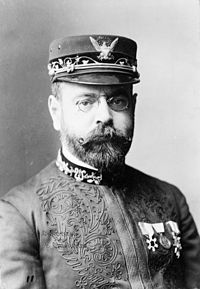
While the composer of iconic marches is famous for directing the U.S. Marine Band and his own world-famous ensembles, John Philip Sousa’s early life as a violin prodigy is relatively unknown.
A sickly child, Sousa was home-schooled, and from the age of six his studies included lessons with an Italian violin teacher. He showed tremendous promise, and his father, a trombonist in the Marine Band, enlisted him as a Marine apprentice when he was 13; there he studied academics and several instruments.
Sousa went on to play the violin in orchestras and chamber groups, where he developed a taste for cutting-edge art music that he never lost; for example, his band performed excerpts from Wagner’s Die Meistersinger ten years before the opera’s first U.S. production.
Astérix le Gaulois, a series of comics written by René Goscinny and illustrated by Albert Uderzo between 1960 and 1999, received much acclaim for the attention to detail in Uderzo’s drawings of ancient civilizations.
Particularly interesting to an organologist are the illustrations of instruments—including carnyx, buccina, lur, bagpipe, harp, lyre, pipes, and drums—used by ancient Romans, Greeks, Egyptians, and Gauls.
In designing his oval spinet, Bartolomeo Cristofori (1655–1731) sought to produce a relatively small instrument with long bass strings, two 8′ registers with a difference in timbre equal to that obtainable with a harpsichord, a symmetrical distribution of the tensions on the soundboard, and an aesthetically appealing and elegant appearance.
The longest string is placed in the center of the soundboard, while the strings move towards the acute in symmetrical alteration to the left and to the right; they therefore require a complicated action system for the movement of the key levers to be transmitted to the appropriate jacks.
All of the first register’s strings are arranged in order towards the back side, while the second register’s strings progress from the center towards the front side—it is the two registers, and not the sequence of notes, that are symmetrical with respect to the center. The selection of the registers is accomplished by sliding the keyboard, which activates a counter-lever system.
This according to “Bartolomeo Cristofori: La spinette ovali del 1690 / Bartolomeo Cristofori’s 1690 oval spinet” by Gabriele Rossi-Rognoni, an essay included in Bartolomeo Cristofori: La spinetta ovale del 1690—Studi e ricerche / The 1690 oval spinet—Study and research (Firenze: Ministero per i Beni e le Attività Culturali, 2002).
Above, a replica built by Tony Chinnery and Kerstin Schwarz. Below, a brief documentary on Cristofori and his instruments.
The open-access online resource John Thompson on the guqin silk string zitherpresents extensive materials on the guqin (古琴, “goo-chin”) including classic handbooks and commentaries; organological details; depictions of the guqin in art, poetry, and song; notation and sound files; playing instructions; analyses of performance practice; history and ideology; and links to other resources. Detailed information on the author is also included.
Below, Tao Zhusheng performs Guan shan yue (Moon over the mountain pass) in a 1977 film by Robert Garfias. The work is an evocation of the Tang-dynasty poem of the same title by Li Bai.
The library of the Institut du Monde Arabe (Arab World Institute) in Paris is home to an extensive collection of writings on music from the Arab world, a region stretching from the Atlas Mountains to the Indian Ocean. This series … Continue reading →
The Filipino ethnomusicologist and composer Jose Maceda created unique works that blended his fieldwork on Filipino and other music with his expertise in European avant-garde traditions. His compositions combined innovative techniques such as spatialization, a focus on timbre, and musique … Continue reading →
The Senegalese singer, songwriter, musician, and politician Youssou N’Dour was born just six months before Senegal achieved independence. His mother hailed from a long line of griots, or gawlo, who served as hereditary musicians and custodians of oral history in … Continue reading →
Ellis Marsalis first learned to play the clarinet and saxophone but the piano later became his main instrument. From 1951 to 1955, he completed a bachelor’s degree in music education at Dillard University in New Orleans while receiving informal jazz … Continue reading →