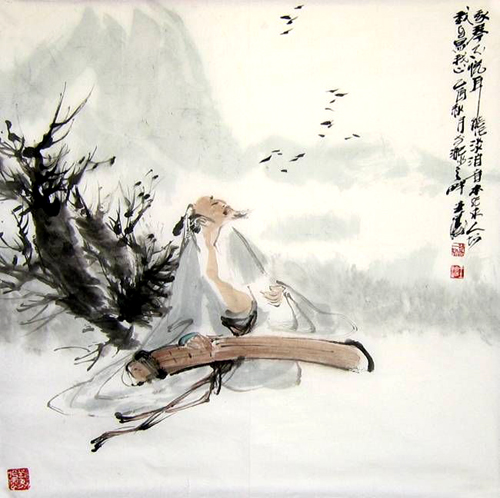
The open-access online resource John Thompson on the guqin silk string zitherpresents extensive materials on the guqin (古琴, “goo-chin”) including classic handbooks and commentaries; organological details; depictions of the guqin in art, poetry, and song; notation and sound files; playing instructions; analyses of performance practice; history and ideology; and links to other resources. Detailed information on the author is also included.
Below, Tao Zhusheng performs Guan shan yue (Moon over the mountain pass) in a 1977 film by Robert Garfias. The work is an evocation of the Tang-dynasty poem of the same title by Li Bai.
Like real rock guitar playing, air guitar—miming electric guitar playing without an instrument—is heavily informed by gendered practices in rock, where the electric guitar functions as a signifier of masculine power and implied sexual prowess, and performing on it involves symbolic aggression and dominance.
Women air guitarists appropriate and disrupt rock culture’s consensus, undermining and subverting its gendered performance. This gender bending emphasizes women’s critique of rock culture’s masculinist attitude while asserting female power through the nonthreatening manipulation of an imaginary phallic symbol.
This according to “The girl is a boy is a girl: Gender representations in the Gizzy Guitar 2005 Air Guitar Competition” by Hélène Laurin (Journal of popular music studies XXI/3 (September 2009) pp. 284–303. Above and below, the multi-award-winning Nanami “Seven Seas” Nagura.
On 2 September 1890 U.S. Navy officer George Breed (1864–1939) was granted a patent for a design for an electrified guitar (Method of and apparatus for producing musical sounds by electricity, patent no. 435,679); it appears to be the first application of electricity to a fretted string instrument.
Like the modern electric guitar and other similar instruments, Breed’s patent was based on a vibrating string in an electromagnetic field; but his design worked on very different musical and electrical principles (in particular the Lorentz force), resulting in a small but extremely heavy guitar with an unconventional playing technique that produced an exceptionally unusual and unguitarlike, continuously sustained sound.
Breed is now almost completely unknown as a musical instrument maker and designer; the significance of this instrument has largely remained underappreciated, and the circuitry unexamined.
This according to “George Breed and his electrified guitar of 1890” by Matthew Hill (The Galpin Society journal LXI [April 2008] pp. 193–203). Below, Dr. Hill discusses his research.
In 2010 Scarecrow Press launched the series The American wind band with A history of the trombone by David M. Guion; the book is a comprehensive account of the development of the instrument from its initial form as a 14th-century medieval trumpet to its acceptance in various kinds of artistic and popular music in the 19th and 20th centuries.
Capable of producing sounds beyond the range of human hearing, the pipe organ presents the ultimate challenge for sound recording. The first known attempt was the Columbia Records recordings of the Mormon Tabernacle Choir from late August and early September 1910, which included two organ solos played by John J. McClellan.
Probably the very first pipe organ recording was a test made on 30 August 1910, with McClellan playing Wagner’s Tannhäuser overture. Two enormous acoustic recording horns, five feet long and two feet wide, were suspended on a rope strung across the Tabernacle. Although the engineer deemed the recordings successful, apparently they were never approved for release.
This according to “The first recordings of organ music ever made” by John W. Landon (Theatre organ: Journal of the American Theatre Organ Society LIII/4 [July–August 2011] pp. 22–28). Above, the Mormon Tabernacle organ as it appeared at the time of the recording (two 15-foot wings were added in 1915).
The heyday of the mortuary pipe organ was the 1920s and 1930s; only a few have been built since World War II. A uniquely American product, the instrument’s characteristics departed significantly from those of the conventional church organ, despite its quasi-liturgical setting and function.
U.S. organ builders, long known for their innovations, met the stringent tonal, space, and cost requirements of funeral homes, cemetery chapels, and mausoleums so successfully that their instruments displaced the reed organ and piano. Over 600 mortuary organs were sold during this period, contributing significantly to the industry’s survival during the Great Depression.
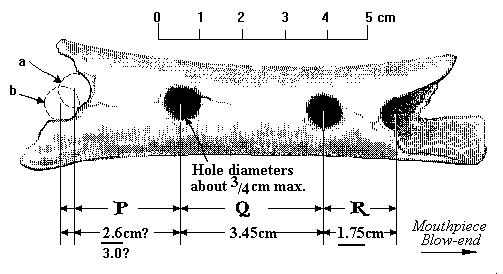
In 1996 Mira Omerzel-Terlep reported that a bone fragment excavated at the Divje Babe I cave site in Slovenia is considered to be the oldest man-made flute, dating from 45,000 years ago (“Koščene piščali: Pričetek slovenske, evropske in svetovne inštrumentalne glasbene zgodovine” [Bone whistles: Origins of the Slovenian, European, and world history of instrumental music], Etnolog: Glasnik Slovenskega Etnografskega Muzeja/Bulletin of the Slovene Ethnographic Museum VI, pp. 235–294). Further studies sought to demonstrate that the fragment had originally belonged to an instrument capable of producing a diatonic scale.
Other researchers were skeptical, though, and in 1998 Paola Villa et al. tried to put the speculation to rest, showing that the holes in the bone were the results of gnawing by animals (“A Middle Paleolithic origin of music? Using cave-bear bone accumulations to assess the Divje Babe I bone ‘flute’”, Antiquity LXXII/275 [March], pp. 65–79).
The argument has not abated. In 2002 a pair of essays staking out the opposing camps was issued in Archäologie früher Klangerzeugung und Tonordnung/The archaeology of sound origin and organization; Musikarchäologie in der Ägäis und Anatolien/Music archaeology in the Aegean and Anatolia (Rahden: Leidorf); April Nowell states that the results of taphonomic testing offered no viable proof that the bone fragment was an instrument (“Is a cave bear bone from Divje Babe, Slovenia, a Neanderthal flute?” pp. 69–81) while Robert Fink presents research supports the theory that it was (“The Neanderthal flute and origin of the scale: Fang or flint? A response” pp. 83–87).
More recently, an exhaustive study by Cajus G. Diedrich of Paleo-Logic, Independent Institute of Geosciences, ends with the conclusion that “The ‘cave bear cub femora with holes’ are, in all cases, neither instruments nor human made at all” (Royal Society Open Science, 2 : 140022; the paper can be read in full here).
Still, the controversy is alive and thriving on the Internet.
Below, Ljuben Dimkaroski performs on a reconstruction of the alleged original bone flute.
The long-lost pipe organ that belonged to the steamship Britannic, the sister ship of the Titanic, was identified in the collection of the Museum für Musikautomaten in Seewen, Switzerland, when restorers in 2007 discovered the inscription Britanik engraved on each beam under the instrument’s windchests.
After the outbreak of World War I in 1914 the British Admiralty requisitioned all large passenger ships as troop transports or hospital ships, so the Britannic was never outfitted for transocean luxury traffic. Around 1920 the organ, built around 1913 by M. Welte & Söhne, was installed in the villa of the camera manufacturer and designer August Nagel (1882–1943) in Stuttgart; around 1935 he returned it to the manufacturer for unknown reasons. In 1937 it was moved to the reception room of the Radium electric light company in Wipperfürth, where it remained in use until the 1960s.
When the Wipperfürth reception room was turned into a storeroom, the organ was offered for sale but attracted no buyers. Eventually it came to the attention of Heinrich Weiss, the founder of the Museum für Musikautomaten, who quickly acquired it for his collection; the instrument was completed and reinaugurated there On 30 May 1970, but its identity and history remained unknown for decades.
In 1909 John Wanamaker bought the instrument for his new emporium. Thirteen freight cars were required to ship it, and installation took two years. The Grand Organ was first heard in the seven-story atrium on 22 June 1911; later that year it was prominently featured when President William Howard Taft dedicated the store. During the following 20 years it was continuously enlarged under the direction of William Boone Fleming.
Daily recitals by store employees provided a harmonious environment for shopping, and special performances, such as annual Christmas concerts, provided outreach to the community. Today the store is owned by Macy’s, and the traditions continue.
This according to “The Grand Court organ” by Ralph Blakely (The musical times CXXX/ 1761 [November 1989] pp. 703–707). Below, Virgil Fox discusses and performs on the organ.
The 200th anniversary of Chopin’s birth in 2010 inspired the launch of a new Russian-language quaterly dedicated to piano, PianоФорум (PianoForum). Published by Международная Муызкально-Техническая Компания (International Music-Technical Company) and edited by the musicologist, pianist, and pedagogue Vsevolod Zaderackij, the journal covers diverse aspects of contemporary pianism, including instrument building, piano repertoire and interpretation, piano competitions and festivals, and piano pedagogy from the beginning level to professional training. A description of the contents of issue no. 3 (2010) in Russian is here.
The Indian singer Jayashri Ramnath (better known as Bombay Jayashri) was introduced to Karnatak music in her early childhood, influenced by her parents’ roles as music teachers. Jayashri began her performing career at the age of 28, and having grown … Continue reading →
The country singer, songwriter, actor, and businesswoman Dolly Parton was the fourth of twelve children in a family of sharecroppers in Sevierville, Tennessee, located in the Appalachian Mountains. Commenting on her childhood, Parton once said, “Everybody where we grew up … Continue reading →
Women have been part of hip hop expression from its early days, primarily as part of MC crews such as the Funky Four Plus One and Sugar Hill’s female group, Sequence. For most of hip hop’s recorded history, however, women … Continue reading →
The music of Central America tends to borrow heavily from the music of Mexico to the north, Colombia to the south, and the Caribbean Islands to the east, and, in the case of Nicaragua, from the politically motivated nueva canción … Continue reading →