SPIN: Study Platform on Interlocking Nationalisms, a free online resource dedicated to the study of the Romantic period in Western culture, includes a database devoted to iconography on banknotes, with a special section for composers. As of this writing 33 portraits of composers on banknotes are documented therein, all with full-color reproductions and many with annotations as well.
Above, Clara Schumann on a German 100-mark note issued in 1989. Below, Antonín Dvořák assissts with instructions for banknote origami.
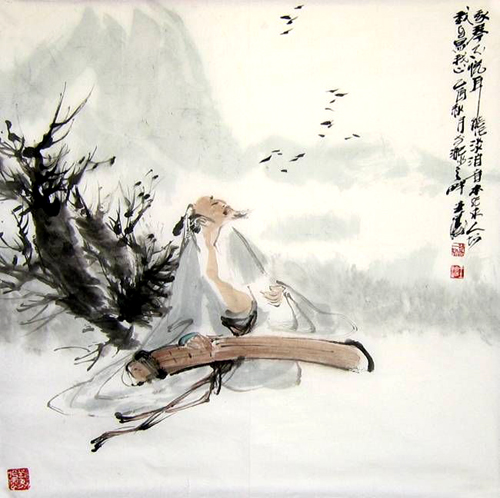
The open-access online resource John Thompson on the guqin silk string zitherpresents extensive materials on the guqin (古琴, “goo-chin”) including classic handbooks and commentaries; organological details; depictions of the guqin in art, poetry, and song; notation and sound files; playing instructions; analyses of performance practice; history and ideology; and links to other resources. Detailed information on the author is also included.
Below, Tao Zhusheng performs Guan shan yue (Moon over the mountain pass) in a 1977 film by Robert Garfias. The work is an evocation of the Tang-dynasty poem of the same title by Li Bai.
Undertaken in conjunction with the Florida Federal Writers’ Project, the Florida Music Project, and the Joint Committee on Folk Arts of the Work Projects Administration, the collection features folk songs and folktales in many languages, including blues and work songs from fishing boats, railroad gangs, and turpentine camps; children’s songs, dance music, and religious music of many cultures; and oral histories.
The website provides access to 376 sound recordings and 106 accompanying materials, including recording logs, transcriptions, correspondence between Florida WPA workers and Library of Congress personnel, and an essay on Florida folklife by Zora Neale Hurston (inset). A new essay by Stetson Kennedy reflects on the labor and the legacy of the WPA in Florida, and an extensive bibliography, a list of related Web sites, and a guide to the ethnic and language groups of Florida add further context to the New Deal era and to Florida culture.
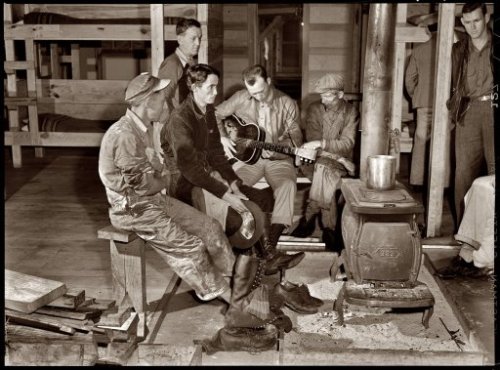
Above, construction workers gathered around the stove in the craftsmen’s barracks at Camp Blanding, Florida, in 1940.
Comments Off on Florida Folklife from the WPA Collections
The menu bar offers broad categories (Biography, People, Writings, Sources, Works, Performances, and Miscellaneous) that lead to some 85 pages, each with a search box, presenting resources including lists, compilations, tables, and analytical charts related to various aspects of Sorabji’s life and works. A printed version of the entire site would produce a 350-page book.
Below, John Carey performs Sorabji’s Fantaisie espagnole.
Launched by the Fundación Juan March in 2011, Clamor: Colección Digital de Música Española presents open-access documentation of performances of over 800 Spanish works—mostly from the 20th or 21st century—at over 130 concerts presented by the Foundation since its inception in 1975.
In addition to the concert recordings, this resource presents pre-concert talks given by composers or specialists, program notes, scores, photographs, and over 230 composer biographies and works lists.
Bach Cantatas Website is a comprehensive open-access resource covering all aspects of Bach’s cantatas and his other vocal works, including discussions and detailed discographies of each cantata and other vocal works, performers, and general topics.
The website also provides texts and translations, scores, musical examples, articles and interviews, and over 8,000 short biographies of performers of Bach’s vocal works and players of his keyboard and lute works, as well as of poets and composers associated with Bach.
Also included are relevant resources such as the Lutheran church year, a database of chorale texts and melodies and their authors, detailed discographies and discussions of many Bach’s instrumental works—including solo keyboard and lute works as well as Die Kunst der Fuge and Musikalisches Opfer—and their performers, reviews, and transcriptions.
Further resources include lists of books and films on Bach, terms and abbreviations, concerts of Bach’s vocal works, Bach festivals, and cantata series; as well as a guide to Bach, a discussion of Bach in arts and memorabilia, and thousands of links to other relevant resources.
Early music online is the result of a project aimed at digitizing 300 volumes of the world’s earliest printed music from holdings at the British Library and making them freely available online. The project has focused on the British Library’s holdings of 16th-century anthologies of printed music, as listed in RISM B/I (Recueils imprimés XVI-XVIIsiècles).
These collections printed in Italy, Germany, France, England, and Belgium contain approximately 10,000 works, which have been individually indexed. The volumes mainly comprise vocal polyphony partbooks, but they also include early printed tablatures for keyboard or plucked string instruments.
The digitized books can be browsed via Royal Holloway’s digital repository. Full details of each volume, searchable by composer and by title, with links to the digitized content, can also be found in the British Library Catalogue, UK RISM database, and COPAC.
Above, an excerpt from a work by Jacob Clément (Clemens non Papa) in Le huitiesme livre des chansons a quatre parties, an anthology published in Antwerp by Tylman Susato in 1545 (click to enlarge). Below, Stile Antico sings Clemens’s Ego flos campi.
Porträtsammlung Friedrich Nicolas Manskopf is a free online resource that presents portraits drawn from the collection of the Frankfurt wine dealer Friedrich Nicolas Manskopf (1869–1928) of composers, instrumentalists, singers, actors, directors, playwrights, and dancers, along with stage scene stills, views of buildings, and allegorical pictures of music and stage situations.
Comprising about 12,500 photographs from 1860 to 1944 and 4900 printed graphics from about 1550 to 1920, the collection is indexed by person, ensemble, or building; by persons involved as photographers, engravers, or lithographers; and by the publishing years of photos and prints.
A general search field enables the search of professions, roles, playwrights, titles, years, and technique of the portraits; a combined search is possible using the Bibliotheksportal at the hosting institution, the Universität Frankfurt am Main. Higher-resolution copies of the images may be ordered for a fee.
Above, a publicity photograph from the collection of the the legendary trio of Alfred Cortot, Jacques Thibaud, and Pablo Casals; below, the trio plays the first movement of Schubert’s piano trio in B flat, op. 99, D.898, in 1926.
The Indian singer Jayashri Ramnath (better known as Bombay Jayashri) was introduced to Karnatak music in her early childhood, influenced by her parents’ roles as music teachers. Jayashri began her performing career at the age of 28, and having grown … Continue reading →
The country singer, songwriter, actor, and businesswoman Dolly Parton was the fourth of twelve children in a family of sharecroppers in Sevierville, Tennessee, located in the Appalachian Mountains. Commenting on her childhood, Parton once said, “Everybody where we grew up … Continue reading →
Women have been part of hip hop expression from its early days, primarily as part of MC crews such as the Funky Four Plus One and Sugar Hill’s female group, Sequence. For most of hip hop’s recorded history, however, women … Continue reading →
The music of Central America tends to borrow heavily from the music of Mexico to the north, Colombia to the south, and the Caribbean Islands to the east, and, in the case of Nicaragua, from the politically motivated nueva canción … Continue reading →