Renovations of Whittaker Library at the Royal Conservatoire of Scotland in 2000 involved dismantling a “robust but not particularly beautiful cupboard” and storing its contents—mostly old sheet music—for later inspection.
Entirely by chance, the librarian and scholar Karen McAulay discovered therein three manuscript collections of traditional Scottish flute tunes notated by one James Simpson. Her subsequent research enabled her to establish some details of Simpson’s identity, including his residences, occupation, and birth and death dates (1806–73).
This according to McAulay’s “From Dalfield Walk, Dundee, to Renfrew Street, Glasgow: The James Simpson manuscripts” (Brio XL/1 [spring-summer 2003] pp. 27–37). Above, Simpson’s notation of the Strathspey Maggie Lauder with variations.
The earliest known staff-notated manuscript collection of Scottish Gaelic music, it contains 92 songs, 51 dance tunes, and 6 pibrochs; it probably represents well the musical repertory of Raasay, one of the islands of the Inner Hebrides. A major task for the editors involved locating, documenting, translating, and underlaying song texts which might have been known to Ross; she provided titles or first lines of verses or refrains for her airs, but not the texts themselves.
The Raasay residents James Macleod and his wife Flora were excellent musicians, and their niece Elizabeth Ross, who lived with them, was clearly a competent transcriber. Raasay was also the home of the great piper John MacKay, from whom Ross learned to play several pibrochs.
Performing Arts in America 1875–1923, a website of The New York Public Library for the Performing Arts, captures a glimpse of the beginning of the modern age, when a combination of technological advances and societal freedoms led the way to a new world where—among other things—entertainment for the masses became a thriving industry. The upbeat mood of America was reflected in its theater, its popular songs, the craze for ballroom dancing, and above all in the newest of popular fads, the motion pictures. At the same time, America was forging its own classical culture worthy of competing with its European forebears.
This searchable database presents some 16,000 archival visual and audio materials from the library’s holdings, including sheet music, newspaper clippings, photographs of theater and dance performances, and publicity posters.
Inaugurated by Boosey & Hawkes in 2011, Online scores presents full digitized scores by a wide range of twentieth- and twenty-first-century composers, free of charge. While the scores cannot be printed or downloaded, they may be viewed and enlarged for study or research. The collection is searchable by composer or genre, and individual accounts can be customized with bookmarks. At launch this resource comprised over 400 scores and promised frequent additions.
At launch, the Jukebox already included over 10,000 recordings made by the Victor Talking Machine Company between 1901 and 1925. Content will be increased regularly, with additional Victor recordings and acoustically recorded titles made by other U.S. labels, including Columbia, Okeh, and some Universal Music Group-owned labels. The selections range from jazz and popular styles to ethnic traditions to Western classical works, including opera arias.
Above, a Victor acoustical recording session ca. 1920.
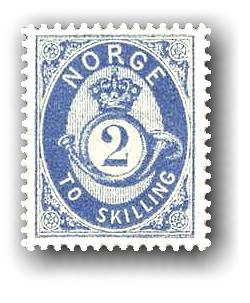
Music philately began with the issuance of some of the very first postage stamps in the mid-nineteenth century: The inaugural issues of several European countries included images of post horns. Purists may argue that post horns were mere signaling devices, but at that time they were already being used in classical compositions, so their depictions may be considered musical images.
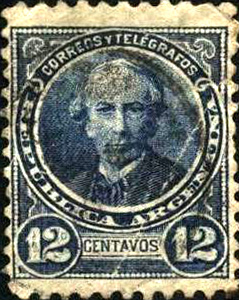
Other nineteenth-century stamps featured depictions of prominent political figures who were also musicians—for example, Argentina issued a stamp honoring the statesman and composer Juan Bautista Alberdi in 1888 (left)—but they were concerned with politics rather than music. The first explicitly musical stamp was Poland’s issuance honoring Ignacy Jan Paderewski in 1919.
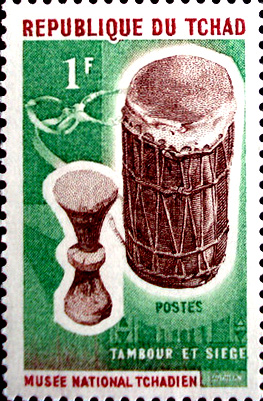
Through the 1950s countries increasingly celebrated Western classical musicians and composers. In the 1960s all aspects of musical life became potential subjects—institutions, festivals, instruments, dancers, and so on—and non-European countries asserted their national identities with images of their own traditional and historical music cultures. In the later twentieth century images of popular and jazz musicians gained increasing demand .
This according to A checklist of postage stamps about music by Johann A. Norstedt (London: Philatelic Music Circle, 1997), which lists some 14,000 stamps with music-related images.
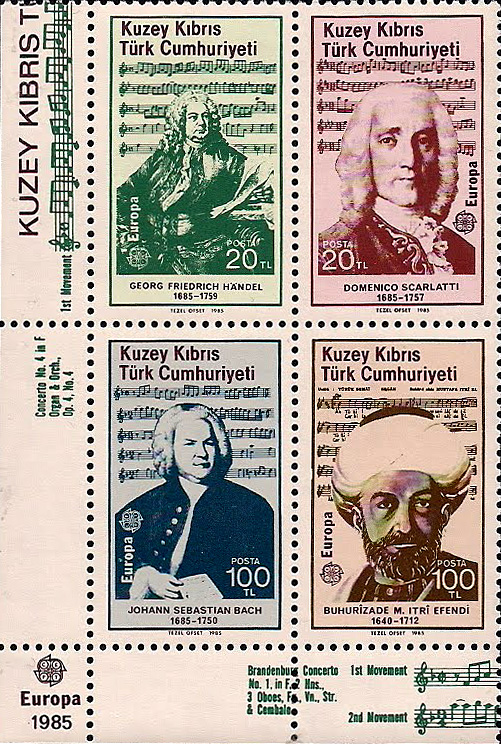
Above, stamps issued in Northern Cyprus in 1985, which was designated European Music Year by the Europa Federation (click images to enlarge). Below, a curious video about Robert Burns iconography.
Part of the Library of Congress’s American Memoryseries, Fiddle tunes of the old frontier: The Henry Reed Collection is a multiformat collection of traditional fiddle tunes played by Henry Reed of Glen Lyn, Virginia, recorded by Alan Jabbour in 1966 and 1967, when Reed was over eighty years old. The tunes represent the music and evoke the history and spirit of Virginia’s Appalachian frontier; many of them passed back into circulation during the fiddling revival of the later twentieth century.
The collection includes 184 sound recordings, 19 pages of field notes, and 69 transcriptions of Reed’s fiddling with notes on tune histories and musical features; an illustrated essay on Reed’s life, art, and influence; a list of related publications; and a glossary of musical terms.
Above, Reed with Bobbie Thompson (guitar) at the Narrows (Virginia) Fiddlers Contest, summer 1967. Below, Alan Jabbour performs a tune that he learned from Henry Reed.
CANTUS: A database for Latin ecclesiastical chant is a free online resource that assembles and publishes indices of over 380,000 chants found in manuscript and early printed sources for the liturgical Office. The database is searchable by text incipit, keyword, Corpus Antiphonalium Officii identification number, or Liturgical occasion.
Jordan’s “The demons in a database: Interrogating Stravinsky the global dancer” (Dance researchXXII/1 [summer 2004] pp. 57–83) presents analyses of findings in the database regarding the distribution of new Stravinsky dance productions over the years, incidence of choreographing the narrative vs. the concert scores, distribution by choreographer, and distribution by country, along with case studies of the choreographic histories of Le sacre du printemps, Apollo, and Agon.
Comhaltas Ceoltóirí Eireann, the largest group worldwide devoted to the preservation and promotion of Irish traditional music, is celebrating its 60th anniversary this year.
With hundreds of branches in 15 countries on 4 continents, the non-profit organization sponsors classes, concerts, and sessions in local communities. It also hosts a website, which accounts for its presence in RILM. A page on their site titled The music includes links to tracks from their CDs, recordings of sessions, and tracks from the Comhaltas Traditional Music Archive; video recordings of some of today’s foremost performers; selections from their own tune books, as well as other tunes from historical sources; a photograph archive; and Treoir, the Comhaltas journal.
Below, Emma O’Sullivan dances a reel at a Comhaltas event. Note that this is not the rigid-posture style popularized by shows like Riverdance, which is considered by many to be a more recent development; this style is known as sean-nós, which means “old style”.
The Indian singer Jayashri Ramnath (better known as Bombay Jayashri) was introduced to Karnatak music in her early childhood, influenced by her parents’ roles as music teachers. Jayashri began her performing career at the age of 28, and having grown … Continue reading →
The country singer, songwriter, actor, and businesswoman Dolly Parton was the fourth of twelve children in a family of sharecroppers in Sevierville, Tennessee, located in the Appalachian Mountains. Commenting on her childhood, Parton once said, “Everybody where we grew up … Continue reading →
Women have been part of hip hop expression from its early days, primarily as part of MC crews such as the Funky Four Plus One and Sugar Hill’s female group, Sequence. For most of hip hop’s recorded history, however, women … Continue reading →
The music of Central America tends to borrow heavily from the music of Mexico to the north, Colombia to the south, and the Caribbean Islands to the east, and, in the case of Nicaragua, from the politically motivated nueva canción … Continue reading →