Ut Orpheus Edizioni launched the series Napoli e L’Europa/Naples and Europe in 2009 with a critical edition of Demofoonte by Niccolò Jommelli. The full project, La Scuola Napoletana dal XVII al XIX Secolo, involves the publication of critical and urtext editions of works by composers of the Neapolitan School along with performances by Riccardo Muti and the Orchestra Giovanile Luigi Cherubini; Demofoonte was performed in conjunction with the Opéra national de Paris in Salzburg, Paris, and Ravenna in spring and summer 2009.
Category Archives: Dramatic arts
Sheet music consortium
An open collection of digitized popular sheet music from the eighteenth through the twentieth centuries, Sheet music consortium is hosted by the UCLA Digital Library Program, which provides an access service to sheet music records at the host libraries. Each of the over 100,000 entries includes full bibliographic information; links to further resources, such as full reproductions, may be provided depending on the host institution.
The consortium members are the Archive of Popular American Music at the University of California, Los Angeles; IN Harmony: Sheet Music from Indiana at Indiana University; the Lester S. Levy Collection of Sheet Music at Johns Hopkins University; and the Historic American Sheet Music collection at Duke University.
Related Articles
- Find Forgotten Music Through Sheet Music Libraries (sheetmusiclibraries.blogspot.com)
Comments Off on Sheet music consortium
Filed under 20th- and 21st-century music, Dramatic arts, Jazz and blues, Popular music, Resources
Bees at the Opéra

Besides his training as a graphic artist, Jean Paucton, the prop man at the Palais Garnier in Paris, studied beekeeping at the Jardin du Luxemboug. In the mid-1980s he ordered his first hive, which was delivered to him at the Opéra, sealed and full of bees. He had intended to take it to his country house north of Paris, but when his plans changed the building’s fireman—who had been raising trout in a huge firefighting cistern under the building—advised him to place them on the seventh-floor roof at the back of the Palais Garnier.
Paucton gradually increased the number of hives to five, and from approximately 75,000 bees he annually collects about 1000 pounds of honey, which he packages in tiny jars, each with the label “Miel récolté sur les toits de l’Opéra de Paris, Jean Paucton”.

Thanks to the concentration of fragrant flowering trees and shrubs at the Bois de Boulogne, the chestnut trees in the Champs Élysées, and the linden trees in the Palais Royal, his honey has an intense floral flavor; it is sold at the Opéra’s gift shop and at the Paris gourmet shop Fauchon.
This according to “Who’s humming at Opera? Believe it or not, bees” by Craig S. Smith (The New York times 152/52,526 [26 June 2003] p. A:4).
Comments Off on Bees at the Opéra
Filed under Animals, Architecture, Curiosities, Dramatic arts, Food, Nature, Science
Mangled Mozart
Mozart’s Entführung aus dem Serail was first performed in London at The Royal Opera House, Covent Garden on 24 November 1827. Stephanie’s libretto was translated into English and quite freely adapted, and one C. Kramer made numerous and inexplicable changes to the score, editing Mozart’s music, substituting his own numbers for some of the original ones, and adding entirely new numbers. None the wiser, audiences and critics received the mangled work with great enthusiasm.
This according to “The first performance of Mozart’s Entführung in London” by Alfred Einstein (1880–1952) in Essays on music (New York: W.W. Norton, 1956), a collection of his writings issued as a memorial volume; the book is covered in our recently published Liber Amicorum: Festschriften for music scholars and nonmusicians, 1840–1966.
Above, a nineteenth-century engraving depicting a production of the opera in London—perhaps the one that Einstein described. Below, Twyla Tharp and Milos Forman imagine the opera’s premiere in Amadeus.
Comments Off on Mangled Mozart
Filed under Classic era, Curiosities, Dramatic arts, Opera, Performance practice, Reception, Source studies
Libretto illustrations
Illustrated libretti for eighteenth-century opera performances comprise a specific and unusual type of visual art. Since these engravings were made before the performances, they cannot be interpreted as objective documentation—indeed, clear evidence points to discrepancies between these representations and what the audiences actually saw. Rather, they must be seen as conveying the intention of these occasions, in surprisingly subtle ways.
Christine Fischer demonstrates this way of reading libretto illustrations in “Engravings of opera stage settings as festival books: Thoughts on a new perspective of well-known sources” (Music in art XXXIV/1–2 [2009], pp. 73–88). In the above engraving by Johann Benjamin Müller of the final scene in Maria Antonia Walpurgis’s Talestri, regina delle amazzoni (1760), Fischer notes that the wide gap between the female Amazons and the male Scythians—their leaders both with drawn swords—demonstrates their opposition, but the bridge in the background indicates their impending reconciliation. The message below the surface involves reassurance that the composer’s ongoing consolidation of her political power in Dresden will be beneficial to all, and that her rule will be based on a deep knowledge of state affairs and peaceful collaboration with powerful men.
Comments Off on Libretto illustrations
Filed under Classic era, Dramatic arts, Literature, Opera, Politics, Reception, Visual art
Der travestirte Hamlet
Der travestirte Hamlet: Eine Burleske in deutschen Knittelversen mit Arien und Chören (1794) was one of several parodies that capitalized on the Hamlet fever that swept the German-speaking lands in the late eighteenth and early nineteenth centuries.
Karl Ludwig Giesecke wrote the play; the composer was not indicated, but there are grounds for believing that it was Vincenc Tuček (1773–1821).
The numbers include a song in which Polonius coaches Ophelia on how to seduce Hamlet, a song in which Hamlet insists that he is not afraid of ghosts, and a duet for Hamlet and Ophelia at the end of the “get thee to a nunnery” scene. No one is killed in the play: Polonius avoids Hamlet’s rapier, Ophelia recovers her sanity, the poisoning is averted, and ultimately everyone goes out to drink wine together. The show ends with a choral finale and a contradance.
This according to “Some Viennese Hamlet parodies and a hitherto unknown musical score for one of them” by Peter Branscombe in Festschrift Otto Erich Deutsch zum 80. Geburtstag (Kassel : Bärenreiter, 1963), which is covered in RILM’s Liber Amicorum: Festschriften for music scholars and nonmusicians, 1840–1966.
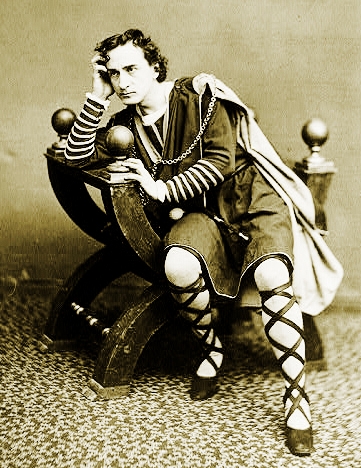
Above, Edwin Booth as the Melancholy Dane, ca. 1870.
Related article: Comedy versus opera
Comments Off on Der travestirte Hamlet
Filed under Classic era, Curiosities, Dramatic arts, Humor, Literature
Musical marksmanship
“Playing the piano with a rifle” in The Strand magazine 28 (December 1904, pp. 580–8) describes a performance by Colonel Gaston Bordeverry, who learned the intermezzo from Mascagni’s Cavalleria rusticana by ear and, having devised a system of bull’s-eyes to indicate the correct notes on a specially-built piano, performed the tune by firing 66 shots at the instrument with a rifle. The specially-made bullets were powderless and noiseless when they struck, which they did with enough force to pierce through a one–inch-thick plank.
Colonel Bordeverry and his daughter were variety show performers in the early twentieth century; his performance of the intermezzo was one of their most successful numbers. The article was reprinted as “Not the usual performance practice” in the American Musical Instrument Society newsletter 32/1 (Spring 2003, pp. 12–13, 16).
Comments Off on Musical marksmanship
Filed under Curiosities, Dramatic arts, Performance practice
Operas as graphic novels
With their dramatic action and vivid characters, operas have inspired a number of graphic novels, including books by P. Craig Russell and a series (now out of print) produced in collaboration with England’s Royal Opera House. The most noteworthy examples of this genre are not just illustrations of libretti; they are autonomous works of art in the graphic novel tradition.
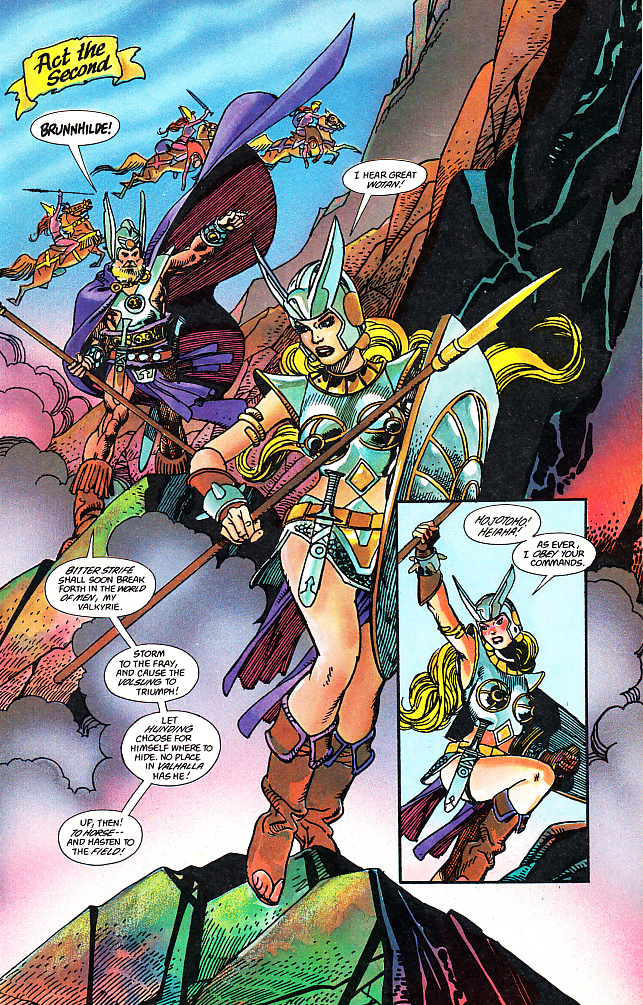
Wagner’s Der Ring des Nibelungen is particularly suited to the treatment it receives in The ring of the Niebelung by Roy Thomas and Gil Kane; set in a mythological time, with illustrious characters who can alter their physical forms, defy gravity, and survive without oxygen, it fits naturally into the medium’s world of fantasy and superheroes.
In some cases this drammata in pittura brings a powerful new dimension to Wagner’s drammata in musica—for example, the action that the audience must imagine during the Vorspiel of Die Walküre is fully depicted over the course of four textless pages. The cycle was first published in four installments by DC Comics.
Above, the opening of Act II of Die Walküre (click to enlarge); below, part of the 2011 production by the Metropolitan Opera.
Related article: The Ring recast
Comments Off on Operas as graphic novels
Filed under Dramatic arts, Opera, Publication types, Romantic era, Visual art