The beloved author and illustrator Maurice Sendak, who died yesterday, was deeply influenced by Western classical music, particularly by the works of Mozart.
“Art has always been my salvation,” he said in an interview, “and my gods are Herman Melville, Emily Dickinson, and Mozart. I believe in them with all my heart. And when Mozart is playing in my room, I am in conjunction with something I can’t explain. I don’t need to. I know that if there’s a purpose for life, it was for me to hear Mozart.”
Below, the full interview with Bill Moyers in 2004.
When Mendelssohn Bartholdy was 13 a family trip to Switzerland afforded his first opportunity to devote himself to drawing; subsequently a sketch book was always an indispensable part of his holiday luggage.
Soon the prodigy’s musical career precluded other artistic activities, but after the death of his beloved sister Fanny when he was 38 he returned to Switzerland and completed a remarkable series of watercolors. These were among his final creative activities; he died in November of that year.
This according to the preface by Margaret Crum for Felix Mendelssohn Bartholdy (Oxford: Bodleian Library, 1972), which reproduces items from the Bodleian Library’s collection.
Above, Mendelssohn Bartholdy’s depiction of Lucerne in July 1847; below, Piero Bellugi conducts the final movements of his sixth string symphony, written around the time he first started drawing.
The music philatelist S. Sankaranarayanan has produced monthly articles for the magazine Sruti almost without a break since April 2004.
Each article covers the issuance of a stamp (or group of stamps) by the Indian Department of Posts and includes a philatelic report along with a first day cover and background information on the stamp’s subject—these have included exponents of the Karnatak and Hindustani traditions as well as Indian folk musicians, dancers, musicologists, and patrons of the arts.
Above, a first day cover of a 1961 stamp honoring the Karnatak composer Tyāgarāja (1767–1847); Sankaranarayanan’s article about this stamp appeared in Sruti 269 (February 2007), pp. 40–41.
The article, which can be read online here, was published in American entomologist (L/3 [fall 2004] pp. 142–151). It is part of a larger project called Insects in rock ’n’ roll music, which also includes lists of insect-related songs, albums, and artist names.
Astérix le Gaulois, a series of comics written by René Goscinny and illustrated by Albert Uderzo between 1960 and 1999, received much acclaim for the attention to detail in Uderzo’s drawings of ancient civilizations.
Particularly interesting to an organologist are the illustrations of instruments—including carnyx, buccina, lur, bagpipe, harp, lyre, pipes, and drums—used by ancient Romans, Greeks, Egyptians, and Gauls.
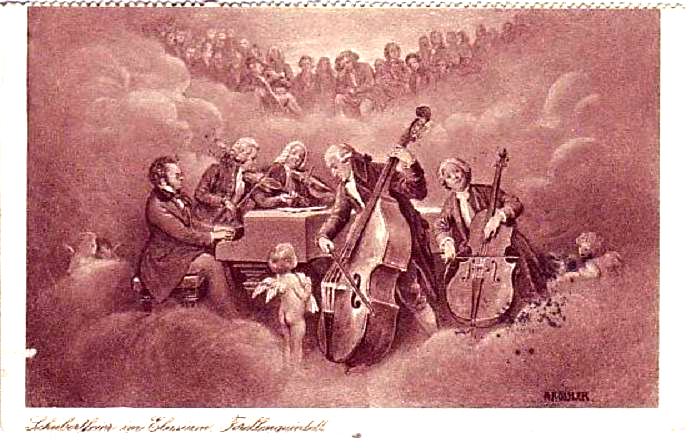
Schubert deltiography, a database produced by The Schubert Institute as part of its Schubert ographies website, is an open-access online resource for postcards bearing images relevant to Schubert—portraits, buildings, and so on. In addition to reproductions of both sides of the cards, entries include detailed annotations for deltiologists and other interested parties.
Above, a postcard depicting Schubert playing the “trout” quintet (piano quintet in A Major, D. 667) with Mozart, Haydn, Bach, and Gluck in Heaven (click to enlarge). The audience includes Beethoven and Wagner; leave a comment if you can identify others!
SPIN: Study Platform on Interlocking Nationalisms, a free online resource dedicated to the study of the Romantic period in Western culture, includes a database devoted to iconography on banknotes, with a special section for composers. As of this writing 33 portraits of composers on banknotes are documented therein, all with full-color reproductions and many with annotations as well.
Above, Clara Schumann on a German 100-mark note issued in 1989. Below, Antonín Dvořák assissts with instructions for banknote origami.
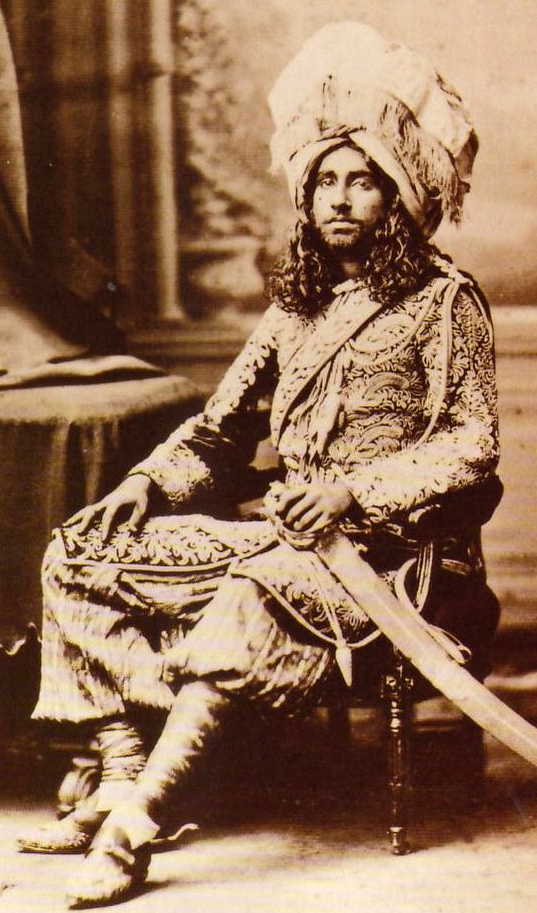
In 1882 Sadiq Muhammad Khan Abbasi IV, Nawāb of Bahawalpur, anonymously commissioned a bed in rosewood covered with about a third of a ton of chased and engraved sterling silver from La Maison Christofle in Paris. The bedposts were four life-size automatons, nude (though bewigged) female figures representing European types, powered by four crank-wound spring mechanisms in their pedestals.
Wires ran from these springs to a music box under the bed. Downward pressure on the center of the mattress activated the music box and caused the bedpost-women to begin shifting their eyes and fanning and whisking in time to the music (an unidentified excerpt from Gounod’s Faust). The performance lasted 30 minutes. A watercolor and several photos taken in 1882 for the Christofle firm are the only evidence of the bed, whose present whereabouts are unknown.
This according to “Asleep with painted ladies” by Carl A. Skoggard (Nest X [2000] pp. 100–105). Below, “Oh Dieu! Que de bijoux” (Jewel song), an aptly themed candidate for the Faust excerpt in question.
Porträtsammlung Friedrich Nicolas Manskopf is a free online resource that presents portraits drawn from the collection of the Frankfurt wine dealer Friedrich Nicolas Manskopf (1869–1928) of composers, instrumentalists, singers, actors, directors, playwrights, and dancers, along with stage scene stills, views of buildings, and allegorical pictures of music and stage situations.
Comprising about 12,500 photographs from 1860 to 1944 and 4900 printed graphics from about 1550 to 1920, the collection is indexed by person, ensemble, or building; by persons involved as photographers, engravers, or lithographers; and by the publishing years of photos and prints.
A general search field enables the search of professions, roles, playwrights, titles, years, and technique of the portraits; a combined search is possible using the Bibliotheksportal at the hosting institution, the Universität Frankfurt am Main. Higher-resolution copies of the images may be ordered for a fee.
Above, a publicity photograph from the collection of the the legendary trio of Alfred Cortot, Jacques Thibaud, and Pablo Casals; below, the trio plays the first movement of Schubert’s piano trio in B flat, op. 99, D.898, in 1926.
According to its author, Markus von Hänsel-Hohenhausen, Vom Sichtbaren zur Wirklichkeit: Das wahre Antlitz Johann Sebastian Bachs (Frankfurt am Main: Frankfurter Verlagsgruppe, 2009) raises fundamental questions relating to image theory, considering the power of the image, the possibility of accessing reality through subjectivity (that is, the objectivity that arises from a dual subjectivity), the rendering of real “presence” by means of technically accurate representation, and the physicality (and noticeable absence of spirit) that results from the application of technical methods alone, e.g., in the case of Andy Warhol’s work.
Beginning with reflections on the royal portrait, Christian ritual, and Jesus Christ’s crown of thorns, the book then delivers a clear statement about the significance of portraits of Bach, at the same time offering therein an answer to the question: Does a person really have a true countenance?
Above, the reconstruction with the 1746 portrait by Elias Gottlob Haußmann, the only portrait Bach is known to have sat for.
The Indian singer Jayashri Ramnath (better known as Bombay Jayashri) was introduced to Karnatak music in her early childhood, influenced by her parents’ roles as music teachers. Jayashri began her performing career at the age of 28, and having grown … Continue reading →
The country singer, songwriter, actor, and businesswoman Dolly Parton was the fourth of twelve children in a family of sharecroppers in Sevierville, Tennessee, located in the Appalachian Mountains. Commenting on her childhood, Parton once said, “Everybody where we grew up … Continue reading →
Women have been part of hip hop expression from its early days, primarily as part of MC crews such as the Funky Four Plus One and Sugar Hill’s female group, Sequence. For most of hip hop’s recorded history, however, women … Continue reading →
The music of Central America tends to borrow heavily from the music of Mexico to the north, Colombia to the south, and the Caribbean Islands to the east, and, in the case of Nicaragua, from the politically motivated nueva canción … Continue reading →