Ricordi’s Disposizioni sceniche (1856–93) reflect the nineteenth-century concept of definitive operatic stagings. These manuals describe the scenery of each opera through plans and diagrams, and outline the entrances, exits, gestures, movements, and positions of the characters; they also provide a list of stage accessories. In most cases, the date and location of the described performance are indicated on the title page.
This practice was continued by the Casa Musicale Sonzogno, which issued seven Messe in scena manuals between 1894 and 1922; the Italian market for them dried up in the 1920s, when the concept of an ideal performance as a reproducible model waned and directorial creativity was increasingly valued.
This according to “The Messa in scena of the Casa Musicale Sonzogno: An iconography of stage direction at the end of the nineteenth century” by Laura Citti (Music in art XXXIV/1–2, pp. 245–253). Above, a sketch made for the Società degli Scenografi della Scala e del Teatro Lirico Internazionale for the Café Momus scene in Leoncavallo’s La bohème; inset, a page from Sonzogno’s Messa in scena for Massenet’s Manon (click to enlarge).
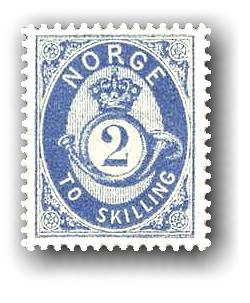
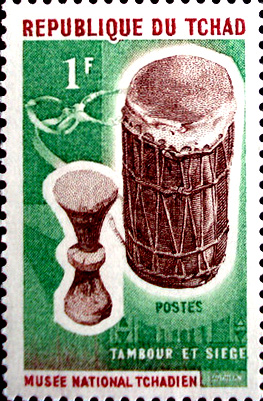
Music philately began with the issuance of some of the very first postage stamps in the mid-nineteenth century: The inaugural issues of several European countries included images of post horns. Purists may argue that post horns were mere signaling devices, but at that time they were already being used in classical compositions, so their depictions may be considered musical images.
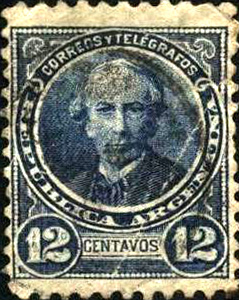
Other nineteenth-century stamps featured depictions of prominent political figures who were also musicians—for example, Argentina issued a stamp honoring the statesman and composer Juan Bautista Alberdi in 1888 (left)—but they were concerned with politics rather than music. The first explicitly musical stamp was Poland’s issuance honoring Ignacy Jan Paderewski in 1919.
Through the 1950s countries increasingly celebrated Western classical musicians and composers. In the 1960s all aspects of musical life became potential subjects—institutions, festivals, instruments, dancers, and so on—and non-European countries asserted their national identities with images of their own traditional and historical music cultures. In the later twentieth century images of popular and jazz musicians gained increasing demand .
This according to A checklist of postage stamps about music by Johann A. Norstedt (London: Philatelic Music Circle, 1997), which lists some 14,000 stamps with music-related images.
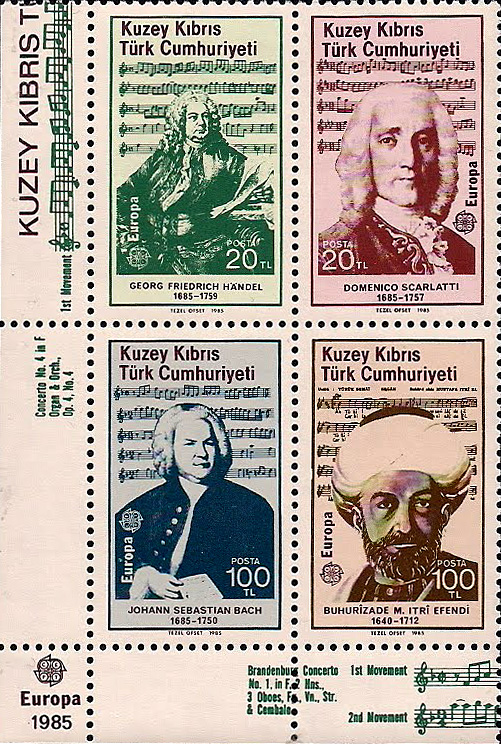
Above, stamps issued in Northern Cyprus in 1985, which was designated European Music Year by the Europa Federation (click images to enlarge). Below, a curious video about Robert Burns iconography.
Unbeknownst to most of his admirers, Woodrow Wilson “Woody” Guthrie (1912–67)—who is widely known as the author of some of the best-loved songs of the twentieth century (including This land is your land) and as the inspiration for singer-songwriters including Bob Dylan and Bruce Springsteen—was also an indefatigable visual artist.
No documentation exists of Guthrie ever having formally studied art, but he produced thousands of visual art works: line drawings, paintings, illustrations, cartoons, portraits, sculptures, commercial art, and designs. He was keenly interested in the impressionists and the modernists, and worked with abstract as well as figurative themes.
Guthrie filled countless notebooks and journals with drawings and writings, often mixing the two, and at various times in his life he traded his sign-painting skills for food and traded sketches of bar patrons for drinks. He often used art as a political vehicle, particularly by drawing political cartoons. Like his music, his visual art was inspired by the everyday experiences of everyday people.
Guthrie’s visual art is documented with over 300 plates, almost all in full color—even for many of the line drawings, thereby capturing the ambience of blue-lined notebooks, yellowing journals, and decaying construction paper—in Woody Guthrie: Art works (New York: Rizzoli, 2005). Above, Dream (click to enlarge).
Le ballet de la nuit, a major ballet de cour, was organized by Louis Cauchon d’Hesselin and first performed in the Louvre’s Salle du Petit Bourbon in 1653. The event was notable for many reasons—not least, for the involvement of the young Louis XIV, who danced in five roles, including his most famous role as the Sun King, accompanied by chosen courtiers and professional dancers, singers, and acrobats.
Edited by Michael Burden and Jennifer Thorp, Ballet de la nuit: Rothschild B1.16.6 (Hillsdale: Pendragon Press, 2009) focuses on the exquisitely produced volume presented to d’Hesselin (who also performed in the work), which passed into the hands of the Rothschild family at Waddesdon Manor and is now in the ownership of the National Trust.
The book presents a full facsimile of the Waddesdon source along with the printed vers pour les personages, lists of performers, cues for special effects, the running order of the entrées, and essays by Burden, Thorp, Catherine Massip, and David Parrott that discuss cultural patronage at the Court of Louis XIV, the musical context, dances and dancers, and the costumes and scenography of this unique and extraordinary ballet. Also included is a modern edition of the surviving music prepared by Lionel Sawkins.
Above, an illustration from the book (click to enlarge); below, Lully’s overture.
In 1833 Sophy Horsley, a well-heeled British teenager, wrote to her aunt “Mendelssohn took my album with him the night of our glee-party, but you have no idea how many names he has got me.” Over the following years Horsley and Mendelssohn Bartholdy, who was a family friend, collected musical works, illustrations, and autographs in a 144-page album measuring 1⅞ by 1¼ inches.
This according to “Sophy’s album” by Anne C. Bromer and Julian I. Edison, an article included in Miniature books: 4,000 years of tiny treasures (New York: Abrams, 2007); the book was published in conjunction with an exhibition at The Grolier Club, New York City, from 15 May through 28 July 2007. Many thanks to James Melo for bringing it to our attention!
Below, Rahmaninov plays his transcription of Mendelssohn-Bartholdy’s “Scherzo” from his incidental music for A midsummer night’s dream, written when the composer was a teenager himself.
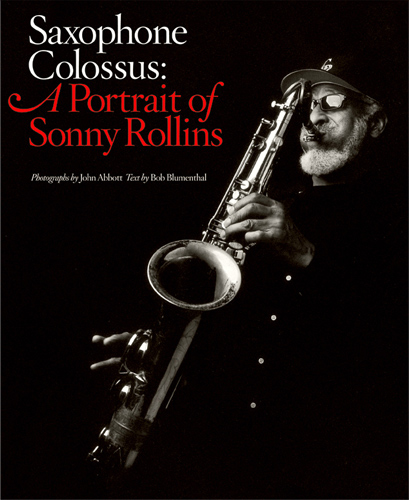
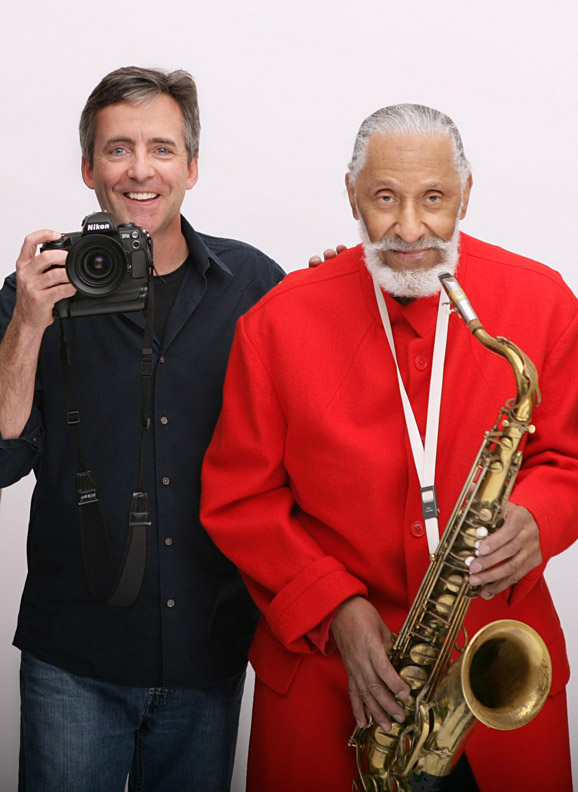
Throughout his career, John Abbott’s award-winning images of jazz have been featured on over 250 album and magazine covers; he has been the primary cover photographer for JazzTimes magazine since 2002.
With his background as a professional jazz guitarist and his MFA in painting, Ken Butler had a long-standing interest in combining his two passions, but he couldn’t find the right connection. Then one night an axe in his basement caught his eye.
In about an hour and a half he had added a bridge, strings, and a contact microphone to the axe. As he describes it, “Suddenly the world opened up to me in terms of “That’s a cello. That’s a violin.’”
Since that night Butler has built hundreds of hybrid instruments, which he describes as “anxious objects”. While all of them can be played, he considers most of them to be primarily collage sculptures; but some of them sound good enough that he considers them real instruments, and performs on them. His raw materials have included a toy Uzi, a motorcycle manifold, and parts of discarded mannequins (inset).
Along with its wide-ranging discussions of theoretical topics, the 1650 treatise Musurgia universalisby the German Jesuit polymath Athanasius Kircher (1602–1680) includes what may be the first transcriptions of bird songs.
The illustration gives the nightingale’s song followed by those of the chicken, the cuckoo, the quail, and the parrot; the latter says χαίρε (“hello”). Vox cuculi is notated as the familiar falling minor third heard in cuckoo clocks (see below).
A facsimile edition of the treatise has been issued by Georg Olms (Hildesheim, 1970; reprinted 2006).
Built at the behest of Richard Beauchamp, 13th Earl of Warwick (1382–1439), the Beauchamp Chapel at the Collegiate Church of St Mary, Warwick, is a remarkable survival of fifteenth-century architecture, sculpture, and—above all—stained glass. These windows are well known to organologists for their depictions of instruments and performance practice; they also provide useful information about chant and polyphony in fifteenth-century England by preserving fragments of neumatic notation.
Over the centuries craftspeople have restored damaged windows, and, lacking the requisite musical training, they often left replacement staves blank; but in two cases nonsense neumes were devised, supplying consistent-looking décor that most observers would never suspect was counterfeit.
The Indian singer Jayashri Ramnath (better known as Bombay Jayashri) was introduced to Karnatak music in her early childhood, influenced by her parents’ roles as music teachers. Jayashri began her performing career at the age of 28, and having grown … Continue reading →
The country singer, songwriter, actor, and businesswoman Dolly Parton was the fourth of twelve children in a family of sharecroppers in Sevierville, Tennessee, located in the Appalachian Mountains. Commenting on her childhood, Parton once said, “Everybody where we grew up … Continue reading →
Women have been part of hip hop expression from its early days, primarily as part of MC crews such as the Funky Four Plus One and Sugar Hill’s female group, Sequence. For most of hip hop’s recorded history, however, women … Continue reading →
The music of Central America tends to borrow heavily from the music of Mexico to the north, Colombia to the south, and the Caribbean Islands to the east, and, in the case of Nicaragua, from the politically motivated nueva canción … Continue reading →