The music philatelist S. Sankaranarayanan has produced monthly articles for the magazine Sruti almost without a break since April 2004.
Each article covers the issuance of a stamp (or group of stamps) by the Indian Department of Posts and includes a philatelic report along with a first day cover and background information on the stamp’s subject—these have included exponents of the Karnatak and Hindustani traditions as well as Indian folk musicians, dancers, musicologists, and patrons of the arts.
Above, a first day cover of a 1961 stamp honoring the Karnatak composer Tyāgarāja (1767–1847); Sankaranarayanan’s article about this stamp appeared in Sruti 269 (February 2007), pp. 40–41.
On 31 March 31 1990, in the early days of the newly restored democracy in Chile, the Cuban cantautorSilvio Rodríguez staged a concert in Santiago de Chile’s Estadio Nacional for an audience of 80,000 people. Accompanying him were the fourteen-piece band Irakere, led by the Cuban jazz pianist Chucho Valdés, and the formerly exiled Chilean singer Isabel Parra and her group.
While it is entirely possible to see the concert as an event whose event-ness is created post facto, it is also useful to posit the concert as part of a construction of a larger process, that of opposition to the event of authoritarianism.
Two songs performed there, Víctor Jara’s Te recuerdo Amanda and Rodríguez’s Unicornio, involve evocations of death and disappearance. Death, as evoked in the Jara song, at least bears the comfort of a tangible end image; disappearance, as Unicornio bears witness, denies closure.
The afterlife of these recorded concert performances and the subjects of cover versions and tributes all contribute to the counter-event suggested by the Rodríguez concert.
Patti Smith’s direct assimilation of Arthur Rimbaud’s work into hers presents a case of cultural cross-fertilization in which the poetry of a foreign high-cultural figure enters into and influences a popular and countercultural discourse, illustrating how a nonacademic reading of a canonical text can help to produce a musical style that disseminates a message of social deviance.
Smith has foregrounded her debt to Rimbaud in several ways, explicitly referring to him as her major poetic influence and participating in a hermeneutic activity as she transformed his texts into her own. The poet has served as Smith’s most credible archetype of subversive behavior, and his work has provided the richest source for the development of her innovative aesthetic practices.
This according to “Rimbaud and Patti Smith: Style as social deviance” by Carrie Jaurès Noland (Critical inquiry XXI/3 [Spring 1995] pp. 581–610). Below, Smith performs Rock n roll nigger, one of the songs analyzed by Noland, in 2011; listen for Rimbaud’s name around 3:20.
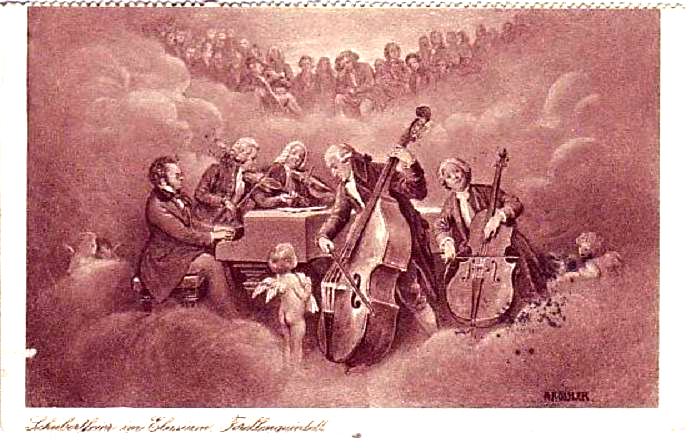
Schubert deltiography, a database produced by The Schubert Institute as part of its Schubert ographies website, is an open-access online resource for postcards bearing images relevant to Schubert—portraits, buildings, and so on. In addition to reproductions of both sides of the cards, entries include detailed annotations for deltiologists and other interested parties.
Above, a postcard depicting Schubert playing the “trout” quintet (piano quintet in A Major, D. 667) with Mozart, Haydn, Bach, and Gluck in Heaven (click to enlarge). The audience includes Beethoven and Wagner; leave a comment if you can identify others!
SPIN: Study Platform on Interlocking Nationalisms, a free online resource dedicated to the study of the Romantic period in Western culture, includes a database devoted to iconography on banknotes, with a special section for composers. As of this writing 33 portraits of composers on banknotes are documented therein, all with full-color reproductions and many with annotations as well.
Above, Clara Schumann on a German 100-mark note issued in 1989. Below, Antonín Dvořák assissts with instructions for banknote origami.
A pair of brief unattributed articles appeared in the July 1901 issue of American musician to articulate opposing viewpoints on ragtime, which had become increasingly popular since the late 19th century.
War on ragtime denounced the genre in no uncertain terms: “The ragtime craze has lowered the standards of American music as compared with other countries…we will not give way to a popular demand that is degrading.”
Suppression of ragtime expressed a more lighthearted view:
“Last week a national association of musicians in convention at Denver solemnly swore to play no ragtime, and to do all in their power to counteract the pernicious influence exerted by Mr. Johnson, My ragtime lady, and others of the Negro school…
“But the people do not want to be educated all the time…Their great desire with music is to be pleased—to forget for a time that there is anything in this world but sunshine and laughter, and birds and flowers and purling brooks.
“And they find all those things in the homely and catchy pieces that quicken the heart-beats and make the nerves tingle with delight; yes, in ragtime, bubbling, frothing, sparkling; as light as a summer breeze and as sweet as woman’s kiss.”
This courtesy of “War on ragtime and Suppression of ragtime” in From jubilee to hip hop: Readings in African American music, edited by Kip Lornell (Upper Saddle River: Prentice-Hall, 2010), pp. 23–25. Below, Jelly Roll Morton plays the ragtime classic Shreveport stomp via piano roll.
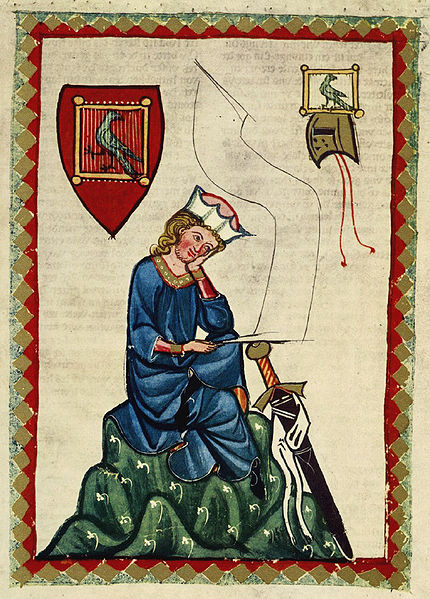
Recent interchanges between medieval music and heavy metal open new perspectives on historically informed practice. A comparison of recordings of Walther von der Vogelweide’s Palästinalied by Thomas Binkley, Paul Hillier, and In Extremo illuminates how historic orientation and its inherent sense influence performance aesthetics.
This according to “Gothic und HIP: Sinn und Präsenz in populären und in historisch informierten Realisierungen des Palästinalieds” by Konstantin Voigt (Basler Jahrbuch für historische Musikpraxis XXXII [2008] pp. 221–234). Above, a portrait of the great Minnesinger; below, In Extremo’s historically informed rendition of Walther’s celebrated work about the Crusades.
The first volume, Collectionner la musique: Histoires d’une passion seeks to define music collecting in all its forms through profiles of some of the great European collectors and analyses of outstanding collections dating from the 16th century to the present—including those of João IV of Portugal, Padre Martini, and Henry Prunières. Further volumes will be devoted to the musician as collector and the learned collector.
Comments Off on Collectionner la musique / Collecting music
Lady Gaga went from nowhere to everywhere in just 18 months due to many factors—not least, to her unprecedented and canny use of social networking.
Gaga used Internet tools to craft her personal mythology, and continues to use them to keep in constant contact with her fans. She has millions of Twitter followers, and is the first musician ever to garner one billion hits on YouTube, where she uploads her videos for free.
This according to Poker face: The rise and rise of Lady Gaga by Maureen Callahan (New York: Hyperion, 2010). Below, the 2008 video that inspired the book’s title.
The “Idol” television format has gone global, and since 2004 an Indian version has featured amateur singers of popular Indian film songs. Seeing this, the producer Subhashree Thanikachalam (left)—who had already pioneered three successful television series focused on Indian music—decided to try a version presenting young performers in the classical South Indian tradition.
The result, Carnatic Music Idol, has run for two highly successful seasons and is preparing a third one. The series has done much to raise awareness of the tradition and to help viewers to understand the technical intracacies of its performance. The final rounds even call for a full rāgam-tānam-pallavi, a tour de force that was formerly considered too esoteric for general audiences.
This according to “An idol among TV shows” by Gayathri Sundaresan (Sruti 321 [June 2011] pp. 55–58. Below, excerpts from the 2011 finals.
The Indian singer Jayashri Ramnath (better known as Bombay Jayashri) was introduced to Karnatak music in her early childhood, influenced by her parents’ roles as music teachers. Jayashri began her performing career at the age of 28, and having grown … Continue reading →
The country singer, songwriter, actor, and businesswoman Dolly Parton was the fourth of twelve children in a family of sharecroppers in Sevierville, Tennessee, located in the Appalachian Mountains. Commenting on her childhood, Parton once said, “Everybody where we grew up … Continue reading →
Women have been part of hip hop expression from its early days, primarily as part of MC crews such as the Funky Four Plus One and Sugar Hill’s female group, Sequence. For most of hip hop’s recorded history, however, women … Continue reading →
The music of Central America tends to borrow heavily from the music of Mexico to the north, Colombia to the south, and the Caribbean Islands to the east, and, in the case of Nicaragua, from the politically motivated nueva canción … Continue reading →