Category Archives: Curiosities

Franck and Rodin

rodin-franck

Both César Franck and Auguste Rodin belonged to the Symbolist movement of the late 19th century, with its sacred ideal and interest in phenomena of metamorphosis.

They also shared the same mythical view of woman and the same sensuality, with its consequent risk of damnation. Both are highly representative figures of their period, although they seldom made use of an aesthetic that verged on the modern.

This according to “Auguste Rodin (1840–1917) et César Franck  (1822–1890): Essai d’une étude comparée” by François Sabatier, an essay included in César Franck et son temps (Revue belge de musicologie/Belgisch tijdschrift voor muziekwetenschap XLV [1991] pp. 77–84).

While there is only circumstantial evidence that Franck and Rodin met, upon the former’s death the latter was commissioned to produce the commemorative medallion shown above.

Today is Franck’s 190th birthday! Below, Renée Fleming sings the “Panis angelicus” from Franck’s Messe à trois voix, op. 12.

Related articles:


1 Comment

Filed under Curiosities, Iconography, Romantic era, Visual art

Louie Louie and the FBI


Written by the Louisiana-born Richard Berry, Louie Louie was inspired by his hearing a Latino-Californian band performing a song with the soon-to-be iconic rhythm. Berry married the rhythm to an R&B-calypso fusion and composed lyrics from the perspective of a lonely Jamaican sailor.

Scoring a regional hit in 1957 with the original recording, the song was picked up—and amped up—by bands in the thriving garlouie louieage rock scene of the Pacific Northwest. Newly recorded versions included one by the Washington-based band The Kingsmen (1963), which rose to number two on the national charts.

The oddity of the left-field hit was exceeded only by the oddity of the nation’s response to it. Recording in only one take, the Kingsmen transformed Louie Louie from a laid-back calypso into a raucous frat anthem with a monomaniacal emphasis on the ten-note riff and a slurred, indecipherable vocal performance.

A two-year investigation by the FBI centered on the alleged obscenity of the lyrics but ultimately determined the song “unintelligible at any speed” in a 250-page report. Louie Louie made its way from being just another one-off novelty hit to a source of cultural anxiety, sexual fantasy, inspiration for hundreds of cover versions, and touchstone for both punk rockers and nostalgic baby boomers.

This according to “Louie Louie: The history and mythology of the world’s most famous rock’n’roll song” by Dave Marsh (New York: Hyperion, 1993). Below, a live performance from 1965.

Related articles:


Comments Off on Louie Louie and the FBI

Filed under Curiosities, Popular music

Stravinsky and recording


Even before he signed a contract with the Columbia Gramophone Company in 1928, Stravinsky was firmly convinced of the importance of documenting his performance wishes through recording; in the early 1920s he was already making piano rolls for the Pleyel firm.

In a brief 1930 essay originally published in German—“Meine Stellung zur Schallplatte” (Kultur und Schallplatte 1 [March 1930] p. 65)—he even anticipated a compositional development that would be facilitated more than a decade later with the advent of magnetic tape:

“It would be of the greatest interest to create music specifically for the phonograph, a music whose true image—its original sound—could only be preserved through mechanical reproduction. This would well be the ultimate goal for the phonographic composers of the future.”

The article is reproduced in an English translation in Music, sound, and technology in America: A documentary history of early phonograph, cinema, and radio (Durham: Duke University Press, 2012). Below, Stravinsky in a 1955 Columbia Records recording session.

Related articles:


5 Comments

Filed under 20th- and 21st-century music, Curiosities

Poisoning Lully

As one of the most powerful nonpolitical figures at Louis XIV’s court, Lully was far from immune to its culture of intrigue.

Henri Guichard, a perpetrator of various frauds and a rival at the court, hatched a plot to poison Lully in 1674, and approached a corrupt police officer, Sébastien Aubry, who had access to the Opéra and often saw Lully there. The unfolding of the plot, which involved a poisoned snuff box, had a strong element of farce as Aubry ineptly attempted to play both ends against the middle, jockeying for his own best interests while appearing to assist Guichard.

Eventually a mutual associate tipped off the composer, who formally accused Aubry of conspiracy to commit murder. Guichard exercised what influence he could, but Lully, as a close associate of the king himself, had the upper hand. In the end, the composer was able to delay the case until the only two dissenting judges finished their terms of duty.

This according to Jean-Baptiste Lully by Ralph Henry Forster Scott (London: Owen, 1973, pp. 76–83).

Today is Lully’s 380th birthday! Below, Boris Terral portrays the composer in Gérard Corbiau’s Le roi danse (2000).

Related article: Comedy versus opera

1 Comment

Filed under Baroque era, Curiosities

Gramophone ethics

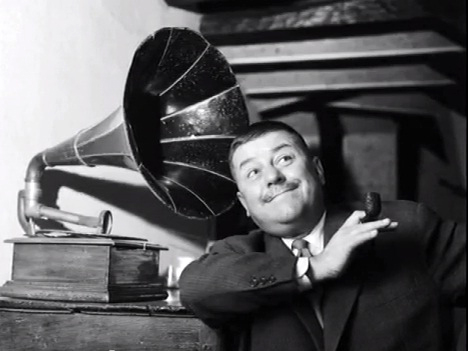
With outward horror, but with secret envy, let us contemplate a man who is wealthy, unambitious, and unencumbered. After breakfast he lights a cigar, sinks into an armchair, and rings for the butler to set the gramophone going.

While one’s imagination may boggle at the thought, let us free ourselves from such trammels of convention that would confine the gramophone to the first half hour of after-dinner plethora. There is music to be had for all times and seasons.

Further, a convincing argument cannot be made against listening to the gramophone alone: If one may read a book without company, how can enjoying music in solitude be indecent?

This according to “Times and seasons” by Orlo Williams (Gramophone June 1923, pp. 38–39), an article reprinted in Music, sound, and technology in America: A documentary history of early phonograph, cinema, and radio (Durham: Duke University Press, 2012). Below, a gramophone record issued a few months after the article appeared.

1 Comment

Filed under Curiosities, Reception

Violins and fungi

In the late 17th and early 18th century the great violin maker Antonio Stradivari used a special wood that had grown in the cold period between 1645 and 1715. In the long winters and the cool summers, the wood grew especially slowly and evenly, creating low density and a high modulus of elasticity. Until now, modern violin makers could only dream of wood with such tonal qualities.

Similar wood can now be made available for violin making. The fungus species Physisporinus vitreus and Xylaria longipes can decay Norway spruce and sycamore—two important kinds of wood used for violin making—to such an extent that their tonal quality is improved. Unlike other fungus species, they gradually degrade the cell walls, inducing thinning; but even in the late stages of decomposition a stiff scaffold structure remains through which the sound waves can still travel directly.

The implementation of such biotechnological methods for treating soundboard wood could make it possible one day for violinists to afford instruments with the sound quality of a Stradivari.

This according to “Production of superior wood for violins by use of wood decay fungi” by Francis W.M.R. Schwarze, et al. (Journal of the Violin Society of America XXII/1 [2009] pp. 116-124). Above, a Stradivarius at the Palacio Real de Madrid. Below, a brief documentary on the process described by Schwarze.

Comments Off on Violins and fungi

Filed under Curiosities, Instruments, Science

Gnawa jazz

The Gnawa ma’llem (spirit master) Abdellah El-Gourd and the African American jazz pianist Randy Weston met in El-Gourd’s native Tangier in the early 1970s; over the next 30 years their interactions transformed their lives.

They recognized a common thread in slavery, as the Gnawa were originally sub-Saharan peoples who were mainly brought to Morocco as slaves. The two men collaborated musically, and Weston’s music was deeply influenced by the experience.

For El-Gourd, the great figures in jazz—both historical and contemporary—became symbolic ancestors; their portraits hang in his home next to those of Gnawa elders. Also due to his Western encounters, El-Gourd realized the importance of documenting his local layla tradition, a project that possesses him in a way that may be compared to the spirit possession of the layla ceremony itself, and which resonates with the way that Gnawa music has possessed and is possessed by the West.

This according to “Possessing Gnawa culture: Displaying sound, creating history in an unofficial museum” by Deborah Kapchan (Music & anthropology: Journal of musical anthropology of the Mediterranean 7 [2002]). Below, a brief interview with El-Gourd.

Related articles:

2 Comments

Filed under Curiosities, Jazz and blues

Dylan and devotion


Small talk at the wall, a Yahoo! Group honoring Bob Dylan, has established a weekly hoot night—a chat room where Dylan’s songs are performed by its members.

These hoot nights can be read into a foreground of medieval representational devotion, due to the structure that consists of canonical texts with which the audience can identify itself. The hoot nights become an example of the transformation of medieval rituals into art.

This according to “Music practices around Bob Dylan, medieval rituals, and modernity” by Nils Holger Petersen, an essay included in The cultural heritage of medieval rituals: Genre and ritual (Transfiguration: Nordisk tidsskrift for kunst og kristendom V/1–2 [2003] pp. 321–330). Below, Weird Al” Yankovic demonstrates his devotion to Dylan.

Related article: The Caffè Lena Collection

2 Comments

Filed under Curiosities, Popular music, Reception

Farinelli’s physical fitness

Today, on the 230th anniversary of the death of virtuoso castrato Farinelli (1705–82), let’s make a pilgrimage to his grave, as did the authors of a study that involved exhuming him to gain insight into his biological profile.

Born Carlo Broschi, Farinelli was castrated before puberty to preserve the treble pitch of the boy’s voice into adult life, and his powerful and sweet voice became legendary. His skeleton displayed some characteristics that are probably related to the effects of castration, including long limb-bones, persistence of epiphyseal lines, and osteoporosis.

In particular, the frontal bone was affected by severe hyperostosis frontalis interna (HFI), a symmetrical thickening of the inner table of the bone. HFI is relatively common in postmenopausal women but very rare in men. In the case of Farinelli, castration was probably responsible for the onset and development of this condition.

This according to “Hyperostosis frontalis interna (HFI) and castration: The case of the famous singer Farinelli (1705–1782)” by Maria Giovanna Belcastro, Antonio Todero, Gino Fornaciari, and Valentina Mariotti (Journal of anatomy CCXIX/5 [November 2011] pp. 632–37).

Above, a portrait of Farinelli by Corrado Giaquinto; below, an excerpt from the 1994 biopic by Gérard Corbiau.


Related articles:


Comments Off on Farinelli’s physical fitness

Filed under Baroque era, Curiosities, Science

Basse danse with attitude II

The letters of Andrea Calmo, a 16th-century Venetian actor and playwright who wrote of having been taught the bassadanza by wolves, highlight how dance was regarded by a member of the middle classes in Venice.

As well as having a general appreciation of dance, which he saw as an enjoyable and moral activity, Calmo was knowledgeable about dance specifics and accurate in his use of dance terminology; in fact, his knowledge of dance practices was extensive enough to enable him to use specific dance references as a tool in creating the humor in his letters.

In a letter wooing a fine dancer, Calmo’s praises include the following:

“Now you can perform well the salti a torno, performing capriole, dancing on only one foot for half and hour, and moving the other foot so quickly it is as if your feet were tickling.”

“Alas, that to go behind, in front, those riprese, those clever steps and turns on joined feet, and all with mesura, with design and grace, in addition to the beautiful, grand, well-rounded and well-proportioned bosom.”

This according to “Learning the bassadanza from a wolf: Andrea Calmo and dance” by Jennifer Nevile (Dance research: The journal of the Society for Dance Research XXX/1 [2012] pp. 80–97). Above, Ball in Venice in Honor of Foreign Visitors, c.1580 (Italian School). Below, bassadanza with attitude!

Related article: Basse danse with attitude I

4 Comments

Filed under Curiosities, Dance, Humor, Performance practice, Renaissance