Category Archives: Curiosities

Glass harmonica horrors

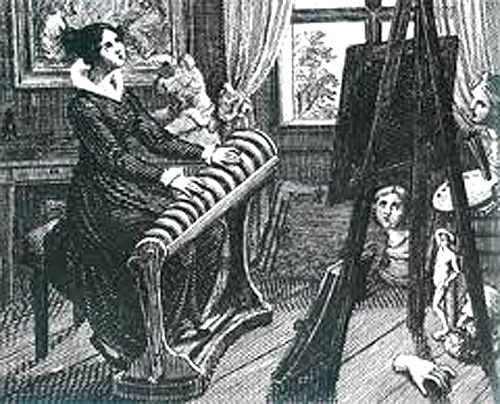
Although it was championed by the likes of Mozart and Benjamin Franklin, in its heyday the glass harmonica was also the object of considerable trepidation.

In the 18th century music was regarded by some as a form of nervous stimulation that could cause a range of maladies, and the glass harmonica was considered especially dangerous.

The glass harmonica player and composer Karl Leopold Röllig stated that the instrument could “make women faint, send a dog into convulsions, make a sleeping girl wake screaming through a chord of the diminished seventh, and even cause the death of one very young”, and physicians warned of possible ill effects including muscle tremors, prolonged shaking of the nerves, fainting, cramps, swelling, paralysis, and seeing ghosts.

This according to Bad vibrations: The history of the idea of music as cause of disease by James Kennaway (Farnham: Ashgate, 2012). Below, Thomas Bloch menaces us with Mozart’s adagio, K.617.

Comments Off on Glass harmonica horrors

Filed under Curiosities, Instruments, Science

Singing and safety

In a study investigating how singing while driving affects driver performance, 21 participants completed three trials of a simulated drive concurrently while performing a peripheral detection task (PDT); each trial was conducted either without music, with participants listening to music, or with participants singing along to music.

Results suggest that singing while driving alters driving performance and impairs hazard perception while at the same time increasing subjective mental workload. However, singing while driving does not appear to affect driving performance more than simply listening to music. Drivers’ efforts to compensate for the increased mental workload associated with singing and listening to music by slowing down appear to be insufficient, as evidenced by relative increases in PDT response times in these two conditions compared to baseline.

This according to “A simulator study of the effects of singing on driving performance” by Christina M. Rudin-Brown (inset), Genevieve M. Hughes, and Kristie L. Young (Accident analysis & prevention, 30 July 2012). Many thanks to the Improbable Research blog for bringing this study to our attention!

Related article: Expression Synthesis Project

1 Comment

Filed under Curiosities, Science

Jimi Hendrix’s asteroid prophecy

A timely prophecy remains hidden in the words of Jimi Hendrix—a connection between history and religions, linking the future with the past—that predicts the existence of an asteroid on course to impact the earth.

Hendrix was an authentic Afro-American Cherokee seer, the World Shaman who glimpsed a trajectory of extraterrestrial events already in place during his lifetime. The dominators have silenced the seers throughout the ages and retarded history by impeding humanity’s advance towards anti-asteroid technology.

In 1993 Microsoft co-founder Paul Allen, who acquired rights to a large collection of Hendrix memorabilia for the Experience Music Project in Seattle, loaned the Hendrix family a sum of money to finance a lawsuit against a Hendrix production company in Hollywood, thus facilitating the coverup of Hendrix’s asteroid prophecy.

This according to Rock prophecy: Sex and Jimi Hendrix in world religions—The original asteroid prediction and Microsoft connection by Michael Fairchild (Rochester: First Century, 1999). Below, Hendrix’s If 6 was 9—a song closely connected with the prophecy.

1 Comment

Filed under Curiosities, Popular music

DayDay MoeMoe’s boingboxes

David Moore (a.k.a. DayDay MoeMoe, a.k.a. Umburkus) is a musician, artist, furniture maker, and visionary hermit hidden away in a secretive corner of a haunted-looking house in the fading Delta cotton town of Rosedale, Mississippi.

The inquisitive, anarchic child of a family that once held considerable sway there, Moore now lives alone in a house covered in vines and filled with his own artwork alongside untold numbers of sweetly unnerving semicollectibles, a trusty dog, and myriad musical instruments and furniture of his own invention, including his signature schizoid zither, a.k.a. buzzstick,  a.k.a. boingbox. The music that he plays with them is unique and unforgettable.

This according to “SoLost: Discovering a visionary hermit musician-artist” by Dave Anderson (Oxford American, 25 July 2012). Below, Umburkus discusses his oeuvre.

Related articles:

2 Comments

Filed under 20th- and 21st-century music, Curiosities, Instruments

Coloratura tuba

Much vocal music has been transcribed for tuba, but little is available for advanced-level players. Coloratura opera arias offer material that would be challenging for more experienced tubists, and these types of arias are much less text-dependent than other kinds of vocal music.

This according to Guidelines for transcribing coloratura opera arias for tuba, with transcriptions of three arias by Vivaldi, Gluck, and Delibes by Robert Lynn, a 2005 dissertation for Ball State University.

Above, a performance by TubaDiva (Jennifer Paradis-Hagar); below, Alessandro Fossi performs Musetta’s aria “Quando me’n vo” from Puccini’s La Bohème.

4 Comments

Filed under Curiosities, Instruments, Opera

Dhuns and dentistry


A 28-year-old woman urgently needed a tooth extraction, and local anesthesia was not an option.

The patient was offered all of the other anesthetizing options, but she chose music instead. A recording of a Rām dhun (Hindu devotional song for the deity Rāma) was played. The patient did not show any signs of pain or any pain behavior during the extraction procedure, indicating that analgesia was induced through music.

This according to “Extraction of a grossly decayed tooth without local anesthesia but with audio analgesia: A case report” by Manish Bhagania and Anirudha Agnihotry (Music and medicine: An interdisciplinary journal III/4 [October 2011] n.p.). Below, Morari Bapu sings the Rām dhun Hare Rām.

9 Comments

Filed under Curiosities, Science

Rousseau and Aunt Rhody


The American traditional song Go tell Aunt Rhody originated as a gavotte composed by Jean-Jacques Rousseau for his opera Le devin du village (1752).

An English version of the opera was produced in London in 1766; subsequently the melody attracted various English texts, including Sweet Melissa (ca. 1788), and inspired a set of variations by the London piano virtuoso Johann Baptist Cramer (Rousseau’s dream, 1812).

Around 1825 the tune—identified as Greenville or Rousseau—began appearing in U.S. hymnals. The Aunt Rhody version has appeared in numerous American traditional song anthologies, and is still often found in children’s song collections.

This according to “Go tell Aunt Rhody she’s Rousseau’s dream” by Murl Sickbert, an essay included in Vistas of American music: Essays and compositions in honor of William K. Kearns (Warren: Harmonie Park, 1999, pp. 125–150).

Today is Rousseau’s 300th birthday! Below, the classic Woody Guthrie recording of his immortal gavotte.

3 Comments

Filed under Classic era, Curiosities

Brahms and Breitkopf

Responding to enthusiastic recommendations from Robert and Clara Schumann, Breitkopf & Härtel published several of Brahms’s early works; but after the hostile public reaction to the 1859 premiere of his D-minor piano concerto the publisher became more cautious, accepting some works and rejecting others.

Brahms’s frustration reached a peak in 1865, when the publisher accepted his G-major string sextet sight unseen and then asked to be released from the obligation to publish it, citing outside opinions that were not attributed or detailed. Brahms responded with a furious letter and never submitted his work to the publisher again.

This according to “Brahms and the Breitkopf & Härtel affair” by George S. Bozarth (The music review LV/3 [August 1994] pp. 202–213). Above, the composer around the time of the decisive incident; below, the final movement of the sextet that the publisher spurned.

More posts about Brahms are here.

3 Comments

Filed under Curiosities, Romantic era

Boomwhackers® music

The music department at the Deichmanske Bibliotek (Oslo Public Library) has recently developed a new package for music teachers in the Norwegian public school system. The service is based on Boomwhackers®, a set of colored plastic tubes that play various notes of the scale when struck.

Children quickly understand the simple notation system based on color, and under the guidance of a teacher begin quickly to play and even compose music. The package includes a set of Boomwhackers®, a detailed guide for teachers based on requirements outlined in the Norwegian national teaching plan of 2006, and a set of large-print sheet music of simple, well-known tunes.

The department also holds courses for teachers, in cooperation with the library’s department for school services, which is part of the Unge Deichman (Young Deichman) department.

This according to “Boomwhackers: A public library service for music teachers in the public school system in Oslo, Norway” by Ann Kunish (Fontes artis musicae LVII/3 [July–September 2010] pp. 291–95). Below, the Unge Deichman department demonstrates.

Related articles:

3 Comments

Filed under Curiosities, Pedagogy

Tarzan redux

Of the many Hollywood films made about Africa, the Tarzan films are among the most influential in creating stereotyped notions of African peoples, geography, and social organization.

An examination of the portrayal of Africa and Africans in Cedric Gibbons’s Tarzan and his mate (1934) provides a window into how music has been used to generate these stereotypes and calls into question the degree to which these (mis)conceptions, under the same or different guises, have survived into the 21st century.

This according to “When hearts beat like native drums: Music and the sexual dimensions of the notions of savage and civilized in Tarzan and his mate, 1934” by Clara Henderson (Africa today XLVIII/4 [winter 2001] pp. 90–124).

Edgar Rice Burroughs’s Tarzan of the apes, the first Tarzan story, is 100 years old this year! Above, an early dust jacket for this classic; below, the original 1934 trailer for Tarzan and his mate.

BONUS: The film’s notorious river scene, for which the Olympic swimmer Josephine McKim temporarily replaced Maureen O’Sullivan as Jane.

Comments Off on Tarzan redux

Filed under Africa, Curiosities, Film music