Zhu Zaiyu (1536–1611) was a mathematician, physicist, music theorist, choreographer, and composer; he is particularly remembered today for creating the theory of 12-tone equal temperament.
Congratulations to our former colleague! Above, a page from the dissertation.
Comments Off on RILM Editor wins Outstanding Dissertation Award
Ryūkyūan kumi wudui (組踊, Japanese kumi odori) uses a variety of codified vocal techniques to identify the gender and social class of each character. Degrees of musicality, variation in timbre, and pitch inflection are all understood as emblematic of particular character types.
These vocal techniques are constructed within Ryūkyūan society with reference to the Ryūkyūan language, class system, and gender relationships. Many parallels can be drawn between the ways vocal identities are constructed in kumi wudui vocal culture and in other world theater traditions.
This according to “Listening to the voice in kumiudui: Representations of social class and gender through speech, song, and prosody” by Matt Gillan (Asian music XLIX/1 [winter–spring 2018] pp. 4–33).
After a chance encounter with a colleague who had studied Indian music, Nancy Lesh decided to spend a summer holiday in India. Having been trained in Western classical music for 12 years, she had assumed that Indian music was “less refined”—but she fell deeply for Hindustani music, and began training in dhrupad, transferring the vocal style to her cello.
Eventually she began to study with the renowned Zia Mohiuddin Dagar, modeling her playing on the rudra vīṇā, the only instrument on which dhrupad is played. “Sixteen years later,” she says, I realize that this music is just beginning to mature within me.”
This according to “Hindustani music on cello” by S. Sankaranarayanan (Sruti 179 [August 1999] pp. 39–41). Below, a performance from 2013.
Music philately began with the issuance of some of the very first postage stamps in the mid-nineteenth century: The inaugural issues of several European countries included images of post horns. Purists may argue that post horns were mere signaling devices, but at that time they were already being used in classical compositions, so their depictions may be considered musical images.
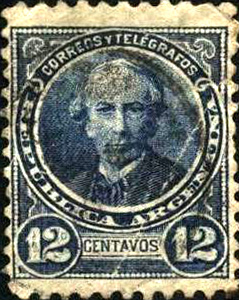
Other nineteenth-century stamps featured depictions of prominent political figures who were also musicians—for example, Argentina issued a stamp honoring the statesman and composer Juan Bautista Alberdi in 1888 (left)—but they were concerned with politics rather than music. The first explicitly musical stamp was Poland’s issuance honoring Ignacy Jan Paderewski in 1919.
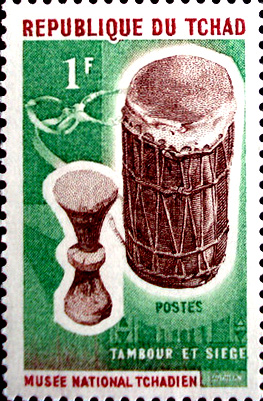
Through the 1950s countries increasingly celebrated Western classical musicians and composers. In the 1960s all aspects of musical life became potential subjects—institutions, festivals, instruments, dancers, and so on—and non-European countries asserted their national identities with images of their own traditional and historical music cultures. In the later twentieth century images of popular and jazz musicians gained increasing demand .
This according to A checklist of postage stamps about music by Johann A. Norstedt (London: Philatelic Music Circle, 1997), which lists some 14,000 stamps with music-related images.
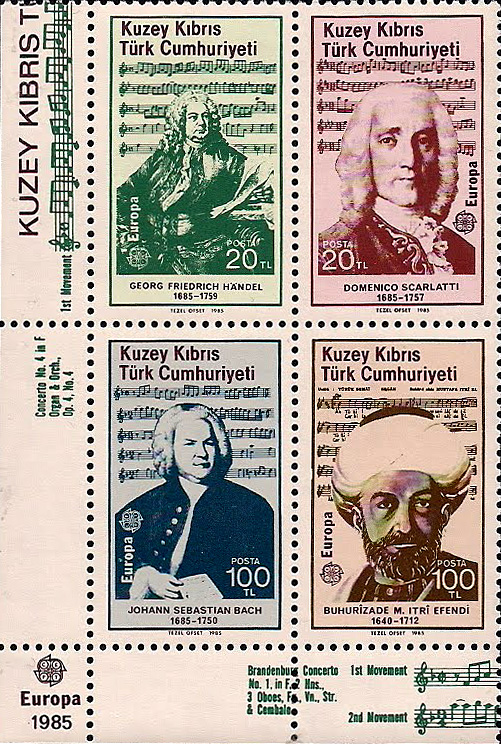
Above, stamps issued in Northern Cyprus in 1985, which was designated European Music Year by the Europa Federation (click images to enlarge). Below, a curious video about Robert Burns iconography.
These visual depictions of rāgas involve the various extramusical associations that theorists have assigned to them; for example, this visualization of the Hindustani rāg bhairavī from about 1610 depicts women worshiping at a shrine to Śiva, embodying the rāga’s association with both Śiva and feminine energy, and evoking the colors of its traditional early-morning context.
Below, the śahnāī player Bismillāh Khān (1915–2006) renders rāg bhairavī.
The Indian singer Jayashri Ramnath (better known as Bombay Jayashri) was introduced to Karnatak music in her early childhood, influenced by her parents’ roles as music teachers. Jayashri began her performing career at the age of 28, and having grown … Continue reading →
The country singer, songwriter, actor, and businesswoman Dolly Parton was the fourth of twelve children in a family of sharecroppers in Sevierville, Tennessee, located in the Appalachian Mountains. Commenting on her childhood, Parton once said, “Everybody where we grew up … Continue reading →
Women have been part of hip hop expression from its early days, primarily as part of MC crews such as the Funky Four Plus One and Sugar Hill’s female group, Sequence. For most of hip hop’s recorded history, however, women … Continue reading →
The music of Central America tends to borrow heavily from the music of Mexico to the north, Colombia to the south, and the Caribbean Islands to the east, and, in the case of Nicaragua, from the politically motivated nueva canción … Continue reading →