Asked whether he saw any similarity between the roles of rock star and pirate lord, Richards said “Actually, you could look at it like that. Both are ways to make a good dishonest living.”
“The music business has never been any different. It’s a pool of piranhas. You want to get in there? You better not be tasty.”
This according to “Johnny Depp & Keith Richards: Pirates of the Caribbean’s blood brothers” by David Wild (Rolling stone 1027 [31 May 2007]).
Today is Richards’s 70th birthday! Below, Edward Teague comes to life.
In an experiment, researchers performed heart transplants on mice and studied the subsequent effects of music on their alloimmune responses.
The researchers exposed different groups of the recuperating mice to three types of recorded music—a collection of works by Mozart, the album The best of Enya, and Verdi’s La traviata—and a single sound frequency as a control. After seven days their results indicated that the mice who listened to La traviata had developed superior alloimmune responses.
This according to “Auditory stimulation of opera music induced prolongation of murine cardiac allograft survival and maintained generation of regulatory CD4+CD25+ cells” by Masateru Uchiyama, et al. (Journal of cardiothoracic surgery VII/26 [2010]). Many thanks to the Improbable Research Blog for sharing this study with us!
Below, we invite you to improve your own alloimmune responses to La traviata while contemplating animated party food.
C. Saraswati Bai (1874–1974) began studying Karnatak music at the age of 6, and by the time she was 9 her exceptional talent was so evident that the harikathā guru Tiruvaiyaru Krishnachar took her under his wing.
By the age of 11 she was gaining local notoriety, and as it became clear that she was contemplating a professional career the established performers of this male-dominated genre moved to undermine her, effectively blackmailing performance venues into refusing to engage her. Saraswati persevered, and public support for her grew; at last, those who had sought to squelch her career relented and tried to make amends.
In early 1911 she embarked on a highly successful tour of India and Sri Lanka, and by the age of 22 she had become one of the most acclaimed harikathā performers of the time.
From 1913 through the 1930s Saraswati traveled almost continually, performing standing up for six to seven hours in a different town each night. She recorded nine successful records for Odeon, and often performed on the radio; she was also in great demand for performances at weddings. At the height of her career she earned 2000 rupees each night, more than any other harikathā performer at that time.
From the 1940s until the early 1960s Saraswati performed less and less, due partly to a decline in audiences with the advent of sound films, and partly to the intense physical demands of traveling and performing. She took a keen interest in developing cultural organizations, and was an ardent supporter of Gandhi.
This according to “C. Saraswati Bai” by Sriram Venkatakrishnan (writing as Sriram V; Sruti 262 [July 2006] pp. 21–31 and 263 [August 2006] pp. 17–38). Below, one of her Odeon recordings.
When Maria Callas returned to Greece to inaugurate the 1957 Athens Festival her demand for an unusually high fee created much antagonism, and she vowed that she would not perform in the country again.
However, in 1959 Κostis Bastias (1901–72) took charge of the administration of the Ethnikī Lyrikī Skīnī (Greek National Theater) and invited Callas to star in an opera in the ancient theater of Epidaurus. Since its opening in 1954, the Epidaurus Festival had only included performances of ancient Greek dramas by Ethnikī Lyrikī Skīnī; performances by other troupes were not allowed.
Finally, Callas consented to present Bellini’s Norma at the festival in 1960, and decided to donate her fee to a scholarship foundation. The performance was a resounding success, and she returned to Epidaurus a year later to present Cherubini’s Médée, further eroding Ethnikī Lyrikī Skīnī’s monopoly.
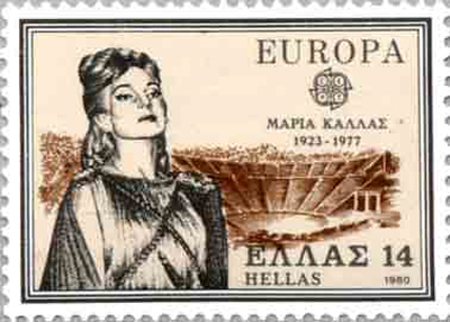
Today is Callas’s 90th birthday! Above, a Greek stamp commemorates her Norma at Epidaurus; below, a slide show includes photographs from the Epidaurus production of Médée.
The novel La musique du diable, ou Le Mercure galant devalisé (Paris: Robert le Turc, 1711) describes the arrival and subsequent activities of Marie-Louise Desmâtins and Lully in Hell; it also recounts events leading up to the soprano’s demise.
In the absence of any historical record of her last days, one might ask whether there could be a modicum of truth in the novel’s reports that Desmâtins had grown so obese that she engaged the finest butcher of the day to remove her fat; that she then mounted a lavish party for which all of the food had been prepared using this fat; at that she died soon thereafter from unknown causes. The reader is assured that she was welcomed to Hell with the highest honors, and that she is happier there than she ever was in her earthly life.
This according to “La musique du diable (1711): An obscure specimen of fantastic literature throws light on the elusive opera diva Marie-Louise Desmatins (fl. 1682–1708)” by Ilias Chrissochoidis (Society for Eighteenth-Century Music newsletter 11 [October 2007] pp. 7–9).
Above, a rather alarmingly corseted Desmâtins in a contemporaneous portrait; below, the final scene of Lully’s Armide, which Desmâtins starred in in 1703 (note that this is not an attempt to replicate the original staging).
Italian opera has played an important role in Russian musical life since the early 17th century, but by the 19th century it was being promoted there more than Russian opera. In retaliation, Russian composers used their operas to make fun of Italian opera’s stock situations and styles, and brought Russian opera back into prominence.
For example, in his early comic farce Богатыри (Bogatyri, Heroic warriors), Borodin used familiar music and arias from Italian and French operas (by Rossini, Verdi, Offenbach, Meyerbeer, and others) to set up situations where the original intention of the music and its new setting were at humorous extremes.
This according to “Italians in a Russian manner: One step from serious to funny” by Svetlana Sergeevna Martynova (Fontes artis musicae LVI/1 [January–March 2009] pp. 1–6).
Today is Borodin’s 180th birthday! Below, the opening of his B-minor symphony, which Massine used for his ballet Bogatyri, illustrated with images of the heroic warriors of Russian folklore.
In 1906, at the age of 34, Serge Diaghilev made his first impact on Western Europe with a widely acclaimed exhibition of Russian art in Paris; he followed this success with well-received concerts of Russian music in 1907 and 1908, which included the Western European debut of the celebrated Russian bass Fëdor Ivanovič Šalâpin.
Even these achievements were overshadowed by the rapturous reception of the newly formed Ballets Russes in 1909, which performed the entire second act of Borodin’s Knâz’ Igor’ (Prince Igor), featuring the singing of Šalâpin and the dancing of the now-famous Poloveckie plâski (Polovtsian dances).
In 1913 Diaghilev produced performances featuring Šalâpin in both Paris and London. An archival document from that year records Šalâpin’s payment for an extra performance of Musorgskij’s Boris Godunov in London; at the bottom one can see the singer’s handwritten note: Finito!
This according to “Diaghilev, Chaliapine, and their contracts” by Cecil Hopkinson (The music review XXV/2 [May 1964] pp. 149–53). The article also includes full English translations of Šalâpin’s contracts with Diaghilev for the 1909 and 1913 seasons.
Above, Šalâpin with a different associate in 1929; below, a performance of a scene from Godunov in 1927.
Archivists at the American Institute for Verdi Studies discovered a document that sheds new light on Verdi’s activity just prior to the composition of his final opera, Falstaff.
A letter from the publisher Giulio Ricordi dated 22 August 1890 congratulates Verdi on the successful launching of a new business devoted to the sale of pork prepared at the composer’s Sant’Agata farm.
Ricordi, having purchased a “G.V. brand” pork shoulder, reports that he found the bill “a bit salty”, but for such exquisite meat he would pay “neither a lira more nor a lira less”.
This according to “New Verdi document discovered” by Martin Chusid (Verdi newsletter XX [1992] p. 23). (The information in this article, delicious as it is, appears to be outdated; see the comment below.)
Today is Verdi’s 200th birthday! Below, in Falstaff’s finale, the opera’s characters prepare to dine together—no doubt anticipating the composer’s own homegrown prosciutto.
In a 2005 interview, Dame Janet Baker explained some of her career choices.
“With the greatest respect to mainstream opera, a great many of the mezzo roles are not that interesting. You are either a nurse or a nanny or a companion or something…and I thought ‘My goodness me, I’m going to be bored witless!’”
“I wanted to do things that interested me from the theatrical point of view and from the musical point of view, which meant that I went down very lesser-known, interesting paths, because I was free from the repertory system. And I was glad about that.”
This from “The compleat mezzo´by David J. Baker (Opera news LXX/4 [October 2005] pp. 32–35).
Today is Dame Janet’s 80th birthday! Below, in recital with Schubert’s An die Musik.
In 2012 Brepols launched the series Mise en scène with Giacomo Puccini et Albert Carré: Madame Butterfly à Paris.
Musicologists and stage directors are familiar with the staging manuals (disposizioni sceniche) for Verdi’s later operas, which resulted directly from the composer’s contact with French practice. Yet the French livrets de mise en scène, intended to provide theater directors wishing to produce a work with its complete mise en scène, are still little known.
The publication with annotations and illustrations of a series of stage manuals for important works in the French operatic repertoire, from Auber’s La Muette de Portici (Paris Opéra, 1828) to more modern works—Debussy’s Pelléas et Mélisande and Ravel’s L’Heure espagnole—will provide researchers and directors with very useful tools, giving access to the original visual, dramatic, and decorative elements of Parisian productions (often thought out by the librettist and the composer). Knowing how works were originally staged can be both enlightening and inspiring. These manuals, providing faithful accounts of theatrical works, have much to offer theater historians and those working in opera.
The main entrance to the New York Public Library for the Performing Arts’s exhibition Lou Reed: Caught between the twisted stars opens up on Lincoln Plaza, directly adjacent to the The Metropolitan Opera house. On a sunny day, the Met’s … Continue reading →
Seven strings/Сім струн (dedicated to Uncle Michael)* For thee, O Ukraine, O our mother unfortunate, bound, The first string I touch is for thee. The string will vibrate with a quiet yet deep solemn sound, The song from my heart … Continue reading →
Introduction: Dr. Philip Ewell, Associate Professor of Music at Hunter College and the Graduate Center of the City University of New York, posted a series of daily tweets during Black History Month (February 2021) providing information on some under-researched Black … Continue reading →
For it [the Walkman] permits the possibility…of imposing your soundscape on the surrounding aural environment and thereby domesticating the external world: for a moment, it can all be brought under the STOP/START, FAST FOWARD, PAUSE and REWIND buttons. –Iain Chambers, “The … Continue reading →