Category Archives: Curiosities

Haydn and Ellington

In what he dubbed “a musicological jeu d’esprit”, Edward Green drew 25 parallels between the lives of Joseph Haydn and Duke Ellington in “Haydn and Ellington: Parallel lives?” (International review of the aesthetics and sociology of music XL/2 [December 2009] pp. 349–51). These include:

  • Both had an outstanding orchestra at their immediate disposal for decades. This meant that they wrote for individuals, not just for instruments, and enabled the striking timbral and contrapuntal risks that they felt safe taking.

  • Both helped to create the predominant musical style of their century, and were celebrated in their lifetime for having done so.

  • Despite the necessity of producing numerous occasional works, both took an experimental attitude to composing, striving for freshness of form, design, and content, and their styles changed and developed remarkably over their careers.

  • Both had a notoriously keen business sense.

Today is Haydn’s 270th birthday! Below, Baryton Trio Valkkoog performs the Adagio and Finale Fuga from Haydn’s “Birthday” trio, Hob.XI:97, composed for the birthday of  Prince Nikolaus Esterházy.

Related articles:

3 Comments

Filed under Classic era, Curiosities, Jazz and blues

Jazz and shamanism

With its emphasis on altered consciousness, shamanism—communication with the spirit world—offers archetypal visionary insight concerning the nature of the psyche; it has much in common with the key Jungian notion of individuation or fully developed and integrated consciousness.

Jazz has much in common with shamanic experience. The pan-tonal and pan-rhythmic music of the Norwegian saxophonist and composer Jan Garbarek exemplifies the healing presence of the shamanic, or individuated, spirit in 20th-century music.

This according to “The body electric: The shamanic spirit in twentieth century music” by Michael Tucker, an essay included in Music and mysticism, two consecutive issues of Contemporary music review (XIV/1–2 and 3–4) dedicated to the memory of Philip Rawson.

Above, a shaman from the Altaj Mountains of Central Asia. Below, Rahsaan Roland Kirk’s I talk with the spirits.

3 Comments

Filed under Curiosities, Jazz and blues

Mozart and folk proverbs

Mozart’s epistolary style was based on spoken traditions, not written ones; his spontaneous use of language—including rich proverbial speech—gives his lively and telling letters their linguistic and emotional authenticity.

Examples include:

    • “Of what use is a great sensation and rapid fortune? It never lasts. Chi va piano, va sano. One must just cut one’s coat according to one’s cloth.”
    • “Now I sit like a rabbit in the pepper! The first act was finished more than three weeks ago…but I cannot compose any more, because the whole story is being altered.”
    • “Yes, my dear little cello, it’s the way of the world, I’m told. Tom has the purse and Dick has the gold; and whoever has neither has nothing, and nothing is equal to very little, and little is not much; therefore nothing is still less than little, and little is still more than not much, and much is still more than little and—so it is, was, and ever shall be.”

This from “‘Nun sitz ich wie der Haass im Pfeffer”: Sprichwörtliches in Mozarts Briefen” by Wolfgang Mieder (Augsburger Volkskundliche Nachrichten XII/16 [December 2002] pp. 7–50; an English translation is in Journal of folklore research XL/I [January–April 2003] pp. 33–70).

Mozart’s appreciation of folklore extended to music as well; below, Clara Haskil plays his variations on the folk song Ah, vous dirai-je maman.

More articles about Mozart are here.

2 Comments

Filed under Classic era, Curiosities

Improvised vocal fugues

Sethus Calvisius (1556–1615), one of the very small number of specialists in the improvised vocal fugue, provided a discussion of the practice in his Melopoiia (1592), illustrated with 21 notated examples of fugæ extemporaneæ—tricinia, or two-part canons, over a cantus firmus.

These pieces were improvised as a third voice sang the cantus firmus, with the two improvising voices entering a minim or semibreve apart; the first of the two singers was effectively the composer. Analysis of Calvisius’s works shows that his mastery of the technique was complete, and he was capable of creating canonic improvisations of surprising originality.

This according to “Harmonia fvgata extemporanea: Fugenimprovisation nach Calvisius und den Italienern” by Olivier Trachier, an essay included in Tempus musicaetempus mundi: Untersuchungen zu Seth Calvisius (Hildesheim: Georg Olms 2008, pp. 77–102). Below, the Dresdner Kreuzchor performs Calvisius’s Freut euch und jubilieret.

Comments Off on Improvised vocal fugues

Filed under Curiosities, Performance practice, Renaissance

Sherlock Holmes, violist

A close reading of the canonical texts yields conclusive evidence that the celebrated sleuth was not a superb violinist—he was a superb violist.

The mistake was likely perpetuated by an early printer’s error. After all, Watson was a doctor, which means that even at best his handwriting was nearly illegible; he undoubtedly wrote “viola”, not “violin”. References to Holmes’s playing such as a “low, dreamy, melodious air” and “low melancholy wailing”—as well as to his habit of playing it “thrown across his knee”—clearly indicate that his instrument must have been a viola.

In fact, further textual references point to a historical mystery solved. Holmes referred to his instrument as a Stradivarius bought from a shady broker for only 55 shillings; surely this was the one Stradivarius viola, dated 1695, whose whereabouts has eluded instrument historians.

This according to “Quick, Watson, the fiddle” by Rolfe Boswell (The Baker Street journal, October 1948; reprinted in Journal of the American Viola Society online 26 [summer 2010] pp. 14–18).

Above, a classic depiction by Sidney Paget, Conan Doyle’s original illustrator; below, Jeremy Brett holds forth.

Related article: Dickens and music

2 Comments

Filed under Curiosities, Humor, Instruments, Literature

Busoni and the Leskovites

During his lonely years as a young traveling performer and teacher in northern Germany, Ferruccio Busoni adopted a Newfoundland for companionship; he named the huge black dog Lesko. When he sailed to Helsinki to begin his first steady teaching position in 1888, of course Lesko came along.

Busoni’s lively personality and prodigious performing skills soon attracted a group of artists who gathered regularly at bars and restaurants. Since his dog always attended these meetings, they declared Lesko the honorary convener and dubbed themselves the Leskovites. This group included Jean Sibelius, the writer Adolf Paul, the conductor Armas Järnefelt, and his brother, the painter Eero Järnefelt.

In 1890 Busoni expressed his regard for the Leskovites with his Geharnischte suite, op. 34a; each movement is dedicated to one of “the four friends of Lesko in Helsinki.”

This according to “The friends of Lesko, the dog: Sibelius, Busoni, Armas and Eero Järnefelt, Adolf Paul” by Barbara Blanchard Hong, an essay included in Sibelius in the old and new world: Aspects of his music, its interpretation, and reception (Frankfurt am Main: Peter Lang, 2010, pp. 57–68).

Below, Busoni’s suite dedicated to the Leskovites.

2 Comments

Filed under Animals, Curiosities, Romantic era

John Philip Sousa, violinist

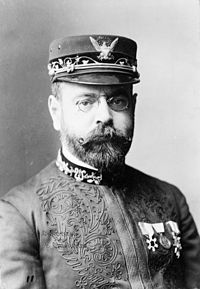
While the composer of iconic marches is famous for directing the U.S. Marine Band and his own world-famous ensembles, John Philip Sousa’s early life as a violin prodigy is relatively unknown.

A sickly child, Sousa was home-schooled, and from the age of six his studies included lessons with an Italian violin teacher. He showed tremendous promise, and his father, a trombonist in the Marine Band, enlisted him as a Marine apprentice when he was 13; there he studied academics and several instruments.

Sousa went on to play the violin in orchestras and chamber groups, where he developed a taste for cutting-edge art music that he never lost; for example, his band performed excerpts from Wagner’s Die Meistersinger ten years before the opera’s first U.S. production.

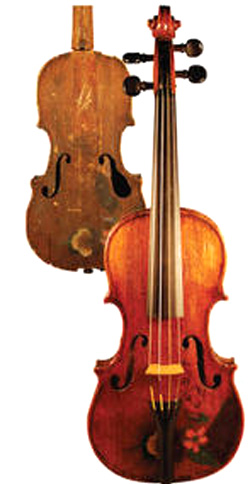
This according to “John Philip Sousa’s violin: An American original” by Erin Shrader (Strings XXV/4:187 [November 2010] pp. 53–56). Above, Sousa’s childhood violin before (background) and after it was restored by John Montgomery. Below, Sousa’s Band performs Carl Friedemann’s Slavonic rhapsody.

Related article: Cylinder Preservation and Digitization Project

Comments Off on John Philip Sousa, violinist

Filed under Curiosities, Instruments, Popular music, Romantic era

Love in the top 100


On this Valentine’s Day, let’s look at an article that analyzes the 100 most popular songs between 1958 and 1998 for performer demographics and expressions of love.

In the 1990s women and black artists recorded more hits than in earlier periods; over time, references to love in lyrics performed by women artists decreased. References to sex in lyrics peaked between 1976 and 1984, when women used sexual references five times more than men; however, between 1991 and 1998, men used more sexual references.

Later songs and songs performed by white female artists expressed greater selfishness; the quality of love expressed in the lyrics remained the same.

This according to “Expressions of love, sex, and hurt in popular songs: A content analysis of all-time greatest hits” by Richard L. Dukes, et al. (Social science journal XL/4 [2003] pp. 643–650). Below, the Beatles—with a little help from their friends—provide further analysis.

Related article: Sexual attraction by genre

Comments Off on Love in the top 100

Filed under Curiosities, Popular music

Liberace’s taste

Władziu Valentino Liberace’s Las Vegas home represented the democratization of aristocracy, a do-it-yourself coronation, the people’s palace. It is the apotheosis of décor as persona and persona as décor.

The Moroccan Room (above, click to enlarge) is a tile-and-glass atrium with Tivoli lights made from a sundeck that Liberace had always found either too hot or too cold. The large convex sofa in flame-stitch upholstery (foreground) sounds a proper note of sloe-eyed languor, while pairs of Italian-Baroque-style blackamoors—referred to by Liberace’s lover Scott Thorson as “harem boys”—support the fireplace mantel (left) and the candelabras that flank the bar (rear).

This according to “Liberace’s taste” by Grant Mudford and Susan Yalevich (Nest 10 [2002] pp. 588–590). Below, Liberace plays Tiger rag in 1969, when he was the highest-paid entertainer in the world.

Related articles:

3 Comments

Filed under Architecture, Curiosities, Popular music

George Breed’s electrified guitar

On 2 September 1890 U.S. Navy officer George Breed (1864–1939) was granted a patent for a design for an electrified guitar (Method of and apparatus for producing musical sounds by electricity, patent no. 435,679); it appears to be the first application of electricity to a fretted string instrument.

Like the modern electric guitar and other similar instruments, Breed’s patent was based on a vibrating string in an electromagnetic field; but his design worked on very different musical and electrical principles (in particular the Lorentz force), resulting in a small but extremely heavy guitar with an unconventional playing technique that produced an exceptionally unusual and unguitarlike, continuously sustained sound.

Breed is now almost completely unknown as a musical instrument maker and designer; the significance of this instrument has largely remained underappreciated, and the circuitry unexamined.

This according to “George Breed and his electrified guitar of 1890” by Matthew Hill (The Galpin Society journal LXI [April 2008] pp. 193–203). Below, Dr. Hill discusses his research.

Related article: Ken Butler’s anxious objects

8 Comments

Filed under Curiosities, Instruments, Science