The chromochord is a bioelectronic musical instrument that is driven by protein expansion and contraction.
Linked to a laptop computer, the device holds 12 vials, each paired with a different sound. When light shines on one vial the proteins inside swell, changing the wavelength they absorb. A sensor measures the change in absorption and cues the sounds. As one set of proteins slowly expands, the chromochord emits the deep thrum of a bass; as another set quickly shrinks, out comes the sound of glass chimes.
The chromochord was developed by Josiah Zayner, a biophysicist at the University of Chicago, and the composer Francisco Castillo Trigueros. “Scientists see beauty in a well-crafted experiment,” Zayner says. “The chromochord allows other kinds of people to experience that beauty.”
David Moore (a.k.a. DayDay MoeMoe, a.k.a. Umburkus) is a musician, artist, furniture maker, and visionary hermit hidden away in a secretive corner of a haunted-looking house in the fading Delta cotton town of Rosedale, Mississippi.
The inquisitive, anarchic child of a family that once held considerable sway there, Moore now lives alone in a house covered in vines and filled with his own artwork alongside untold numbers of sweetly unnerving semicollectibles, a trusty dog, and myriad musical instruments and furniture of his own invention, including his signature schizoid zither, a.k.a. buzzstick, a.k.a. boingbox. The music that he plays with them is unique and unforgettable.
Like real rock guitar playing, air guitar—miming electric guitar playing without an instrument—is heavily informed by gendered practices in rock, where the electric guitar functions as a signifier of masculine power and implied sexual prowess, and performing on it involves symbolic aggression and dominance.
Women air guitarists appropriate and disrupt rock culture’s consensus, undermining and subverting its gendered performance. This gender bending emphasizes women’s critique of rock culture’s masculinist attitude while asserting female power through the nonthreatening manipulation of an imaginary phallic symbol.
This according to “The girl is a boy is a girl: Gender representations in the Gizzy Guitar 2005 Air Guitar Competition” by Hélène Laurin (Journal of popular music studies XXI/3 (September 2009) pp. 284–303. Above and below, the multi-award-winning Nanami “Seven Seas” Nagura.
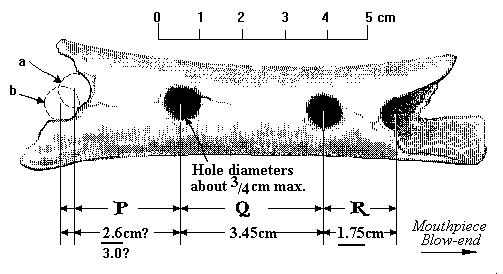
In 1996 Mira Omerzel-Terlep reported that a bone fragment excavated at the Divje Babe I cave site in Slovenia is considered to be the oldest man-made flute, dating from 45,000 years ago (“Koščene piščali: Pričetek slovenske, evropske in svetovne inštrumentalne glasbene zgodovine” [Bone whistles: Origins of the Slovenian, European, and world history of instrumental music], Etnolog: Glasnik Slovenskega Etnografskega Muzeja/Bulletin of the Slovene Ethnographic Museum VI, pp. 235–294). Further studies sought to demonstrate that the fragment had originally belonged to an instrument capable of producing a diatonic scale.
Other researchers were skeptical, though, and in 1998 Paola Villa et al. tried to put the speculation to rest, showing that the holes in the bone were the results of gnawing by animals (“A Middle Paleolithic origin of music? Using cave-bear bone accumulations to assess the Divje Babe I bone ‘flute’”, Antiquity LXXII/275 [March], pp. 65–79).
The argument has not abated. In 2002 a pair of essays staking out the opposing camps was issued in Archäologie früher Klangerzeugung und Tonordnung/The archaeology of sound origin and organization; Musikarchäologie in der Ägäis und Anatolien/Music archaeology in the Aegean and Anatolia (Rahden: Leidorf); April Nowell states that the results of taphonomic testing offered no viable proof that the bone fragment was an instrument (“Is a cave bear bone from Divje Babe, Slovenia, a Neanderthal flute?” pp. 69–81) while Robert Fink presents research supports the theory that it was (“The Neanderthal flute and origin of the scale: Fang or flint? A response” pp. 83–87).
More recently, an exhaustive study by Cajus G. Diedrich of Paleo-Logic, Independent Institute of Geosciences, ends with the conclusion that “The ‘cave bear cub femora with holes’ are, in all cases, neither instruments nor human made at all” (Royal Society Open Science, 2 : 140022; the paper can be read in full here).
Still, the controversy is alive and thriving on the Internet.
Below, Ljuben Dimkaroski performs on a reconstruction of the alleged original bone flute.
The Indian singer Jayashri Ramnath (better known as Bombay Jayashri) was introduced to Karnatak music in her early childhood, influenced by her parents’ roles as music teachers. Jayashri began her performing career at the age of 28, and having grown … Continue reading →
The country singer, songwriter, actor, and businesswoman Dolly Parton was the fourth of twelve children in a family of sharecroppers in Sevierville, Tennessee, located in the Appalachian Mountains. Commenting on her childhood, Parton once said, “Everybody where we grew up … Continue reading →
Women have been part of hip hop expression from its early days, primarily as part of MC crews such as the Funky Four Plus One and Sugar Hill’s female group, Sequence. For most of hip hop’s recorded history, however, women … Continue reading →
The music of Central America tends to borrow heavily from the music of Mexico to the north, Colombia to the south, and the Caribbean Islands to the east, and, in the case of Nicaragua, from the politically motivated nueva canción … Continue reading →