Category Archives: Curiosities

Brahms was Chilean

436px-Johannes_Brahms_1853

To honor Brahms’s 180th birthday, let’s recall the article about his birthplace that ignited a musicological firestorm!

In “Brahms era chileno” (Pauta: Cuadernos de teoría y crítica musical, no. 63 [July-Sept 1997] pp. 39–44), the Argentine composer Juan María Solare states that Johann Jakob Brahms (1806–72), accompanied by his wife, Johanna Henrika Christiane Nissen (1789–1865), took part in a tour of South America as a performer in the orchestra of the Alsterpavillon in Hamburg, and that Johanna gave birth to Johannes Brahms in the village of Copiapó, northern Chile, on 6 February 1833.

He further states that the birth is documented in a letter that Johanna wrote to her sister in Hamburg, but which was lost and eventually ended up in the archive of an obscure village in Patagonia, where it can still be seen; the birth was concealed from German society, and Brahms was baptized under a false place and date of birth upon his parents’ return to Germany.

Later, in an interview, Solare clarified his intention: He wrote the article as a piece of speculative fiction, a type of writing that Pauta sometimes publishes; but since the journal also presents peer-reviewed research, the piece was mistaken for authentic musicology, generating widespread controversy among Brahms scholars.

BONUS: Brahms was from New Orleans:

More posts about Brahms are here.

5 Comments

Filed under Curiosities, Humor, Romantic era

Willie Nelson goes to pot


“I was about six when I started smoking cedar bark and grapevine, and rolling up Bull Durham” writes Willie Nelson. “I was trading a dozen eggs for a pack of Camels.”

“Then I ran into beer and whiskey, pills, and then pot. By then I was twenty-five years old and my lungs were killing me….So then I said to myself, “Hey, you’re not getting high on cigarettes, and they killed half your family….”

“So I started quitting everything. No more cigarettes at all. I started running again and getting back in shape.”

“I took my cigarettes and threw them away. I rolled up twenty joints and put them in the cigarette package, and every time I wanted a cigarette, I smoked a hit or two off a joint instead. One joint would last all day and it worked for me.” (Roll me up and smoke me when I die: Musings from the road [New York: HarperCollins, 2012] p. 121).

Today is Nelson’s 80th birthday! Below, the book’s namesake.

1 Comment

Filed under Curiosities, Popular music

Globalized Bollywood


The Hindi film song Thoda resham lagta hai (It takes a little silk), written by Bappi Lahiri for the 1981 film Jyoti, was long forgotten before it was rediscovered in 2002 by the American producer DJ Quik.

Based around an unauthorized 35-second sample of the recording, the Truth Hurts song Addictive prompted Lahiri to sue Dr. Dre (the executive producer of the song), Aftermath Records, and Universal Music (Aftermath’s parent company and distributor) for $500 million.

Beyond Lahiri’s claims of cultural imperialism, obscenity, and outright theft, DJ Quik’s rearrangement of the song was, in turn, adopted by music producers, including Lahiri himself, in a wide variety of international genres, including Indian, American, and Jamaican contexts. Yet even as this well-traveled tune evokes different historical and local meanings, it evokes an eroticized Other in each context, including its original one.

This according to “It takes a little lawsuit: The flowering garden of Bollywood exoticism in the age of its technological reproducibility” by Wayne Marshall and Jayson Beaster-Jones (South Asian popular culture X/3 [October 2012] pp. 249–260). Above, a screen shot from the Addictive video; below, the song in its original context. (Yes, that’s the voice of the great Lata Mangeshkar!)

Related article: From Bollywood to fusion

3 Comments

Filed under Curiosities, Popular music

Caballé, Mercury, and Barcelona


After Queen’s 1985 tour of Spain, the group’s frontman Freddie Mercury amazed his fans by declaring on Spanish television that the Spaniard he most longed to meet was Montserrat Caballé. Mercury hoped to collaborate with the legendary diva, and in March 1987 he finally arranged a meeting in the Garden Room of the Ritz Hotel in Barcelona with a grand piano, state-of-the art recording and playback equipment, and a sumptuous buffet.

She later described the scene: “We spent the whole time listening to music, eating, and improvising…Barcelona as such did not exist at that time—it was only a musical sketch of just a few bars that Freddie sang. But I liked it and he promised to develop it for me to celebrate the Olympic success.” (Barcelona had just been selected for the 1992 Summer Olympics.)

Mercury worked quickly on the song, and Caballé’s recital in London later that month dovetailed with a recording session at his home. Working until 6:00 in the morning, they produced what effectively became Barcelona’s unofficial Olympic anthem.

This according to Montserrat Caballé: “Casta diva” by Stephen Taylor and Robert Pullen (London: Gollancz, 1995, pp. 302–05).

Caballé is 80 years old today! Below, a memorable performance of Barcelona.

Comments Off on Caballé, Mercury, and Barcelona

Filed under Curiosities, Opera, Popular music

Stravinsky’s persona


Stravinsky has been widely characterized as enigmatic, a composer whose stylistic transformations were impossible to anticipate. He cultivated this image, not in a disingenuous way, but because his eccentricity was central to his self-definition.

More than any composer of 20th-century art music, Stravinsky was able to make the leap from a rarefied intellectual world to the status of a pop icon, widely respected by people who largely did not understand his music. He needed to be public, accepted, and popular, and a surprisingly large proportion of his archival documents reflects his efforts toward these goals.

Television producers in Europe and North America found in Stravinsky the ideal nonconformist film icon: droll, quirky, conversational, contentious, and pedestaled as the epitome of the rebellious hero. He was drawn to them as well, as a natural performer who needed and commanded the spotlight.

This according to “Truths and illusions: Rethinking what we know” and “Film documentaries: The composer on and off camera” by Charles M. Joseph, two essays included in Stravinsky inside out (New Haven: Yale University Press, 2001, pp. 1–34 and 162–195, respectively).

Below, the composer works the camera with some of his favorite things to say about Le sacre du printemps.

Related articles:


3 Comments

Filed under 20th- and 21st-century music, Curiosities

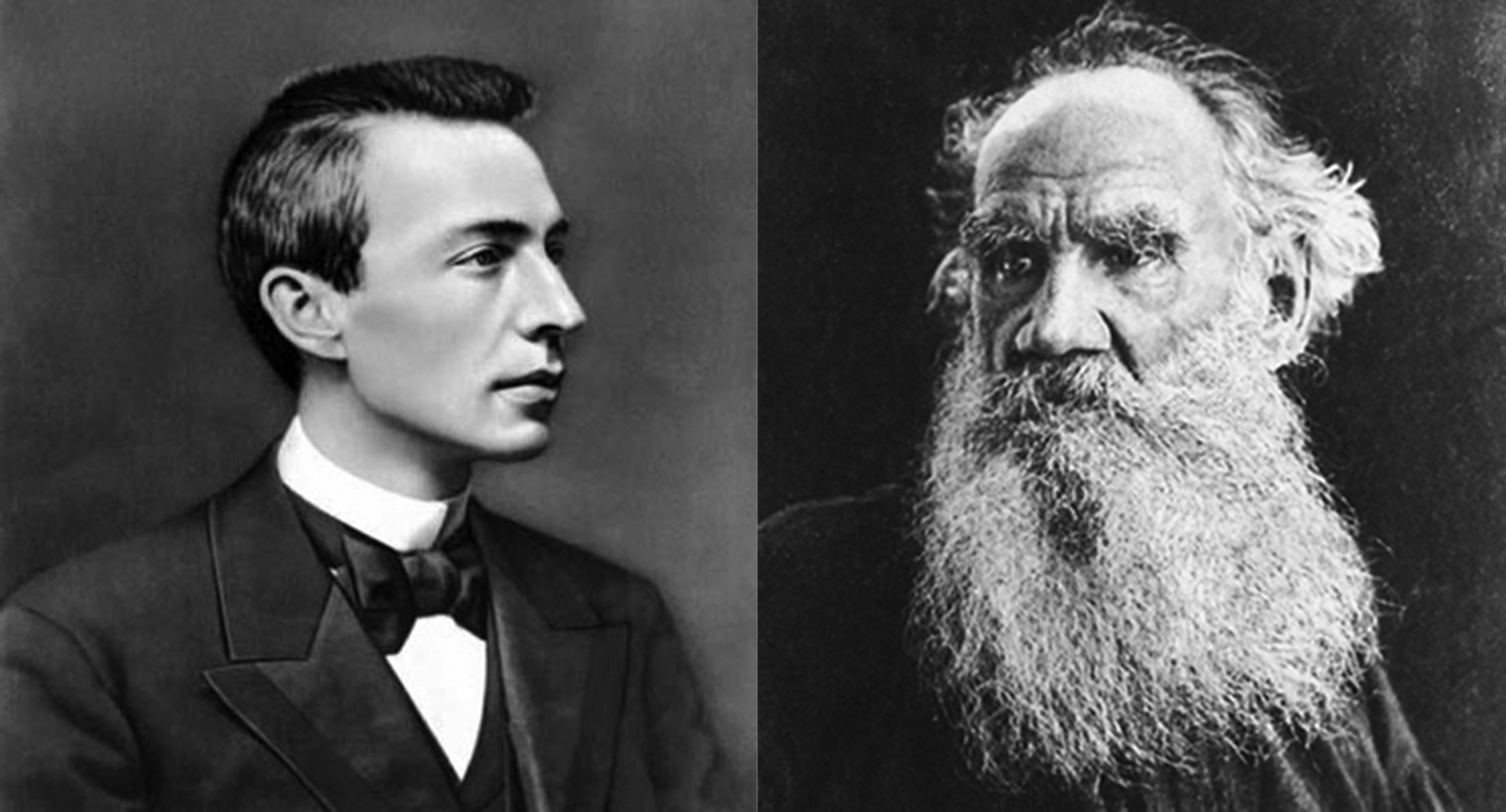
Rahmaninov and Tolstoj

rach-tolstoy

In January 1900 Rahmaninov and the bass Fëdor Ivanovič Šalâpin were invited to perform for a gathering at Tolstoj’s home; they were both 26 years old. Their excitement was tempered with no little trepidation about meeting the revered author, but they could not have foreseen what transpired.

Šalâpin recalled that after the performance Tolstoj accosted him and asked “What kind of music is most necessary to men—scholarly or folk music?”

Rahmaninov’s own experience was no less harrowing, as he later described it:

“Suddenly the enthusiastic applause was hushed and everyone went silent. Tolstoj sat in an armchair a little apart from the others, looking gloomy and cross. For the next hour I evaded him entirely, but suddenly he came up to me and declared excitedly: ‘I must speak to you. I must tell you how I dislike it all!’

“And he went on and on: ‘Beethoven is nonsense, Puškin and Lermontov also.’ It was awful….

“After a while Tolstoj came up to me again: ‘Please excuse me. I am an old man. I did not mean to hurt you.’ I replied: ‘How could I be hurt on my own account if I was not hurt on Beethoven’s?’”

This according to Sergei Rachmaninoff: A lifetime in music by Sergei Bertensson, Jay Leyda, and Sof’â Aleksandrovna Satina (Bloomington: Indiana University Press, 2001 [reprint] pp. 88–89; RILM Abstracts of Music Literature 2001-23752).

Today is Rahmaninov’s 150th birthday! Below, Šalâpin sings one of his romances.

1 Comment

Filed under Curiosities, Literature, Romantic era

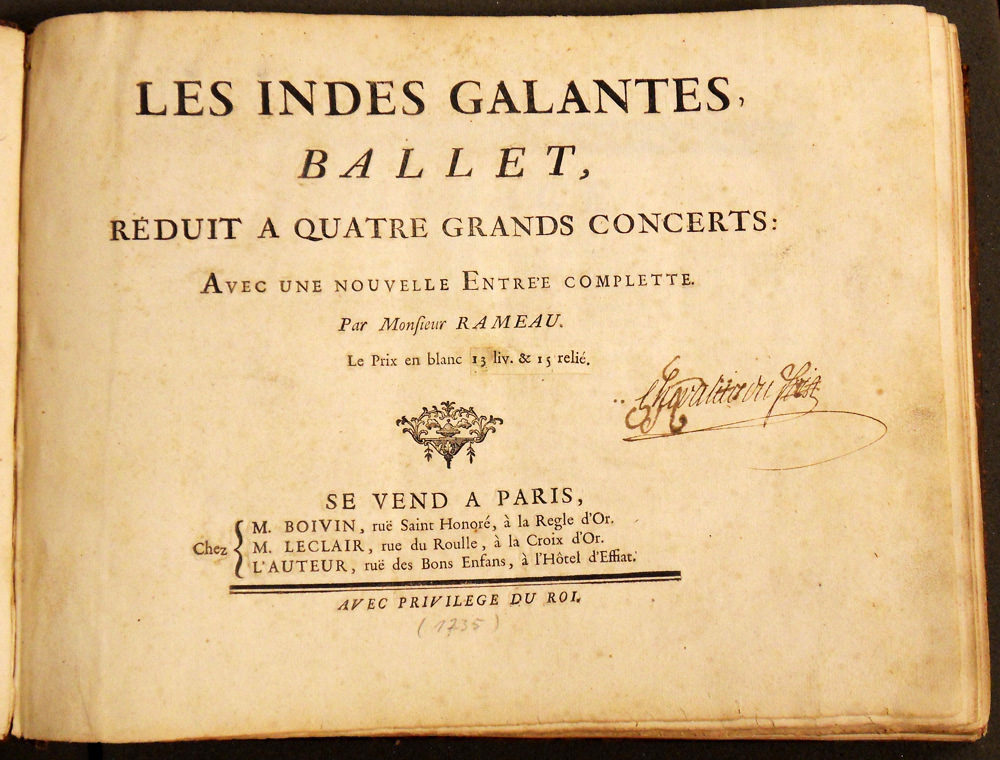
Ballet and sauvagerie

SAMSUNG DIGITAL CAMERA

A semiotics of sex roles in French society was played out in 18th- and 19th-century ballet by projecting it onto imaginary Native American societies.

In the 18th century, sauvage culture became a canvas for the projection of utopian sentiment with subtle social texturing, allowing the expression of fantasies of less restrictive sexual roles; in the 19th century, sauvagerie became grotesque and increasingly unrefined, shifting the emphasis from cultural to racial difference and affirming the status quo.

This according to “Sauvages, sex roles, and semiotics: Representations of Native Americans in the French ballet, 1736–1837” by Joellen A. Meglen (Dance chronicle XXIII/2 [2000] pp. 87–132; XXIII/3 [2000] pp. 275–320).

Above and below, Rameau’s Les Indes galantes (1735).

Related article: Rameau’s American dancers

3 Comments

Filed under Baroque era, Curiosities, Dance

19th-century acoustical research

manometric capsule

The 19th century was a golden age for the invention of acoustical research instruments—tools for measuring audible frequencies or the speed of sound, or for making sound visible.

Advancements in instrument making and voice physiology paralleled advancements in sound recording, reproduction, and transmission. Apparatuses developed during that time included tuning forks, sirens, sonorous pipes, singing and sensitive flames, manometric capsules, and resonators.

This according to “1800–1900: Un secolo di strumenti per lo studio dell’acustica/1800–1900: A century of instruments for the study of acoustics” by Paolo Brenni, an essay included in L’acustica e suoi strumenti: La collezione dell’Istituto Tecnico Toscano/Acoustics and its instruments: The collection of the Istituto Tecnico Toscano (Firenze: Giunti, 2001, pp. 57–72).

Above, a manometric capsule; below, Professor Henry Higgins demonstrates a sensitive flame, using a rotating mirror for isolating the flame’s oscillations.

1 Comment

Filed under Curiosities, Science

Corelli in the wilderness

Arcangelo_Corelli

On 26 April 1706, in a solemn ceremony in Rome, Arcangelo Corelli was accepted as a member of the Accademia dell’Arcadia; as customary, he assumed a shepherd’s name: Arcomelo.

Forty years later, the Swiss Jesuit Martin Schmid copied several of Corelli’s works into his draft-book of music for the Indian community in Bolivia that he was fostering and overseeing—a community that was sometimes known as New Arcadia.

In Bolivia, Corelli’s Arcadian music was subjected to a radical metamorphosis by those who understood Indian performers and audiences. His works were thereby consigned to a museum of cultural symbols as objects of a revered past.

This according to “Arcadia meets Utopia: Corelli in the South American wildnerness” by Leonardo J. Waisman, an essay included in Arcangelo Corelli: Fra mito e realtà storica–Nuove prospettive d’indagine musicologica e interdisciplinare nel 350° anniversario dalla nascita (Firenze: Leo S. Olschki, 2007, pp. 651–85).

Today is Corelli’s 360th birthday! Below, the original version of one of the works that was subjected to a Bolivian metamorphosis.

Comments Off on Corelli in the wilderness

Filed under Baroque era, Curiosities

Music and delinquency

frankie-lymon-im-not-a-juvenile-delinquent

A four-year longitudinal study (n = 309) explored whether early adolescents’ preferences for nonmainstream types of popular music indicate concurrent and later minor delinquency.

The results showed that early fans of types of rock (e.g., rock, heavy metal, gothic, punk), African American music (rhythm and blues, hip-hop), and electronic dance music (trance, techno, hardhouse) showed elevated minor delinquency concurrently and longitudinally. Preferring conventional pop or highbrow music (classical music, jazz), in contrast, was not related to or was negatively related to minor delinquency.

Early music preferences emerged as more powerful indicators of later delinquency than early delinquency, indicating that music choice is a strong marker of later problem behavior.

This according to “Early adolescent music preferences and minor delinquency” by Tom F.M. ter Bogt, Loes Keijsers, and Wim H.J. Meeus (Pediatrics CXXXII/2, pp. e382–e389). Many thanks to the Improbable Research blog for bringing this article to our attention!

Below, Jerry Lee Lewis introduces an earlier study.

BONUS: The Frankie Lymon classic pictured above.

Related article: Sexual attraction by genre

Comments Off on Music and delinquency

Filed under Curiosities, Popular music