Category Archives: Visual art

Music on money

Like postage stamps, musical subjects depicted on money represent a type of iconography that is controlled by governmental organizations; their didactic goals are minimal, and their political role is paramount. Most often they involve the celebration of a national composer whose work embodied and enacted a national character—but their symbolism occasionally misfires.

For example, the above Romanian  50,000 lei banknote pictures George Enescu on the front alongside some recognizable musical images, but the depiction of a Bucegi-Mountains rock formation known in Romania as The Sphinx, which appears to be a reference to the character of the Sphinx in the composer’s opera Oedipe, was judged to be sufficiently puzzling to merit a redesign omitting the image.

This according to “Music on money: State legitimation and cultural representation” by Marin Marian-Bălaşa (Music in art XXVIII 1–2, pp. 173–189.

Related article: Enescu and makam

Comments Off on Music on money

Filed under 20th- and 21st-century music, Iconography

Album covers

fela-zombie

Record album covers comprise a genre of music iconography that shows how musicians wish to be perceived—or how their producers wish them to be perceived. This type of iconography makes no claim to objectivity; rather, it explicitly presents images meant to arouse specific associations with the recorded music inside.

For example, the cover of Fela Anikulapo-Kuti’s 1977 album Zombie shows him brightly dressed, singing and gesturing defiantly, facing images of Nigerian soldiers: the zombies of the scathing title song, which satirizes these enforcers of the military government. The singer appears as a vibrant, strong leader, while the soldiers are depicted in a jagged, grey collage—as dehumanized and sinister as the zombies of horror fiction.

Below, Sahr Ngaujah and the cast of Fela! perform Zombie on Broadway.

Click here for more on music iconography.

Comments Off on Album covers

Filed under Africa, Iconography, Politics, Popular music

Rāgamālā paintings

Bhairavi

Rāgamālā painting is a form of iconography that arose around 1600 in northern India.

These visual depictions of rāgas involve the various extramusical associations that theorists have assigned to them; for example, this visualization of the Hindustani rāg bhairavī from about 1610 depicts women worshiping at a shrine to Śiva, embodying the rāga’s association with both Śiva and feminine energy, and evoking the colors of its traditional early-morning context.

Below, the śahnāī player Bismillāh Khān (1915–2006) renders rāg bhairavī.

Comments Off on Rāgamālā paintings

Filed under Asia, Iconography

Postage stamps

Postage stamps are singular sources for music iconography. Since these images comprise officially sanctioned national and international recognition, they provide windows on what governments and constituencies in various cultures and at various times have deemed worthy of celebration.

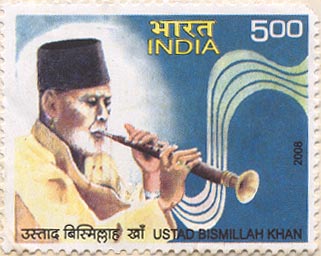
For example, the South Indian magazine Sruti regularly features philatelic reports on stamps issued by the Indian Department of Posts; these include an impressive number of commemorations of composers and performers from India’s classical Karnatak and Hindustani traditions. The stamp pictured above was issued to honor the śahnāī player Bismillāh Khān (1915–2006) on 21 August 2008.

Below, the music of Ghanaian postal workers canceling stamps.

Related article: Music stamps redux

Comments Off on Postage stamps

Filed under Asia, Iconography, Reception