Once he had decided on the value of a new work he was determined to program it, regardless of whether it was long, abstruse, dissonant, difficult to perform, or difficult to comprehend. Often he arranged for the major portion of the week’s rehearsal time to be devoted to perfecting the orchestra’s interpretation of the new work.
This according to “Serge Koussevitzky and the American composer” by Aaron Copland (The musical quarterly XXX/3 [July 1944] pp. 255–269); an appendix lists 123 American works that he programmed during his first 20 years in Boston.
Today is Koussevitsky’s 140th birthday! Below, his recording of Copland’s Appalachian spring.
Comments Off on Koussevitsky and American composers
In 2014 Edition text + kritik launched the series FilmMusik with Ennio Morricone, a collection of essays edited by Guido Heldt, Tarek Krohn, Peter Moormann, and Willem Strank. Compiled in the year of Morricone’s 85th birthday, the book encompasses traditional readings of his music as well as new perspectives on it.
Morricone became famous in the 1960s as the composer of the music for Sergio Leone’s spaghetti westerns. Their unconventional sound is, however, only one aspect of his multifaceted work, which—in addition to more than 500 film and television scores—also includes classical orchestral music, avant-garde jazz, electronic music, and borrowings from contemporary pop music styles. The book explores the full diversity of Morricone’s oeuvre and lets the maestro speak for himself in an exclusive interview.
Below, an excerpt from Giuseppe Tornatore’s Malèna (2000), one of five of Morricone’s Oscar-nominated film scores (he received an honorary Oscar in 2007).
Kaikhosru Shapurji Sorabji completed his Second Organ Symphony in 1932. Over 78 years later, on 6 June 2010, Kevin Bowyer premiered the work in a nine-hour marathon; the symphony is longer than Mahler’s first seven combined.
Bowyer performed from his own hand-written edition of the work’s 350+ page score. When he learned of the project, the composer asked a friend “Why is this young man going to such trouble?”
“Well”, the friend ventured, “had your manuscript been much clearer, he might not have had to.” Sorabji promptly retorted that if all his manuscripts had been written with such fastidious care he probably never would have gotten around to writing that symphony at all!
This according to “Sorabji’s second organ symphony played at last: Kevin Bowyer’s nine-hour marathon” by Alistair Hinton (The organ LXXXIX/353 [summer 2010] pp. 41–47).
Above, Sorabji in 1933, a year after completing the symphony; below, a much briefer example of his work.
Sun Ra’s music and poetry can claim to create otherwise impossible utopian worlds; this contrasts with the European Romantic tradition in which compositions or poems seek to describe utopian worlds that remain unattainable.
Music and words in Sun Ra’s view of the arts—a view based on African aesthetics—both have a magical function: they do not portray impossibilities but strive to make them a reality.
This according to “Pictures of infinity: Sun Ras klangliche Umrahmungen der Grenzenlosigkeit” by Christian Zürner, an essay included in “Was du nicht hören kannst, Musik”: Zum Verhältnis von Musik und Philosophie im 20. Jahrhundert (Hildesheim: Georg Olms, 1999, pp. 205–238).
Today is Sun Ra’s 100th birthday! Below, the Arkestra in 1976.
Nicolas Slonimsky’s Thesaurus of scales and melodic patterns (1947) is a highly systematic compendium of templates for composition and improvisation.
In an interview, Slonimsky stated that “the scales are compositions and they also provide materials for more extended compositions…I wrote several works in those scales.”
“Everybody warned me that only dyed-in-the-wool academics would touch the Thesaurus, but what actually happened was that academics did not care at all for it. So who picked it up? Jazz players!”
“I have interviewed McCoy Tyner, Coltrane’s pianist for a number of years, and he directly confirmed Coltrane’s use of the book. [According to Tyner,] Coltrane carried the book with him constantly during the years 1957 to ’59…He always took it with him when he travelled on concert tours, and…practiced it as part of his daily routine.”
Quoted in “Conversation with Nicolas Slonimsky about his composing” by Richard Kostelanetz (The musical quarterly LXXIV/3 [1990] pp. 458–72).
Today is Slonimsky’s 120th birthday! Below, selections from the Thesaurus played on electric guitar; a full open-source publication of the work is here.
BONUS: Coltrane’s Giant steps and Countdown, both of which are thought to have been influenced by Slonimsky’s Thesaurus.
In 1958 Miriam Gideon (1906–1996) completed her only opera: Fortunato, based on the eponymous tragicomic farce by the Spanish playwrights Serafín and Joaquín Álvarez Quintero (1871–1938 and 1873–1944, respectively).
Although Gideon’s opera has never received a full performance and has only been available until now in a marginally legible autograph copy of the piano-vocal score, it may be regarded as a central work within the composer’s style and oeuvre and an important American operatic work of the 1950s.
Fortunato: An opera in three scenes (1958) (Middleton: A-R Editions, 2013) includes the fully edited piano-vocal score along with a substantial introductory essay by the editor, Stephanie Jensen-Moulton, which summarizes Gideon’s compositional activity during the post–World War II years, her most active period. The essay also provides a context for the opera by examining attitudes toward women composers in the U.S. in the 1950s and by placing the work’s main themes into dialogue with recently discovered personal writings by the composer.
A supplement includes Gideon’s full orchestration of Fortunato’s first scene, recently discovered among the composer’s personal papers, which she may have intended as a sample to be pitched to television networks.
Alas, there are no recordings of Fortunato; below, another example of Gideon’s vocal writing—Bömischer Krystall from 1988.
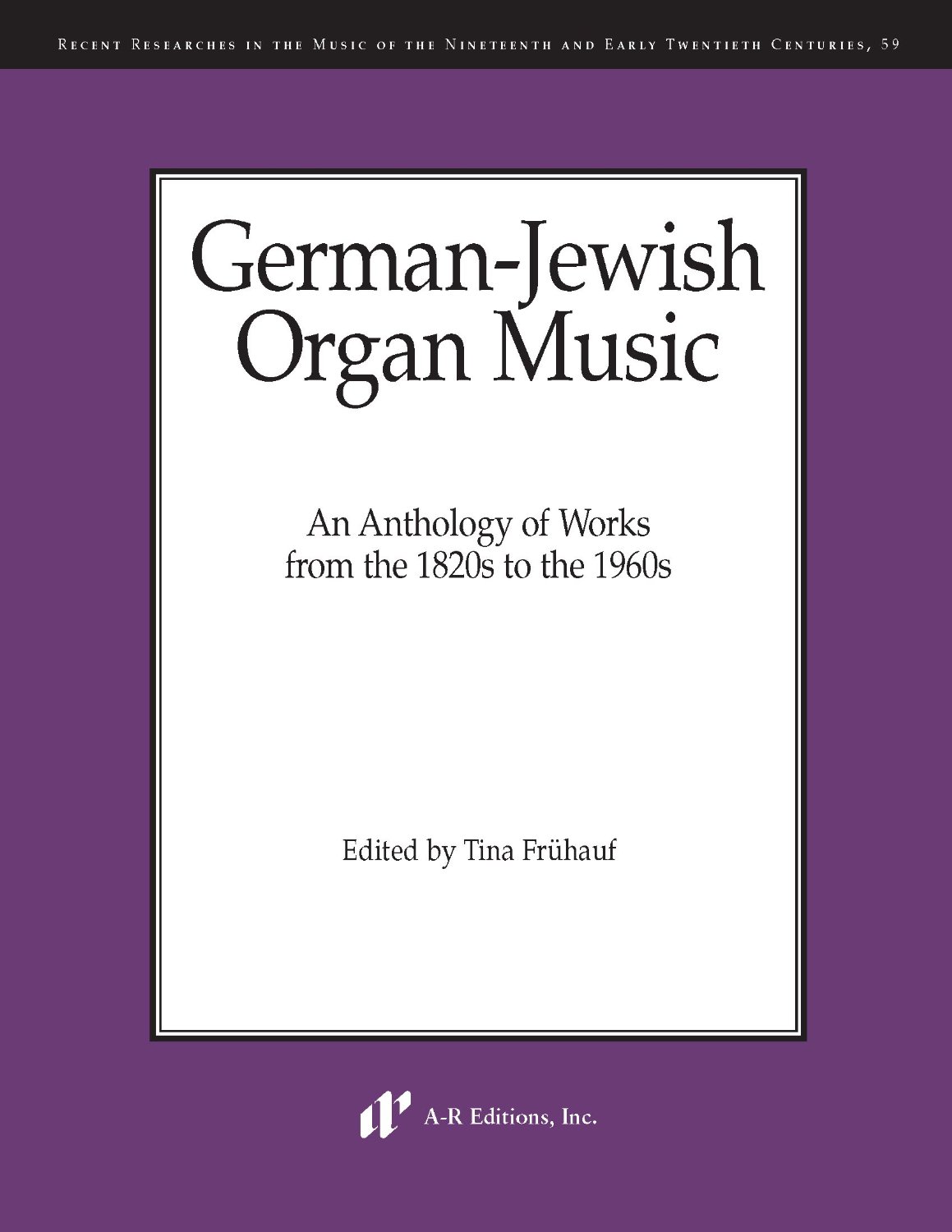
German-Jewish organ music: An anthology of works from the 1820s to the 1960s, edited by Tina Frühauf (Madison: A-R Editions, 2013), traces the main phases of the history and stylistic development of organ music in the Reform Jewish communities in Central Europe, as well as in the German-influenced communities of Königsberg (Kaliningrad) and Odessa, and works by German-Jewish composers who emigrated to the U.S. and Israel after World War II.
The small but respectable body of compositions for the organ in the synagogue is represented by fourteen exemplary works; the pieces span the period beginning with the Reform movement in the early 19th century to post-Holocaust works in the mid-20th century.
Initially oriented predominantly toward Christian models, a specifically Jewish style of organ music emerged in the late 19th century, made up from elements of both Jewish and Western musical cultures. The selected repertoire featured in the anthology, although all emanating from the same cultural milieu, is based on a wide variety of musical thematic material, including biblical cantillation, 19th-century synagogue song, Yiddish folk song, and the musical traditions of various Jewish cultural groups (Ashkenazic, Sephardic, and Yemenite).
Some of the selected repertoire corresponds to detailed analyses published in the editor’s monograph The organ and its music in German-Jewish culture (New York: Oxford University Press, 2009).
Below, music by Louis Lewandowski, with an assortment of relevant images; he is represented in German-Jewish organ music by his Fünf Fest-Präludien (1871),
This open-access resource includes a biography and an appreciation; a list of his compositions; bibliographies of his correspondence and writings about him; lists of concerts, lectures, and exhibitions held in his honor; and numerous photographs of him and facsimiles of his manuscripts and editions.
Below, Mitropoulos’s Greek sonata, performed by Charis Dimaras.
The work draws on both long-standing symbols of African American cultural identity and more immediate historical context. It is a modernist work as well, as Roach (1924–2007) and his musicians strove to make use of African and African American legacies in new ways.
Decades after the recording, We insist! still sounds fresh, modern, and haunting, reminding us that jazz tradition has always been in dialogue with the social and cultural movements going on around it, and has often been at its most inspired when engaged in social commentary.
This according to “Revisited! The Freedom now suite” by Ingrid Monson (JazzTimes XXXI/7 [September 2001] pp. 54–59,135; available online here).
Today is Roach’s 90th birthday! Below, a recording of the work.
BONUS: Roach was the first jazz musician to receive a MacArthur Fellowship! You can read about it here.
The Indian singer Jayashri Ramnath (better known as Bombay Jayashri) was introduced to Karnatak music in her early childhood, influenced by her parents’ roles as music teachers. Jayashri began her performing career at the age of 28, and having grown … Continue reading →
The country singer, songwriter, actor, and businesswoman Dolly Parton was the fourth of twelve children in a family of sharecroppers in Sevierville, Tennessee, located in the Appalachian Mountains. Commenting on her childhood, Parton once said, “Everybody where we grew up … Continue reading →
Women have been part of hip hop expression from its early days, primarily as part of MC crews such as the Funky Four Plus One and Sugar Hill’s female group, Sequence. For most of hip hop’s recorded history, however, women … Continue reading →
The music of Central America tends to borrow heavily from the music of Mexico to the north, Colombia to the south, and the Caribbean Islands to the east, and, in the case of Nicaragua, from the politically motivated nueva canción … Continue reading →