Natesan Ramani performed his debut seven decades ago. He has spent six decades as a soloist, five decades as a globetrotting star, four decades as a top-ranked performer and teacher, three decades as an academic, and two decades as an elder of the Karnatak music community.
This according to “N. Ramani: A front-rank flutist” by Manna Srinivasan (Sruti 223 [April 2003] pp. 21–29)—except that we have added one decade to each category in honor of his 80th birthday!
The system is based on one devised in the late 19th century by Victor-Charles Mahillon, the curator of musical instruments at the Conservatoire Royal de Bruxelles/Koninklijk Conservatorium Brussel. Mahillon divided instruments into four broad categories according to the sound-producing material—air column, string, membrane, or the instrument’s body. For the most part, Mahillon’s system was limited to instruments used in Western classical music; Hornbostel and Sachs expanded Mahillon’s system to make it applicable to any instrument from any culture.
The Hornbostel– Sachs system is formally modeled on the Dewey Decimal Classification for libraries. It has five top-level classifications, with several levels below those, adding up to over 300 basic categories; it was updated in 2011 as part of the work of the MIMO Project – Musical Instrument Museums Online.
Below, perhaps the grooviest time you’ve ever had with instrument classification.
In West Bengali tradition, a person known as a patua travels around the countryside to entertain with sung narratives illustrated with painted scrolls. The patua’s audiences are usually poor and illiterate, lacking access to televisions and films as well as to written entertainments.
Increasingly, however, patuas are finding that their scrolls are viewed as valuable folk art, and that their storytelling skills are in demand among the urban intellectual elite as a means of selling these illustrations, which thereby take on a new, passive function.
This according to “From oral tradition to folk art: Reevaluating Bengali scroll paintings” by Beatrix Hauser (Asian ethnology LXI/1 [2002] pp. 105–122). Below, a patua demonstrates her art.
BONUS: A more modern example of the patua’s skills used to raise ecological awareness, with English subtitles.
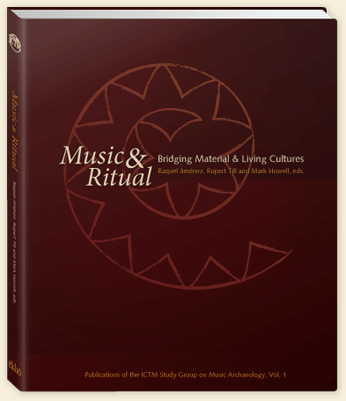
The volumes in this series are anthologies of peer-reviewed articles focused on a specific topic. Reflecting the broad scope of music-archaeological research worldwide, they draw in perspectives from a range of disciplines, including newly emerging fields such as archaeoacoustics, but particularly encouraging both music-archaeological and ethnomusicological perspectives.
Comments Off on Publications of the ICTM Study Group on Music Archaeology
On this day in 1864 all of the children in the parish schools marched in procession with flowers and wreaths, along with the Cheshire Rifle Volunteers Band and a cart carrying the May Queen and her ladies-in-waiting. Then, as now, the procession ended on the Heath in the center of town, where the Queen was crowned.
Today the tradition is augmented with several dances, both as part of the procession and as displays before and after the crowning; morris, hornpipe, and sword dances are among the perennial favorites. Maypole dances round out the proceedings.
This according to “Royal May Day!” by Derek Schofield (English dance and song LXXVI/1 [spring 2014] pp. 32–35). Below, selections from the 145th celebration.
A week-long festival centered on stories about the deity Kṛṣṇa is held in the hamlet of Naluna, Garhwal district, Northern India; this practice (known as a saptāh) is primarily a product of an elite Hindu community of the North Indian Plain.
Two loci of power are salient: the village deity representing local authority, and the text-as-artifact of the Bhāgavata purāṇa, the metonymy of the authority of the recently imported cultural practice.
The local community comprises modern subjects and empowered agents, accounting for the nature of the interaction between the village deity and the sacred text, and the new cultural synthesis that emerges.
This according to “Village deity and sacred text: Power relations and cultural synthesis as an oral performance of the Bhāgavatapurāṇa in a Garhwal community” by McComas Taylor (Asian ethnology LXX [2011] pp. 197–221).
Taarab’s performers and audiences consider the genre to be a link to Egypt as another powerful place of coastal imagination, but it demonstrably owes more to centuries of exchange across the Indian ocean.
Despite the political agendas that engulfed Zanzibar in the mid-20th century, Swahili musical and urban sensibilities prevailed, and taarab continues to flourish. However, the older style of song text, which thrived on social commentary and improvisation, gave way in the 1950s to songs about the human condition, particularly romantic love songs.
This according to “Between mainland and sea: The taarab music of Zanzibar” by Werner Graebner, an essay included in Island musics (Oxford: Berg, 2004).
The June 2013 issue of Journal of new music research (XLII/2) is a special issue devoted to computational ethnomusicology.
The editors, Emilia Gómez, Perfecto Herrera, and Francisco Gómez-Martin, explain that the term computational ethnomusicology is over 30 years old, but it has recently been redefined as “the design, development, and usage of computer tools that have the potential to assist in ethnomusicological research.”
Above, a diagram of the Tarsos platform from “Tarsos, a modular platform for precise pitch analysis of Western and non-Western music” by Joren Six, Olmo Cornelis, and Marc Leman (pp. 113–29). Below, a vintage computer cover of The house of the rising sun.
C. Saraswati Bai (1874–1974) began studying Karnatak music at the age of 6, and by the time she was 9 her exceptional talent was so evident that the harikathā guru Tiruvaiyaru Krishnachar took her under his wing.
By the age of 11 she was gaining local notoriety, and as it became clear that she was contemplating a professional career the established performers of this male-dominated genre moved to undermine her, effectively blackmailing performance venues into refusing to engage her. Saraswati persevered, and public support for her grew; at last, those who had sought to squelch her career relented and tried to make amends.
In early 1911 she embarked on a highly successful tour of India and Sri Lanka, and by the age of 22 she had become one of the most acclaimed harikathā performers of the time.
From 1913 through the 1930s Saraswati traveled almost continually, performing standing up for six to seven hours in a different town each night. She recorded nine successful records for Odeon, and often performed on the radio; she was also in great demand for performances at weddings. At the height of her career she earned 2000 rupees each night, more than any other harikathā performer at that time.
From the 1940s until the early 1960s Saraswati performed less and less, due partly to a decline in audiences with the advent of sound films, and partly to the intense physical demands of traveling and performing. She took a keen interest in developing cultural organizations, and was an ardent supporter of Gandhi.
This according to “C. Saraswati Bai” by Sriram Venkatakrishnan (writing as Sriram V; Sruti 262 [July 2006] pp. 21–31 and 263 [August 2006] pp. 17–38). Below, one of her Odeon recordings.
Zoomusicology is an area of intellectual endeavor that developed outside of music studies, among scholars interested in animal behavior.
Although this field is almost 30 years old, people operating in ethnomusicology, who are potentially the better equipped to understand the goals and challenges of zoomusicology, are often not aware of how compatible the two fields are.
Zoomusicology and ethnomusicology have much to gain from each other. Moreover, if ethnomusicology indeed has the ambition to be a field that brings together musical knowledge in a worldwide perspective, then one would have to maintain that zoomusicology should be seen as part of ethnomusicology.
This according to “Zoomusicology and ethnomusicology: A marriage to celebrate in heaven” by Marcello Sorce Keller (Yearbook for traditional music XLIV [2012] 166–83). Above and below, lupine group vocalizations.
The Indian singer Jayashri Ramnath (better known as Bombay Jayashri) was introduced to Karnatak music in her early childhood, influenced by her parents’ roles as music teachers. Jayashri began her performing career at the age of 28, and having grown … Continue reading →
The country singer, songwriter, actor, and businesswoman Dolly Parton was the fourth of twelve children in a family of sharecroppers in Sevierville, Tennessee, located in the Appalachian Mountains. Commenting on her childhood, Parton once said, “Everybody where we grew up … Continue reading →
Women have been part of hip hop expression from its early days, primarily as part of MC crews such as the Funky Four Plus One and Sugar Hill’s female group, Sequence. For most of hip hop’s recorded history, however, women … Continue reading →
The music of Central America tends to borrow heavily from the music of Mexico to the north, Colombia to the south, and the Caribbean Islands to the east, and, in the case of Nicaragua, from the politically motivated nueva canción … Continue reading →