A number of people attend U.S. bluegrass festivals not for the stage show, but for the informal jam sessions in the campgrounds or parking lot.
The interactional etiquette that jammers follow is manifested both in the conventions that help strangers to come together and in choices made during group playing of bluegrass standards. Ethics and aesthetics are fused as jammers negotiate interactional guidelines to reach a heightened musical and social communion.
This according to “A special kind of courtesy: Action at a bluegrass festival jam session” by Michelle Kisliuk (TDR: The drama review XXXII/3 [fall 1988] pp. 141–155). Above and below, festival attendees jamming with that special courtesy.
In the late 19th century the new Japanese government chose European models for economic and political systems; it also chose European music as its official standard.
European musicians were brought to Japan, and in 1879 Franz Eckert (above) arrived in response to Japan’s request to the German navy for a kapellmeister. As a conductor for the Japanese navy and teacher at military and civilian music schools, he was among the most influential European musicians in Japan in the 1800s.
Eckert is widely considered the composer of Japan’s national anthem, Kimi ga yo, though he maintained that he merely arranged an old Japanese melody.
This according to “German military musicians in Japan during the early Meiji Era (since 1868)” by Wolfgang Suppan and Wilhelm Baethge (Journal of the World Association for Symphonic Bands and Ensembles III [1996] pp. 13-32). Below, Kimi ga yo as it was sung by Koyanagi Yuki and the audience when Japan played Trinidad and Tobago in 2006.
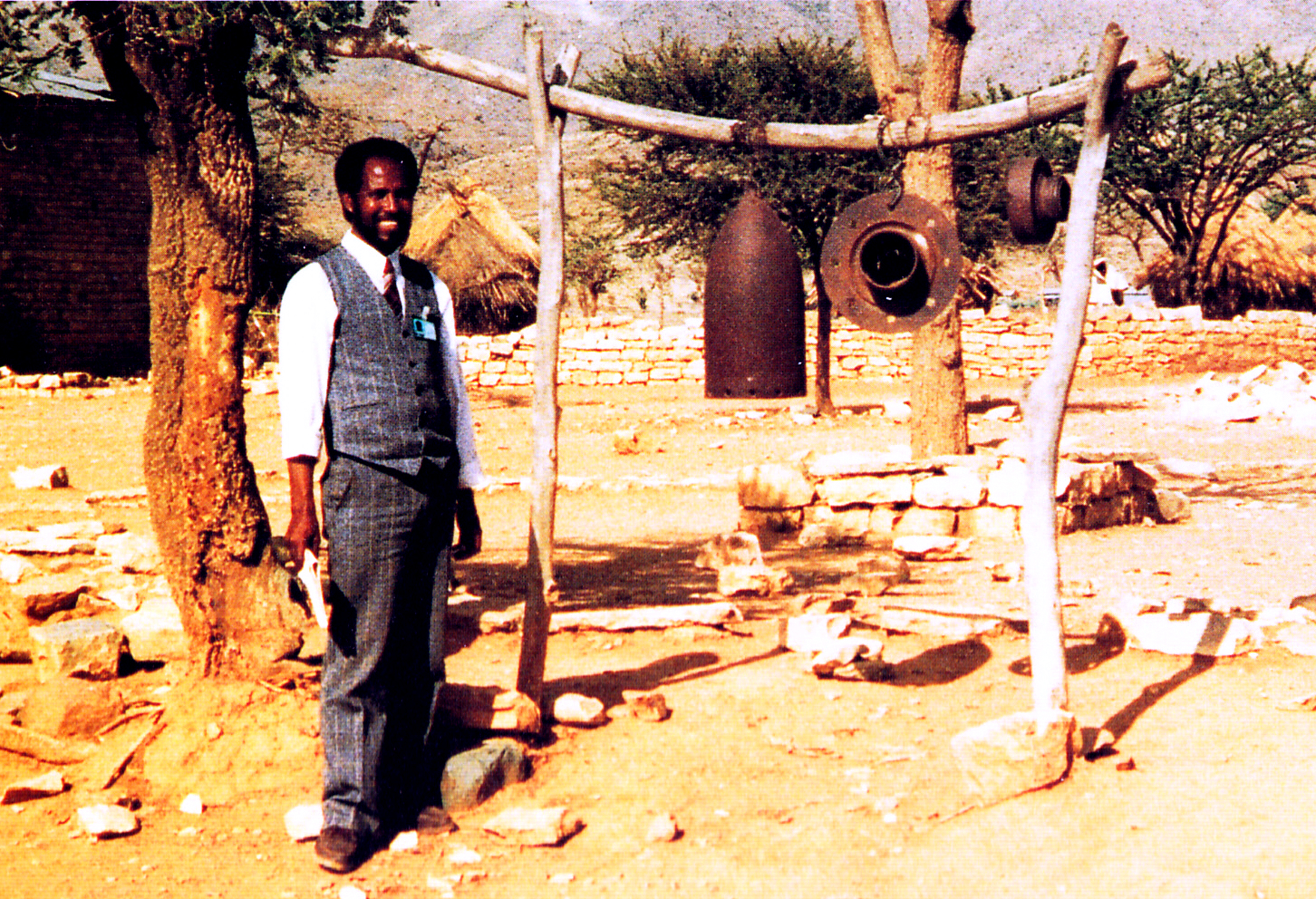
During their Revolution (1974–91) the Ethiopian penchant for not throwing anything away was, out of necessity, given full rein; ammunition boxes were converted to book satchels, artillery shells were made into pots and pans, and so on.
In one instance, a traditional three-piece gong ensemble associated with the Ethiopian Orthodox Christian Church was made from components of an abandoned Soviet-made tank; some 600 of these tanks were used in Ethiopia during the 1970s and 1980s. Struck by an acolyte using a small stone, the gongs mark the beginnings of services and other notable events.
This according to “Make army tanks for war into church bells for peace: Observations on musical change and other adaptations in Ethiopia during the 1990s” by Cynthia Tse Kimberlin, an essay included in Turn up the volume! A celebration of African music (Los Angeles: Fowler Museum of Cultural History, 1999, pp. 124–131).
Above, the bells in question; below, a comparable set of Ethiopian stone chimes (please turn your screen or head sideways).
When he came to power in 1970, Sultan Qaboos bin Said of Oman began efforts aimed at modernization and reversing isolationism. Having graduated from an English military academy and served in a Scottish regiment, he had developed a taste for Western military band and Scottish bagpipe music.
During the 1970s and 1980s several military wind bands and bagpipe bands were founded at his command, with only Omani musicians allowed. The pressure to perform well was intense, and a high standard of musicianship was attained in a fairly short time.
Increasingly, efforts are being made to include Arabic music in the repertoire; bagpipes are considered particularly suitable, as their intervals match some Arabic scales better than those of wind band instruments.
Tuk, a syncretic fife and drum tradition of Barbados, may have roots stretching back to the first stationings of British troops there in the 17th century; it was the music of the black plantation slaves until Emancipation in 1838.
Two specific functions for tuk developed subsequently: as entertainment for the working classes and as the music of Landship, a music and dancing society. The tradition declined during the 20th century due to several cultural factors, but a revival began in the 1970s, and in the 1990s the government started to promote tuk as a uniquely Barbadian tradition.
This according to “Tuk music: Its role in defining Barbadian cultural identity” by Sharon Meredith (European meetings in ethnomusicology VIII [2001] pp. 16–25).
Above, a tuk band and their stock character Mother Sally interacting with their audience; below, a tuk band at a local festival, first in a parade and later joined by dancers (ca. 4:50).
For centuries Central Asia has been a crossroads of civilizations, peoples, and societies, a land in between East and West and a territory contested by political powers. Its modern history—from imperial and Soviet domination to the emergence of independent nation-states—has witnessed a profound transformation of its political and social geography, calling for a re-evaluation of Central Asia as a region, not least in terms of its expressive cultures and music.
Near the end of his visit to Rome in 1933, the Hindustānī vocalist Omkarnath Thakur (1887–1968) received an invitation to dine with Mussolini; Il Duce had caught wind of Thakur’s theories and experiments regarding the inducement of emotional states by rāga performances, and he wanted a demonstration.
After a specially prepared vegetarian dinner, Thakur began with hindolam, which depicts valor. “When I was soaring in the high notes of the rāga,” he later recalled, “Mussolini suddenly said ‘Stop!’ I opened my eyes and found that he was sweating heavily. His face was pink and his eyes looked like burning coals. A few minutes later his visage gained normalcy and he said ‘A good experiment.’”
After Thakur brought him to tears with rāga chayanat, which is meant to depict pathos, Mussolini said, after taking some time to recover, “Very valuable and enlightening demonstration about the power of Indian music.”
Il Duce then returned the favor: Producing his violin, he treated Thakur to works by Paganini and Mozart. Again, both agreed on the music’s power to evoke emotion.
“I could not sleep at all the entire night,” the vocalist recalled, “wondering whether the meeting had really taken place; I thought it was a part of a dream.” The next day, two letters from Mussolini arrived—one thanking him and one appointing him as director of a newly formed university department to study the effect of music on the mind (an appointment that he was unable to accept).
This according to “Omkarnath Thakur & Benito Mussolini” by B.K.V. Sastry (Sruti 163 [April 1998] pp. 19–21; RILM Abstracts 1999-26342).
Although the exact date of this meeting is not recorded, we know that it took place in May 1933—80 years ago this month! Below, Thakur performs rāga bhairavi.
This bilingual series aims to raise the study of the music-related activities of the pre-Columbian Americas to a new level, with peer-reviewed studies of both past and living traditions, providing a platform for the most up-to-date information on the music archaeology of the New World.
Below, a brief film about the pre-Columbian instruments of Mexico.
The Tibetan saga of King Gesar of Ling comprises some 120 epics; individuals have been documented performing as many as 40 of these, and some claim that they are able to perform all of them.
While most performers study and learn in the usual oral fashion, those known as ’babs-sgrung seem to have acquired the ability to reproduce them without effort: Often after a mysterious dream, they discover that they suddenly have the power to recite whole epics at will.
This according to “Bab sgrung: Tibetan epic singers” by Zhambei Gyaltsho (Oral tradition XVI/1 [2001] pp. 280-293). Above, a mural depicting King Gesar; below, a brief documentary on one of the genre’s practitioners.
Dating from the 5th century B.C.E., the tomb of Marquis Yi of Zeng in Suizhou, Hubei, furnished some of China’s oldest musical instruments and earliest reliable musicological writings.
The instruments, found in two separate rooms, appear to represent two separate musical genres. Those in the large central chamber—65 bronze bells in graduated sizes ranging over more than five octaves, a large pole-drum and two smaller drums, seven large 25-string se (zithers), four sheng (mouth organs), two paixiao (panpipes), and two chi (transverse flutes)—match the description of a courtly ensemble described in the Shijing (551–479 B.C.);
The instruments in the smaller chamber containing the Marquis’s coffin—two mouth organs, one small frame drum, three se, and one five-stringed and one ten-stringed instrument—suggest a more intimate chamber genre such as that depicted in a 5th-century tomb in Shaoxing, Zhejiang. These two genres may correspond to the “old” music of the Zhou court (ca. 1050–256 B.C.) that Confucius preferred, and the “new” music of the surrounding states that he felt had a corrupting influence.
This according to “Different tunes, different strings: Court and chamber music in ancient China” by Jenny F. So (Orientations XXI/5 [May 2000] pp. 26–34). Above, replicas of the bells; below, a performance on the bell replicas and those of other instruments from the tomb.
The library of the Institut du Monde Arabe (Arab World Institute) in Paris is home to an extensive collection of writings on music from the Arab world, a region stretching from the Atlas Mountains to the Indian Ocean. This series … Continue reading →
The Filipino ethnomusicologist and composer Jose Maceda created unique works that blended his fieldwork on Filipino and other music with his expertise in European avant-garde traditions. His compositions combined innovative techniques such as spatialization, a focus on timbre, and musique … Continue reading →
The Senegalese singer, songwriter, musician, and politician Youssou N’Dour was born just six months before Senegal achieved independence. His mother hailed from a long line of griots, or gawlo, who served as hereditary musicians and custodians of oral history in … Continue reading →
Ellis Marsalis first learned to play the clarinet and saxophone but the piano later became his main instrument. From 1951 to 1955, he completed a bachelor’s degree in music education at Dillard University in New Orleans while receiving informal jazz … Continue reading →