Tag Archives: Keyboard

RILM’s first digital platform

From its inception in the mid-1960s, it was clear that a sophisticated set of computer programs would be essential to achieve the goals of the newly established RILM project. Automation was the buzzword of the day, with the American Council of Learned Societies collaborating with New York University’s Institute for Computer Research in the Humanities to integrate it across various sectors. However, when RILM’s founder, Barry S. Brook, presented his programming specifications to the Director of the Institute detailing the need for various fonts, accents, indexing, and features like random inputting and automatic numbering of abstracts, the response was far from optimistic. Despite RILM being set to launch in just six months, Brook was told that developing such a program would take approximately three years.

Core memory array of an IBM S/360 with transistor driver boards. (Image courtesy of Ken Shirriff’s blog)

At the time, Brook was also collaborating on a digital musical analysis program at Queen’s College with Richard Golden, a computer science student whom Brook described as “one of those whiz kids who seemed to have been born inside an IBM 360”. After hearing Brook’s specifications for the RILM platform, Golden spent three days pondering the challenge before presenting Brook with a solution in the form of scribbled diagrams and notes. Although Golden could not finish all the software before the publication of the first RILM issue, he successfully completed the programming for the crucial author and subject indexes. Soon after, a fully functional set of programs was up and running, including a custom-built, oversized keyboard that featured four different fonts, all possible accents, compound letters, foreign symbols, and even musical notation. Given that most keyboards at the time only supported capital letters and a single font, the creation of this keyboard was a remarkable feat. It also allowed for editing to be done directly on the computer screen, eliminating the need to sift through complex codes.

Leave a Comment

Filed under RILM

Electroacoustic sound, multimedia, and digital opera

Digital opera has roots in electroacoustic works that integrate spatial soundscapes into performance, such as Kaija Saariaho’s L’amour de loin (2000, pictured above). Musicologist Anna Schürmer offers a broader view, tracing its history even further, suggesting its origins may precede electroacoustic sound. Schürmer links the evolution of digitally mediated works to the construction of larger 18th century theaters, where sound connected audiences across physical divides. Earlier multimedia-infused productions, like Bernd Alois Zimmermann’s Die soldaten (1965), Harrison Birtwistle’s The mask of Orpheus (1986), Libby Larsen’s Frankenstein (1990), and Bill Viola’s The Tristan project (2004, in collaboration with the Los Angeles Philharmonic), are significant for their use of electronics. However, they fall short of utilizing digital sound sample processing. Additional antecedents include mid-20th century radio plays and performances where multimedia significantly shaped the auditory experience.

A production of Viola’s The Tristan project.

From Rihm’s Die Hamletmaschine.

The most prominent use of contemporary digital technology in opera lies in sound design, where digital processing techniques shape how audiences perceive sound within the performance space. This innovation builds on earlier milestones, including IRCAM (the French institute of research on music and sound) performances employing electronic or MIDI keyboards and voice, such as Wolfgang Rihm’s Die Hamletmaschine (1987) and various works by Karlheinz Stockhausen. In the 21st century, the digital manipulation of sound samples has become a staple–though often overlooked–in both contemporary and traditional operatic productions, with subtle amplification techniques further extending its reach.

This according to the new entry on digital opera by Megan Steigerwald Ille, in DEUMM Online.

Below is a performance of Die soldaten with music by Bernd Alois Zimmermann, along with an excerpt from Kaija Saariaho’s L’amour de loin sung by the soprano, Susanna Phillips.

Read related Bibliolore posts:

https://bibliolore.org/2024/03/19/kaija-saariahos-avant-garde-sound-worlds/

https://bibliolore.org/2014/04/05/spohr-and-german-opera/

https://bibliolore.org/2011/07/10/italian-opera-manuals/

Comments Off on Electroacoustic sound, multimedia, and digital opera

Filed under Opera, Sound, Space, Uncategorized

Liszt’s monster instrument

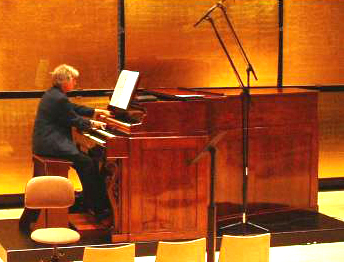
In September 1854 Liszt wrote to the cellist Bernhard Cossmann “My monster instrument with three keyboards arrived about a fortnight ago and seems to be a great success.”

The 3000-pound instrument, a seven-octave grand piano plus two five-octave harmonium keyboards, was built by Alexandre Père et Fils and Pierre Érard to Liszt’s specifications. Although the critic Richard Pohl reported having heard the composer play this piano-harmonium, apparently it was never heard in concert until Joris Verdin (left) presented a recital on the instrument, newly restored by Patrick Collon and the Manufacture d’orgues de Bruxelles 150 years after it was built, at the Wiener Musikverein.

In addition to the piano and pumping pedals seen above, the original version included a 20-note pedalboard and an attachment allowing an assistant to pump the bellows while the player used the organ or piano pedals; these are lost and have not been reconstructed.

This according to “Liszt’s monster instrument revisited” by Wayne T. Moore (The diapason XCVI/5 [May 2005] p. 15). Today is Liszt’s 210th birthday!

Below, Professor Verdin demonstrates Liszt’s monster instrument.

More posts about Franz Liszt are here.

6 Comments

Filed under Curiosities, Instruments, Romantic era