Boccherini and embodiment

boccherini

Boccherini’s posthumous reputation has suffered because his works do not emphasize the structural coherence and teleology emblematic of 18th-century Classicism; but regarded through the lens of performance—the sensations and images involved in its bodily presentation—his works evoke those aspects of the era characterized by urgent, even volatile, inquiries into the nature of the self.

Contemporaneous theories of embodiment illuminate the heart of Boccherini’s oeuvre, the chamber music for strings, which presents sensibilité through repetitiveness, a hyperattention to details of dynamics and articulation, the grotesque and bizarre timbres and registral excesses, and Newtonian mechanistic philosophy through gestural enactments of rapidity and rigidity.

These works often distance and ironize the performer, particularly in regard to virtuosity. They thereby make a sophisticated contribution to the central Enlightenment tension between subjectivity and appearance so memorably articulated in Diderot’s Paradoxe sur le comédien.

This according to “‘One says that one weeps, but one does not weep’: Sensibile, grotesque, and mechanical embodiments in Boccherini’s chamber music” by Elisabeth Le Guin (Journal of the American Musicological Society LV/2 [summer 2002] pp. 207–54).

Today is Boccherini’s 270th birthday! Below, a work cited by Le Guin as an example.

Comments Off on Boccherini and embodiment

Filed under Classic era

Corelli in the wilderness

Arcangelo_Corelli

On 26 April 1706, in a solemn ceremony in Rome, Arcangelo Corelli was accepted as a member of the Accademia dell’Arcadia; as customary, he assumed a shepherd’s name: Arcomelo.

Forty years later, the Swiss Jesuit Martin Schmid copied several of Corelli’s works into his draft-book of music for the Indian community in Bolivia that he was fostering and overseeing—a community that was sometimes known as New Arcadia.

In Bolivia, Corelli’s Arcadian music was subjected to a radical metamorphosis by those who understood Indian performers and audiences. His works were thereby consigned to a museum of cultural symbols as objects of a revered past.

This according to “Arcadia meets Utopia: Corelli in the South American wildnerness” by Leonardo J. Waisman, an essay included in Arcangelo Corelli: Fra mito e realtà storica–Nuove prospettive d’indagine musicologica e interdisciplinare nel 350° anniversario dalla nascita (Firenze: Leo S. Olschki, 2007, pp. 651–85).

Today is Corelli’s 360th birthday! Below, the original version of one of the works that was subjected to a Bolivian metamorphosis.

Comments Off on Corelli in the wilderness

Filed under Baroque era, Curiosities

Music and delinquency

frankie-lymon-im-not-a-juvenile-delinquent

A four-year longitudinal study (n = 309) explored whether early adolescents’ preferences for nonmainstream types of popular music indicate concurrent and later minor delinquency.

The results showed that early fans of types of rock (e.g., rock, heavy metal, gothic, punk), African American music (rhythm and blues, hip-hop), and electronic dance music (trance, techno, hardhouse) showed elevated minor delinquency concurrently and longitudinally. Preferring conventional pop or highbrow music (classical music, jazz), in contrast, was not related to or was negatively related to minor delinquency.

Early music preferences emerged as more powerful indicators of later delinquency than early delinquency, indicating that music choice is a strong marker of later problem behavior.

This according to “Early adolescent music preferences and minor delinquency” by Tom F.M. ter Bogt, Loes Keijsers, and Wim H.J. Meeus (Pediatrics CXXXII/2, pp. e382–e389). Many thanks to the Improbable Research blog for bringing this article to our attention!

Below, Jerry Lee Lewis introduces an earlier study.

BONUS: The Frankie Lymon classic pictured above.

Related article: Sexual attraction by genre

Comments Off on Music and delinquency

Filed under Curiosities, Popular music

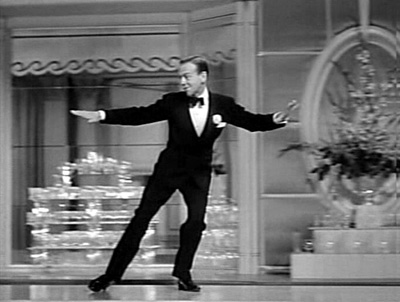
Fred Astaire’s drunk dances

Astaire

In his comic depictions of drunk dancing, Astaire used choreography to project social views and feelings about drunkenness, and to set up tensions between those qualities of inebriation and the precision and agility that his dancing embodied.

Memorable examples include the solo number “One for my baby (and one more for the road)” in The sky’s the limit (1943, above and below).

This according to “Stepping high: Fred Astaire’s drunk dances” by Sally Banes, an essay included in Writing dancing in the age of postmodernism (Hanover: Wesleyan University Press, 1994, pp. 171–183).

BONUS: The astonishing New Year’s Eve dance from Holiday Inn.

2 Comments

Filed under Dance

Stuttgarter Musikwissenschaftliche Schriften

Was bleibt

In 2011 Schott launched the series Stuttgarter Musikwissenschaftliche Schriften with Was bleibt? 100 Jahre Neue Musik, edited by Andreas Meyer.

Noting that the musical revolutions of Debussy, Stravinsky, and Schoenberg are over a century old, and that the experimentalism of the 1950s belongs to a bygone era, the authors assess the current new music scene and demonstrate how audiences have changed in recent years.

Below, Stockhausen’s pioneering Gesang der Jünglinge (1955–56).

Comments Off on Stuttgarter Musikwissenschaftliche Schriften

Filed under 20th- and 21st-century music, New series

Folk lexicon

weavers

Folk lexicon: Lexicon of the modern folk fan was published by Caffè Lena in 2013.

This free online resource provides information on the folk music scene as it has evolved (mainly in North America) since the 1950s. Categories include awards, folk festivals, instruments, musical styles, publications, radio shows, and record companies, along with discussions of terminology and corny nicknames.

Above, the Weavers were influential founders of the contemporary scene. Below, the group’s 1980 reunion at Carnegie Hall.

Related articles:

Comments Off on Folk lexicon

Filed under Resources, World music

Studien, Beiträge und Materialien zur Leschetizky-Forschung

Leschetizky book

The series Studien, Beiträge und Materialien zur Leschetizky-Forschung was launched by Musikverlag Burkhard Muth in 2011 with Theodor Leschetizky by Annette Hullah, in a German translation from the original English (London: J. Lane, 1906).

This volume is particularly suitable as the beginning of the series, since—in addition to presenting a contemporaneous, authentic text—it provides an ideal introduction for those who know little or nothing about the pianist, composer, and teacher.

The first two chapters are devoted to Leschetizky’s biography; the remaining chapters explore his approach to teaching. Information on newly published editions of his piano works is also included.

Below, Leschetizky plays one of his own compositions via piano roll.

Comments Off on Studien, Beiträge und Materialien zur Leschetizky-Forschung

Filed under New series, Romantic era

Hound music

hounds

West Virginians appreciate the music made by hounds baying during a fox chase, and there are various tastes in the matter.

Some hunters prefer a “coarse mouth” whereas others esteem a “fine” or “tenor mouth”; other terms for hound vocalizations include “fast chop”, “turkey mouth”, and “pretty-tongued beller”.

This according to “‘Listen to that beautiful music’: Fox chasing in the Mountain State” by Gerald Milnes (Goldenseal XX/2 [summer 1996] pp. 27–33). Below, a polychoral welcoming anthem.

Related articles:

3 Comments

Filed under Animals

Negativland and U2

U2_Negativland

Negativland is a group of sound artists who mix fragments and samples of sounds from the mass media to produce a parodic critique of contemporary culture.

The group’s 1991 single U2 combined samples from and a vocalized parody of the band U2’s I still haven’t found what I’m looking for with studio outtakes of Casey Kasem verbally abusing his staff on the American Top 40 radio program. Soon after the single was released it was pulled from stores and Negativland was sued by Island Records, Warner-Chappell Music (U2’s label and music publishing company, respectively) and by their own label, SST.

Over time a community arose that provided a loose distribution system for the recording, along with a medium for producing and disseminating an oppositional discourse to the dominant legal and economic system that had stopped its legitimate release.

This according to “Negativland, out-law judgments, and the politics of cyberspace” by John Sloop and Andrew Herman, an essay included in Mapping the beat: Popular music and contemporary theory (Malden: Blackwell, 1998).

Below, the recording in question. Warning: Negativland is not shy about using profanity.

1 Comment

Filed under 20th- and 21st-century music, Curiosities, Popular music

17th-century Persian music

Kaempfer

“Fifteen musicians sat in a crosswise position on both sides, and thus in a broken row divided into two groups; these in turn sounded together a strange tune with reed-instruments, cymbals and various stringed instruments; drums struck with a light finger, and less often the human voice, joined in with them.

Perhaps you expect my opinion about this ensemble? A noise rather than an ensemble, it was unencumbered by any rules of harmony, but nevertheless not confused nor disagreeable; in truth if I except the singer’s voice, it was pleasant enough, and subordinated to the extent that it did not disturb the conversations or the proceedings in the assembly, but rather with a certain strangeness in its varied but low-level sound caressed the ears and spirits of the seated company with its sweetness.”

So wrote Engelbert Kaempfer in Amoenitates Exoticae (1712), which documented his observations in Persia in the late 17th century. Excerpts from the book are translated in Time, place and music: An anthology of ethnomusicological observation c. 1550 to c. 1800 by Frank Harrison (Amsterdam: Fritz Knuf, 1973).

Above, a plate from the original publication; below, a modern-day performance of Persian court music.

Related articles:

2 Comments

Filed under Asia, Curiosities, Ethnomusicology, Instruments