In the 1960s boogaloo, a dance akin to the jitterbug, leapt out of New York’s black and Latino communities and swept across the U.S. Boogaloo music and dance also captured the hearts of white teenagers, driving men like Berry Gordy and the founders of Stax Records to find musicians who could capitalize on this crossover appeal.
Tupac Shakur, Dr. Dre, and other rappers are anointed heirs of these R&B musicians, as hip hop is firmly rooted in boogaloo.
This according to Boogaloo: The quintessence of American popular music by Arthur Kempton (New York: Pantheon, 2003).
In the eiri-kyōgenbon (illustrated editions of kabuki plot synopses) of the Genroku reign (1688–1704), evidence is found for the representation of exotic animals on the kabuki stage: tigers and elephants, regarded as Chinese animals, in plays of the Edo tradition, as fierce opponents of the protagonist; and peacocks in the Kamigata (Kyōto-Ōsaka) style, in kaichō scenes (the unveiling of a Buddhist image).
It is not clear whether stuffed prop animals were always used or if actors portrayed the animals; it seems certain that real animals were not used.
This according to “元禄歌舞伎に登場する動物” (Animals in Genroku kabuki) by 鎌倉 恵子 (Kamakura Keiko), an article included in Kabuki: Changes and prospects—International Symposium on the Conservation and Restoration of Cultural Property (Tōkyō: Tōkyō Kokuritsu Bunkazai Kenkyūjo/National Research Institute for Cultural Properties, Tokyo, 1998, pp. 135–47).
Above, Bandō Mitsugorō I as a samurai subduing a tiger; below, a modern-day kabuki dragon.
Happy Boxing Day! On this day in 1899 Cecil Sharp witnessed a performance by the Headington Quarry Morris Dancers at the home of his mother-in-law. Intrigued by the tunes, he invited William Kimber, the group’s concertina player, to return the next day so that Sharp could notate them.
Sharp did not begin his folk song collecting until four years later, and in 1905 Mary Neal, an organizer at the Espérance Club for girls, asked Sharp if there were any dances to go with the tunes he had collected. Sharp referred her to Kimber, who traveled to the club to teach the dances, thus beginning the revival of traditional dance in England.
This according to “Absolutely classic” by Derek Schofield (English dance and song LXI/2 [summer 1999] pp. 8–9). Above, the Headington Quarry Morris Dancers in 1916, With Kimber and his concertina front and center. Below, Kimber plays Getting upstairs in 1946.
The notion of “dancing to Sinatra” immediately calls to mind images of World War II-era GIs and their sweethearts dancing cheek-to-cheek to the crooner’s ballads or couples jitterbugging to Five minutes more.
A provocative presence among social dance musicians of the swing era, Sinatra’s songs have also inspired the dancing of professional choreographers in ballet and modern dance. Perhaps the most important choreography created for the concert stage to Sinatra’s music is Twyla Tharp’s Sinatra suite, which was choreographed in 1983 for American Ballet Theatre’s Mihail Baryšnikov and Elaine Kudo.
This according to “Dancing to Sinatra: The partnership of music and movement in Twyla Tharp’s Sinatra suite” by Lisa Jo Sagolla, an essay included in Frank Sinatra: The man, the music, the legend (Rochester: University of Rochester, 2007, pp. 117–23).
Today is Sinatra’s 100th birthday! Above, recording dance music for the kids; below, an excerpt from Tharp’s work.
The U.S. television series So you think you can dance is located within the broader aesthetics of popular screen dance rather than in the aesthetic realm of reality television, as dance has been featured in popular screen media—big and small—since the birth of the moving picture medium.
Taking into consideration the aesthetics, structure, and star personas from the backstage Hollywood musical of the studio era, So you think you can dance draws on and transforms this earlier contribution to popular screen dance, creating a haunted space as a result.
The start of the new millennium has seen another upsurge in the production of dance for popular moving picture media, and an increasing presence of dance in the mass mediascape. As So you think you can dance is simultaneously located at the beginning and in the middle of this new popular dance craze, it actively contributes to the reconfiguration of traditions from popular screen dance aesthetics.
This according to “‘We are not here to make avant-garde choreography!’: So you think you can dance and popular screen dance aesthetics” by Elena Natalie Benthaus, an essay included in Dance ACTions: Traditions and transformations (Society of Dance History Scholars 2013, pp. 55–62).
Comments Off on Reconfiguring popular screen dance
Ballet manga, in which the heroine withstands numerous trials to become a notable dancer, is very popular among Japanese girls and women, and has greatly contributed to the establishment of ballet in Japan.
The genre emerged during the 1950s; with an increase in its popularity, more children began attending private ballet classes, since Japan had no official ballet schools. After some decades now, many Japanese dancers have begun winning international dancing competitions.
While most ballet manga is fictional, some examples have been based on the lives of famous ballet dancers such as Vaclav Nižinskij and Maria Tallchief.
This according to “The relationship between ballet and manga in Japan” by Yukiyo Hoshino, an essay included in Writing dancing/Dancing writing (Birmingham: Society of Dance History Scholars, 2014, pp. 103–106).
Above, the first volume of Swan, a popular serialized ballet manga from the 1970s; below, the related genre of ballet anime.
What is partnered social dance but a ritualized embodiment of the battle of the sexes? The inevitable symbolism of women and men moving and touching, from 18th-century cotillions and reels, to 19th-century European style waltzes, to the ragtime dances of the early 20th century, has repeatedly ignited accompanying public discourses rife with vexed questions about sexuality, gender roles, class, race, morality, and modernity.
The dramatic metaphoric possibilities of social dance reached one extreme in the danse apache of the early 20th century, which was a stylized imagining of the violent lifestyle of Parisian pimps and prostitutes. Here a male and female dancer participated in a dummy display of violence and sexual attraction, combining one-step dancing with gymnastics and theater.
This dance was appropriated by professionals, often as a cabaret act, and was interpolated into several films—sometimes mistaken for real violence by other characters that try to intervene to comic effect. Pretense or not, the footage of this dance displays an alarming level of violence that makes us fear for the dancers’ well-being.
This according to “Dancing with a vengeance: Ritualized sexual aggression in social dance of the ragtime era and beyond” by Eden E. Kainer, an essay included in Dance and the social city (Birmingham: Society of Dance History Scholars, 2012, pp. 141–148).
Above, souvenirs of a reconstructed danse apache from the early 1950s; below, a film from 1934.
On this day in 1864 all of the children in the parish schools marched in procession with flowers and wreaths, along with the Cheshire Rifle Volunteers Band and a cart carrying the May Queen and her ladies-in-waiting. Then, as now, the procession ended on the Heath in the center of town, where the Queen was crowned.
Today the tradition is augmented with several dances, both as part of the procession and as displays before and after the crowning; morris, hornpipe, and sword dances are among the perennial favorites. Maypole dances round out the proceedings.
This according to “Royal May Day!” by Derek Schofield (English dance and song LXXVI/1 [spring 2014] pp. 32–35). Below, selections from the 145th celebration.
Snowball, a male sulphur-crested cockatoo, was brought to the rescue shelter Bird Lovers Only in 2007; his caregiver had gone off to college, and the family was having trouble managing him.
The family gave a CD to Irena Schulz, the shelter’s director, and told her to play it and watch Snowball. She was amazed to see the cockatoo dance to the music, accurately keeping time with his head, shoulders, legs, and claws!
A video that Schulz made of Snowball ended up on YouTube, where it went viral; he went on to appear in several television shows and ads.
The video was brought to the attention of Annirudh D. Patel and John R. Iversen, two researchers interested in connections between animal behavior and music; they were astonished, and Schulz allowed them to conduct experiments to verify that Snowball was actually listening to the music and responding with physical rhythmic mimicry. Their vindicating study, “Experimental evidence for synchronization to a musical beat in a nonhuman animal” (Current biology XIX/10 [26 May 2009] pp. 827–830) carries a byline for Schulz along with Patel, Iversen, and Micah R. Bregman.
Below, a brief video about Schulz and Snowball, followed by more videos of Snowball in action.
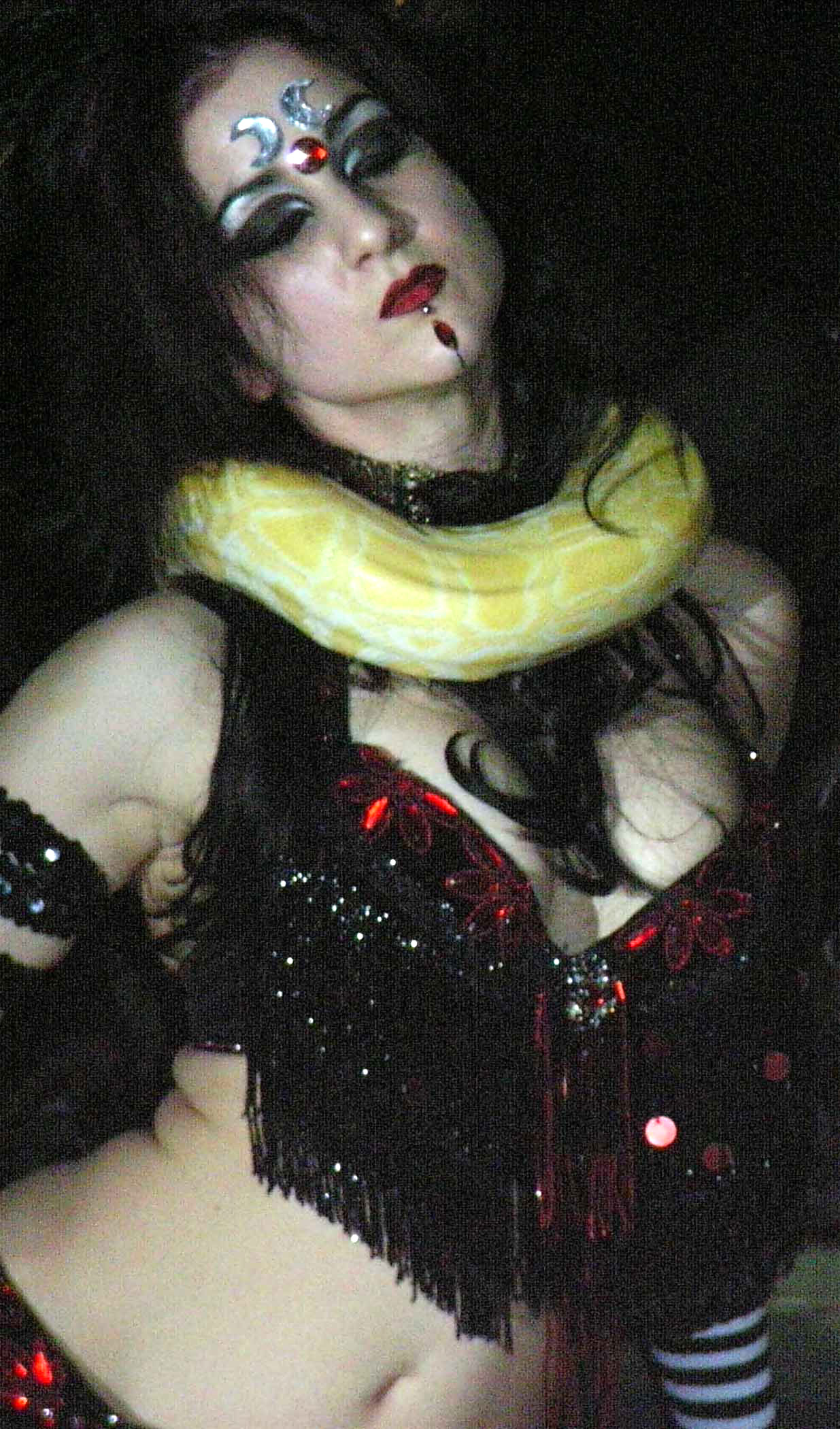
Goth belly dance or raqs gothique—a term coined from the Arabic raqs sharqi (dance of the East)—fuses the already Westernized interpretative dance style of the Middle East with Goth subculture.
This new experimental dance involves different musics (from goth rock to world music), altered costuming, and new performance settings. Although rooted in belly dance and its ties to colonialism, Goth belly dance transforms Orientalism and embodies decolonization as process and product.
This according to “Raqs gothique: Decolonizing belly dance” by Tina Frühauf (TDR: The drama reviewLIII/3 [fall 2009] pp. 117-138). Above, Maiiah with her snake, Maharet (photo by Pryor Dodge; click to enlarge); below, the late JeniViva Mia performs.
The Indian singer Jayashri Ramnath (better known as Bombay Jayashri) was introduced to Karnatak music in her early childhood, influenced by her parents’ roles as music teachers. Jayashri began her performing career at the age of 28, and having grown … Continue reading →
The country singer, songwriter, actor, and businesswoman Dolly Parton was the fourth of twelve children in a family of sharecroppers in Sevierville, Tennessee, located in the Appalachian Mountains. Commenting on her childhood, Parton once said, “Everybody where we grew up … Continue reading →
Women have been part of hip hop expression from its early days, primarily as part of MC crews such as the Funky Four Plus One and Sugar Hill’s female group, Sequence. For most of hip hop’s recorded history, however, women … Continue reading →
The music of Central America tends to borrow heavily from the music of Mexico to the north, Colombia to the south, and the Caribbean Islands to the east, and, in the case of Nicaragua, from the politically motivated nueva canción … Continue reading →