The only clear difference between human dance and primate dancelike behavior is that the former is culturally patterned; otherwise, attributes only vary in terms of their complexity.
Dance, therefore, is not a human invention—it is a human variation on a primate theme.
This according to “The origins of dance: The perspective of primate evolution” by Sandra T. Francis (Dance chronicle XIV/2–3 [1991] pp. 203–220). Above, a lemur trips the light fantastic; below, the story behind a popular YouTube video.
Although he was only eight years younger, Bob Dylan called Mike Seeger (1933–2009) a father figure, and considered him the ultimate embodiment of a folk-star persona. Recalling him in Chronicles. I (New York: Simon & Schuster, 2004), Dylan wrote:
“Mike was unprecedented. He was like a duke, the knight errant. As for being a folk musician, he was the supreme archetype. He could push a stake through Dracula’s black heart. He was the romantic, egalitarian, and revolutionary type all at once—had chivalry in his blood…”
“He played all the instruments, whatever the song called for—the banjo, the fiddle, mandolin, autoharp, the guitar, even harmonica in the rack….He played on all the various planes, the full index of old-time styles, played in all the genres and had the idioms mastered—Delta blues, ragtime, minstrel songs, buck-and-wing, dance reels, play party, hymns and gospel—being there and seeing him up close, something hit me. It’s not as if he just played everything well, he played these songs as good as it was possible to play them.” (pp. 69–71)
Today would have been Mike Seeger’s 80th birthday! Below, Seeger in 1976.
Comments Off on Mike Seeger, according to Bob Dylan
Dark elegies marked the culmination of Antony Tudor’s exploration into an approach to ballet choreography in which the psychology of the characters is more important than external circumstances and events.
Although the classic idiom was the basis for his experimentation, his quest for new movement—often based on one-on-one work that illuminated the propensities of specific dancers—resulted in virtually no use of classical vocabulary. Mahler’s Kindertotenlieder functions as a partner to the choreography, not as a guide.
This according to “Dark elegies (1938): Antony Tudor” by Rachel S. Richardson, an essay included in Choreography: Principles and practice (Guildford: National Resource Centre for Dance, 1987, pp. 206–217).
An excerpt from the work is below; other excerpts are here. We would be grateful if anyone can share a link to a complete version!
A number of people attend U.S. bluegrass festivals not for the stage show, but for the informal jam sessions in the campgrounds or parking lot.
The interactional etiquette that jammers follow is manifested both in the conventions that help strangers to come together and in choices made during group playing of bluegrass standards. Ethics and aesthetics are fused as jammers negotiate interactional guidelines to reach a heightened musical and social communion.
This according to “A special kind of courtesy: Action at a bluegrass festival jam session” by Michelle Kisliuk (TDR: The drama review XXXII/3 [fall 1988] pp. 141–155). Above and below, festival attendees jamming with that special courtesy.
When Fanny Elssler (1810–84) left the Paris Opéra to tour the U.S. between 1840 and 1842, adoring critics there were faced—apparently for the first time—with the dilemma of writing approvingly about a woman making herself an object of desire.
Recurring descriptions of her being a divinity or an enchantress evince the process of assuaging guilt over this desire, and assumptions that male dancers were homosexuals enabled the suspension of jealousy over her dancing partners.
This according to “The personification of desire: Fanny Elssler and American audiences” by Maureen Needham Costonis (Dance chronicle XII/1 [1990] pp. 47–67).
Above, an image used for her U.S. tour of Elssler performing her signature La cachucha; below, a recreation performed by Carla Fracci.
For 15 seconds a year, Steve Buttleman is the most famous man in America.
On the first Saturday of every May, wearing his famous red jacket and black cap, he marches from the white pagoda behind the Churchill Downs Winner’s Circle, lifts a bugle to his lips, and plays Call to post, cuing the jockeys to lead their horses to the starting gate.
Buttleman plays for the spring and fall meets as well as the Kentucky Derby, often performing Call to post as many as eleven times a day.
This according to “America’s most famous bugler” by Patrick Wensink (The Oxford American 1 May 2013; the article is here). Below, Mr. Buttleman’s 15 seconds of fame.
We cannot understand the nature of music and its role in human life by conceiving of it as a thing; we must see it as an event in a context, replacing the noun music with the verb musicking.
The nature of musicking may then be addressed by asking whose ideal relationships are being celebrated, what the nature of those relationships is, and how they are represented in the performance.
This according to “Musicking: A ritual in social space” by Christopher Small, an essay included in Aflame with music: 100 years of music at the University of Melbourne (Melbourne: Centre for Studies in Australian Music, 1996 pp. 521–533).
Below, an example of musicking that involves minimal precomposition.
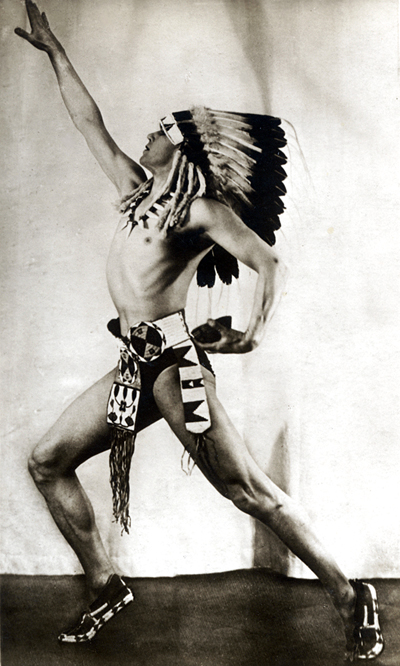
Ted Shawn was the first choreographer to introduce carefully researched interpretations of Native American dance to audiences in North America, Europe, and Asia.
Beginning in the 1910s, when prominent dance critics were utterly dismissive of Native American dance, Shawn formed a high opinion of it—a view that was confirmed when he witnessed a complete Hopi ceremony in 1924.
This according to “The American Indian imagery of Ted Shawn” by Jane Sherman (Dance chronicle XII/3 [1989] pp. 366–382). Below, archival footage of some of Shawn’s work.
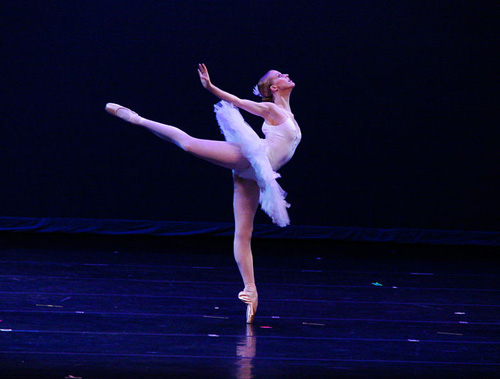
Alternately stiff and pliable, the ballerina demonstrates that which is desired, while her partner embodies the forces that pursue, guide, and manipulate the desired object.
An understanding of the ballerina-as-phallus may allow her to reconfigure her power, so that she can sustain her charisma even as she begins to determine her own fate; it may also reclaim for ballet a sensual and even sexual potency.
This according to “The ballerina’s phallic pointe” by Susan Leigh Foster, an essay included in Corporealities: Dancing knowledge, culture, and power (London: Routledge, 1996 pp. 1–24). You can see her inimitable performance of the paper here.
As a child, Bream first learned to play the guitar along with his father from “an extraordinary little book, and that was great fun.”
When he was around 11 Boris Perrot, the president of the Philharmonic Society of Guitarists, heard him and, duly impressed, offered to teach him. The boy was honored, but soon found that he disliked the outmoded technique that Perrot insisted on.
Bream stopped the lessons and never took another one; instead, “I watched how Segovia did it and made up my technique as I went along.”
“Actually, I think I must have been quite a little horror because I was very instinctive about things. I only did what I wanted to do. I didn’t care a damn what other people wanted me to do.”
This according to “Julian Bream at 60: An interview” by Gareth Walters (Guitar review 96 [winter 1994] pp. 2–15).
Today is Julian Bream’s 80th birthday! Above, the guitarist in 1947; below, his arrangement of Danza del molinero from Manuel de Falla’s El sombrero de tres picos.
In contemporary Africa, new electronic music can generally be classified into two distinct categories. The first involves artists who adapt mainstream genres like house, techno, or electronica, giving them a local twist. These artists incorporate samples of traditional music into … Continue reading →
The Filipino ethnomusicologist and composer Jose Maceda created unique works that blended his fieldwork on Filipino and other music with his expertise in European avant-garde traditions. His compositions combined innovative techniques such as spatialization, a focus on timbre, and musique … Continue reading →
In practice, the term música popular brasileira, often referred to by the acronym MPB, does not apply to a particular genre of Brazilian music. Although it came into widespread use around 1965, the term had been used since at least … Continue reading →
Women have been part of hip hop expression from its early days, primarily as part of MC crews such as the Funky Four Plus One and Sugar Hill’s female group, Sequence. For most of hip hop’s recorded history, however, women … Continue reading →