Category Archives: Curiosities

Mozart's flyswatter

Franz Niemetschek’s legendary report that La clemenza di Tito was composed in 18 days was not seriously challenged until 1960, when Tomislav Volek published important archival materials relating to the chronology of the opera’s composition. Physical evidence from the autograph manuscript, including the remains of a fly squashed on the paper (probably by the composer in the heat of August), contributes to discrediting the hypothesis that Mozart’s work had begun before he signed his July 1791 contract for the opera.

This according to “The chronology of Mozart’s La clemenza di Tito reconsidered” by Sergio Durante (Music & letters, 80, no. 4 (Nov 1999): 560–594), where the evidence is described thus:

“On folio 114 of the autograph . . . a thick black spot in the shape of a cross is found. . . . On direct and close examination, the centre of the spot proves to host the remains of a fly (a kind of evidence not often found in music sources!). After a long reflection, my best guess is that the fly was smashed under the loose bifolium at the very time of composition, after it had unduly annoyed Mozart at work; he also provided a witty ‘service’ to the insect by marking a cross over it (‘requiescat’!); in any case, such was the force and determination of the action, combined with the gluing action of the ink, that the corpse is still stuck on the page after two hundred years of musicological investigations.” (p. 574)

More articles about Mozart are here.

4 Comments

Filed under Animals, Baroque era, Curiosities, Nature, Science, Source studies

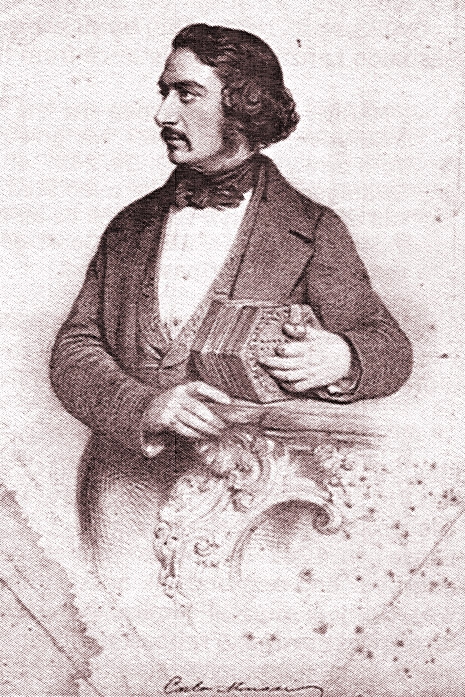
Carlo Minasi

Carlo Minasi (1817–91) was a London-based pianist and concertina player who also taught both instruments, a prolific composer and arranger for the concertina and other instruments, the author of 21 instrumental tutors (13 for the concertina), and a talented inventor. He produced 42 albums of songs and tunes—22 for the English concertina, 10 for the German concertina, and 10 for general use—and he obtained patents on concertinas of his own design and on several specific improvements. He also patented improvements in firearm and furniture design, as well as one for a poultry incubator.

Despite his accomplishments, Minasi is not profiled in any of the standard music encyclopedias; as far as we know, the only comprehensive source for information about him is Randall C. Merris’s Carlo Minasi: Composer, arranger, and teacher, concertina and piano in Papers of the International Concertina Association volume 6 (2009), pp. 17–45.

4 Comments

Filed under Curiosities, Instruments, Romantic era

Brahms era chileno

In the article “Brahms era chileno” (Pauta: Cuadernos de teoría y crítica musical, no. 63 [July-Sept 1997] pp. 39–44), the Argentine composer Juan María Solare states that Johann Jakob Brahms (1806–72), accompanied by his wife, Johanna Henrika Christiane Nissen (1789–1865), took part in a tour of South America as a performer in the orchestra of the Alsterpavillon in Hamburg, and that Johanna gave birth to Johannes Brahms in the village of Copiapó, northern Chile, on 6 February 1833.

He further states that the birth is documented in a letter that Johanna wrote to her sister in Hamburg, but which was lost and eventually ended up in the archive of an obscure village in Patagonia, where it can still be seen; the birth was concealed from German society, and Brahms was baptized under a false place and date of birth upon his parents’ return to Germany.

Later, in an interview, Solare clarified his intention: He wrote the article as a piece of speculative fiction, a type of writing that Pauta sometimes publishes; but since the journal also presents peer-reviewed research, the piece was mistaken for authentic musicology, generating widespread controversy among Brahms scholars.

More posts about Brahms are here.

Comments Off on Brahms era chileno

Filed under Curiosities, Humor, Romantic era